Not long ago, quantum computing still felt like one of those technologies people talked about more than they actually understood. The industry loved throwing around phrases like “quantum advantage” while everyone else politely nodded and pretended they weren’t completely lost.
Every few months, another headline would pop up about higher qubit counts or some breakthrough experiment happening in a lab somewhere. But underneath all the hype was a much simpler question nobody seemed eager to answer:
How do you actually build these things at scale?
Not as fragile science projects.
Not as impressive conference demos.
But as real infrastructure that can survive manufacturing, supply chains, budgets, and time.
That question is getting harder to avoid.
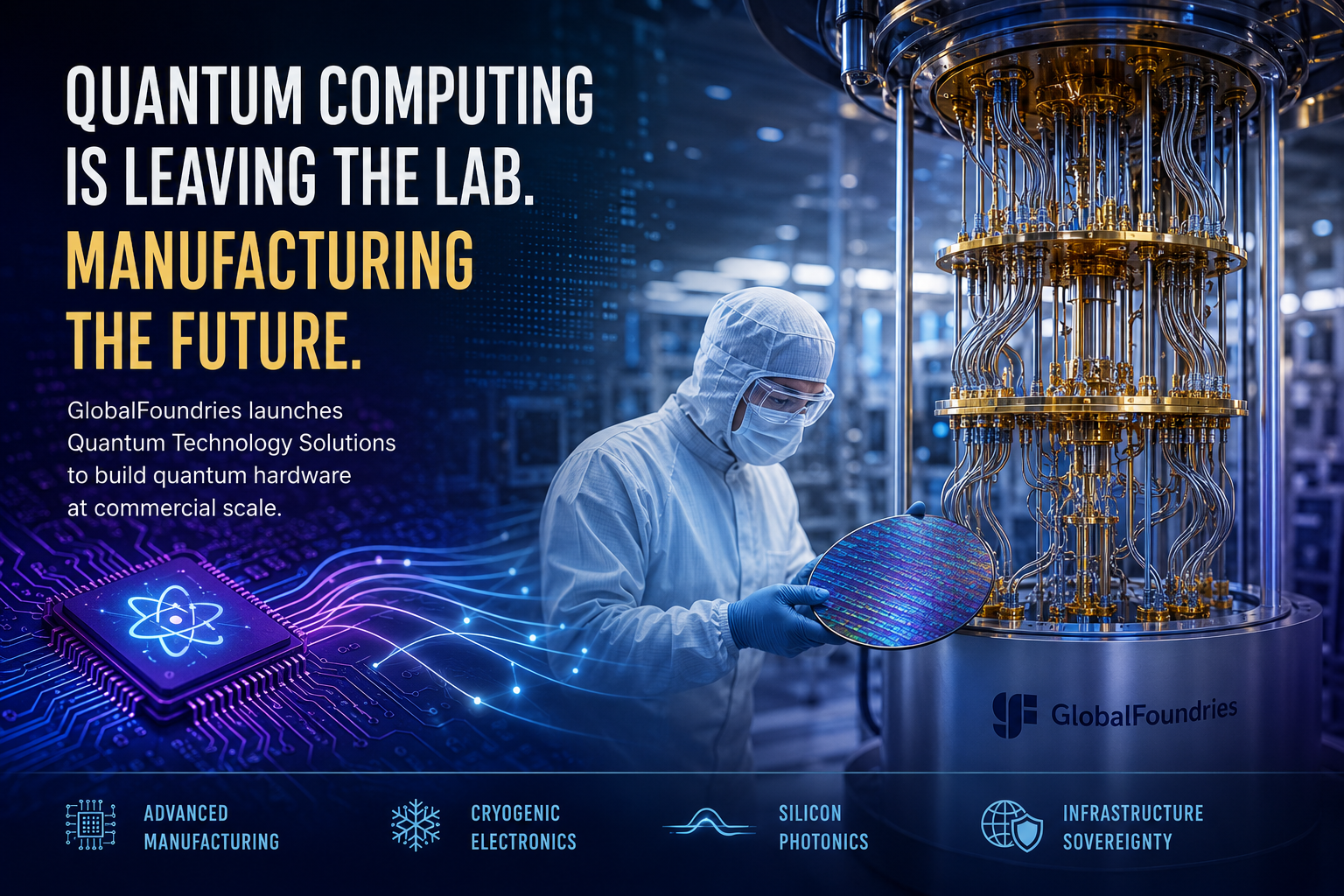
This week, GlobalFoundries officially launched Quantum Technology Solutions, a business unit focused on manufacturing quantum hardware commercially.
And honestly, this might matter more than another incremental qubit milestone.
Because quantum computing is finally running into the same reality every transformative technology hits eventually:
The manufacturing phase.
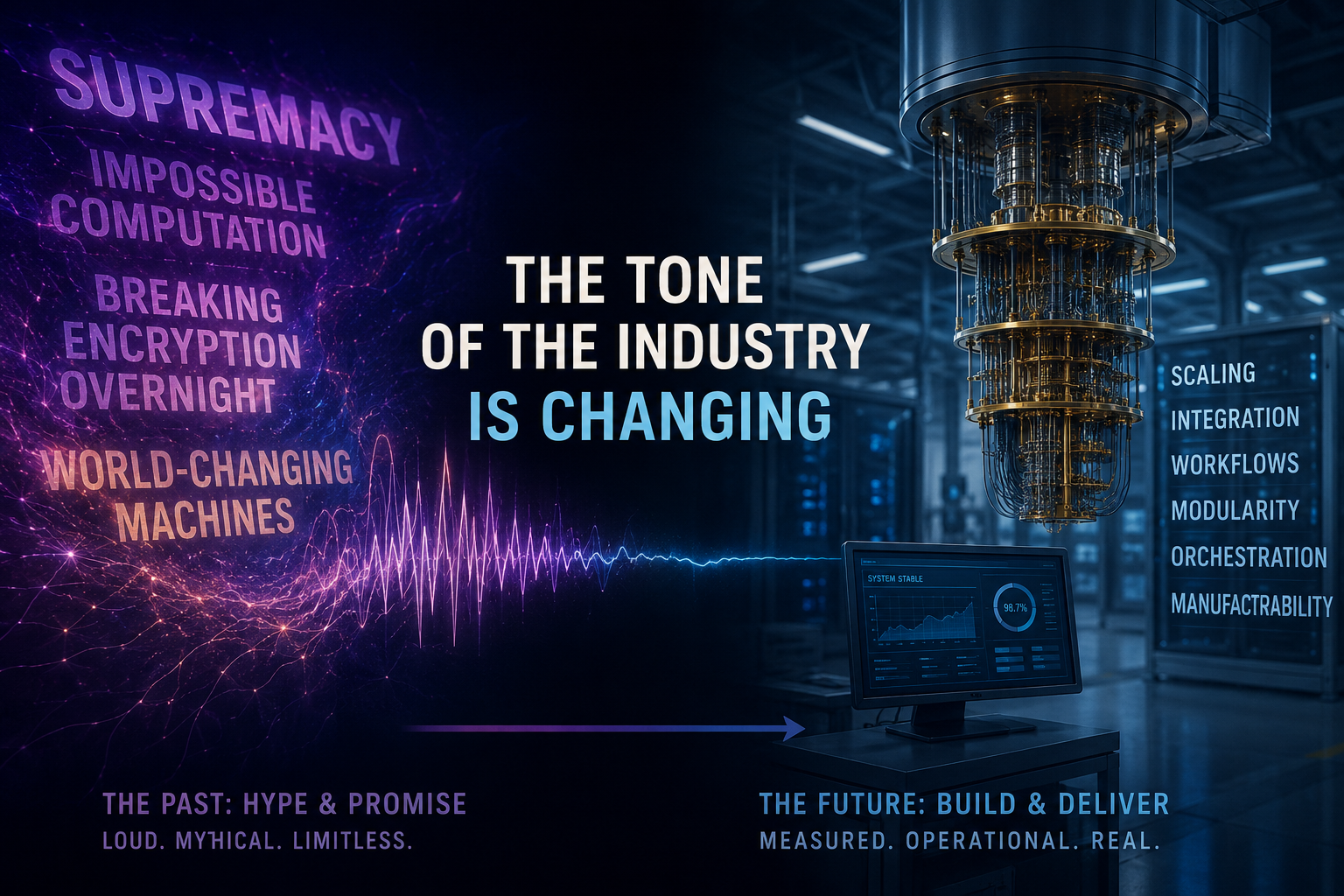
First comes the excitement. The glossy keynote presentations. The futuristic diagrams glowing in neon blue while executives confidently explain things nobody in the audience wants to admit they don’t fully understand.
Then reality shows up.
Yield rates.
Material defects.
Thermal instability.
Supply chains.
Repeatability.
The deeply unglamorous problems that determine whether a technology actually survives outside a research lab.
For years, quantum hardware has existed in a strange space that feels almost handcrafted. Tiny cleanrooms. Highly customized fabrication processes. Small research teams babysitting systems so delicate they operate at temperatures colder than outer space.
That works for prototypes.
It gets a lot messier when you’re trying to build an industry.
Quantum systems are unbelievably sensitive. A microscopic defect can destabilize qubits almost immediately. Tiny inconsistencies in materials can quietly ruin calculations before they even finish.
There’s something strangely human about that.
An impossibly advanced machine brought down by something almost invisible.
And that’s where GlobalFoundries enters the picture.
The company is trying to move quantum manufacturing away from boutique experimentation and into the industrial environment that modern semiconductors already rely on.
On paper, that sounds technical.
In reality, it changes the industry’s entire tone.
Because once manufacturing matures, everything starts moving differently.
Costs fall.
Access expands.
Experimentation speeds up.
Smaller companies suddenly have room to build things that once required billion-dollar budgets.
Infrastructure changes who gets to participate.
One of the more interesting parts of this announcement is that GlobalFoundries isn’t betting everything on a single quantum architecture. They’re supporting multiple approaches at once, which honestly feels refreshingly realistic in a field that still has enormous uncertainty hanging over it.
Superconducting systems.
Spin qubits.
Photonic computing.
Cryogenic electronics.
Right now, quantum computing still feels like several competing versions of the future happening simultaneously.
And one of the biggest problems they’re trying to solve is something most people outside the industry never even think about:
The wiring problem.
Modern quantum systems rely on massive bundles of cables connecting room-temperature electronics to processors buried deep inside dilution refrigerators. Most quantum computers look less like computers and more like metallic chandeliers hanging inside giant silver cylinders.
Beautiful in a weird way.
Completely impractical for scale.
Because the more qubits you add, the more physically complicated everything becomes. More wiring. More heat leakage. More opportunities for signal loss. At a certain point, scaling stops feeling elegant and starts feeling like fighting physics itself.
GlobalFoundries is investing heavily in cryogenic control electronics — often called Cryo-CMOS — which would allow more control systems to operate directly inside the refrigeration environment alongside the processors.
It’s not the kind of advancement that gets dramatic headlines.
But it’s exactly the kind of advancement that determines whether an industry becomes usable or stays experimental forever.
The company is also expanding its work in silicon photonics, which is becoming increasingly important as photonic quantum computing and quantum networking continue gaining momentum. Instead of relying entirely on electrical systems, these architectures use light itself to process and move information.
And honestly, there’s something kind of surreal about that idea.
Light carrying computational states through microscopic waveguides. Computing starting to look more like physics than machinery.
But underneath all the technical ambition sits another theme that keeps showing up across nearly every advanced technology conversation right now:
Sovereignty.
Artificial intelligence.
Semiconductors.
Quantum computing.
Governments no longer see these industries as normal commercial markets. They see strategic infrastructure. Economic leverage. National security.
Which is why efforts like this are so connected to legislation like the CHIPS and Science Act. Building advanced semiconductor infrastructure is staggeringly expensive. Most startups will never have the resources to build fabrication facilities capable of producing quantum hardware at industrial scale.
Even major companies struggle with the economics.
Public-private partnerships are becoming less optional and more necessary.
Not because the technology lacks promise.
Because the timelines are too long for short-term thinking.
And honestly, that may be the clearest sign the industry is maturing.
The conversation is slowly becoming less obsessed with hype and more focused on endurance.
Who can manufacture reliably?
Who can sustain infrastructure?
Who can support an ecosystem instead of chasing isolated breakthroughs?
That may end up being the real dividing line in quantum computing.
What makes this particularly important is that GlobalFoundries is positioning itself as a fabrication partner for the broader ecosystem instead of building a completely closed platform. That means startups, universities, research labs, and enterprise teams could eventually access commercial-grade manufacturing without needing to build billion-dollar cleanrooms themselves.
And historically, that’s when innovation gets interesting.
Not when one company controls everything.
When thousands of people suddenly gain the ability to build.
Some technological revolutions arrive loudly.
Others arrive quietly through infrastructure becoming stable enough for creativity to spread outward.
That’s what this feels like.
Not the arrival of quantum computing itself.
But the beginning of the roads underneath it.