In the vast and intricate tapestry of the universe, quantum mechanics stands as a curious and complex design. It challenges our perceptions of reality, introduces notions that feel almost poetic in their elusiveness, and invites us to consider if every choice, every possible outcome, unfolds in a parallel reality somewhere beyond our immediate understanding. This is no longer just a philosophical exercise but a scientific inquiry with profound implications.
01:22:20 Final Thoughts: Adapting to a Stranger Universe
Based on content from World Science Festival
In the vast and intricate tapestry of the universe, quantum mechanics stands as a curious and complex design. It challenges our perceptions of reality, introduces notions that feel almost poetic in their elusiveness, and invites us to consider if every choice, every possible outcome, unfolds in a parallel reality somewhere beyond our immediate understanding. This is no longer just a philosophical exercise but a scientific inquiry with profound implications.
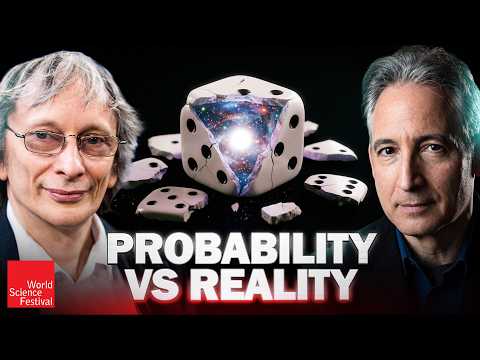
The recent discussion between Brian Greene, a physicist and author, and David Deutsch, often heralded as the father of quantum computing, explores these themes deeply. Through the World Science Festival’s “Rethinking Reality” series, supported by the John Templeton Foundation, they dissect what quantum mechanics truly tells us about the universe.
Quantum mechanics, a field marked by strange and non-intuitive predictions, has often led to debates over the interpretation of its core elements. Deutsch, a pioneering theorist, argues vigorously for the many-worlds interpretation. This suggests not just a theoretical possibility but something more concrete: that our universe is one among a vast multiverse of universes, each a manifestation of different potential outcomes from every event.
This prompts questions about the nature of probability itself. If multiverses are real, and every potential outcome occurs in some version of the universe, what becomes of probability? Deutsch posits that probability, as we know it, doesn’t truly exist at a fundamental level. In a fully deterministic multiverse, probability becomes a tool for decision-making, helping us navigate a world where each choice we make is replicated in countless other realities.
His innovative approach, known as constructor theory, pushes the boundaries of how we think about physics itself. Constructor theory attempts to redefine fundamental concepts in physics by emphasizing what can and cannot happen rather than detailing how things occur. It requires a reconsideration of questions we’ve traditionally sidelined, believing them too entrenched in philosophical or metaphysical realms.
Greene and Deutsch’s conversation also touches on the historical context and evolution of these ideas. The discussion trails through the roads taken by Niels Bohr and others, who were confronted with the daunting task of understanding a new quantum reality that seemed to defy logic. Bohr embraced a philosophy that often skirted around definitive answers, opting instead to embrace the interpretive challenge that quantum mechanics presented—a stance not universally accepted but undeniably influential.
As our understanding of the universe expands and traditional physics intersects with newer theories, the tension between determinism and randomness remains. Historically, mathematical formalism has been the bridge guiding this understanding, yet typically, it is whispered that there might be too much reliance on the math in the absence of concrete data. Thinkers like Weinberg and Deutsch advocate for taking the mathematics seriously, yet not blindly so; the ultimate goal is to illuminate the unseen mechanisms that craft our reality.
In finishing, Greene and Deutsch’s dialogue pushes us to contemplate the broader implications of these theories. What does it mean for free will if our choices are mirrored endlessly across different universes? Do we truly have control, or is our perceived control just an artifact of our limited understanding? As these questions linger, they nudge us—not towards immediate answers, but towards a deeper appreciation of the universe’s breathtaking complexities.
In pursuing these questions, we find ourselves not just rethinking reality, but also revisiting our place within it. The search for clarity amidst the overwhelm is not simply a scientific journey but a deeply human one, inviting us to expand our horizons and imagine the unseen threads connecting us all. As Deutsch eloquently suggests, it is often the questions we’ve been taught to disregard that hold the keys to the most profound insights in science.
—