There’s a certain kind of question that lingers longer than it should.
Not loud. Not urgent. Just… persistent.
Which of these companies will actually work?
Not in the theoretical sense. Not in the way quantum so often leaves beautiful, complex, slightly out of reach, but in the way that matters to someone trying to make a decision. Someone with a budget. A timeline. A quiet pressure to choose correctly.
That’s the space this audit sits in.
For more, check out the Quantum Startup Landscape interactive map.
It doesn’t try to crown winners. It doesn’t pretend the market is settled. Instead, it does something more revealing. It looks at a hundred companies and asks a softer, more practical question: who is starting to feel… usable?
And when you sit with the data long enough, patterns begin to surface. Not immediately. At first, it’s just categories. Modalities. Familiar labels. Photonic. Superconducting. Trapped ion. The usual language we use to organize something that still resists being neatly organized.
But then your eye drifts to something else.
The imbalance.
There’s a kind of quiet weight to it. Forty-two companies living in that in-between space, NISQ, a hybrid utility close enough to application to be interesting but not yet stable enough to feel inevitable. And almost the same number are still grounded in research or at the pilot stage. Only a handful are reaching toward fault tolerance, like distant markers that don’t quite anchor the landscape yet.
It doesn’t feel like a race with a finish line. It feels more like a field of experiments, all happening at once.
And maybe that’s where the tension lives.
Because technical brilliance, on its own, is no longer enough. You can feel that shift. It shows up in what the audit chooses to value. Not just what a system is, but how it moves. Whether it connects. Whether it’s already brushing up against real workflows, even lightly. Cloud access. Enterprise pilots. Early signals of integration. Small proofs that something has left the lab, even if just for a moment.
There’s something grounding about that. Like watching a theory touch the floor.
And then there’s the absence.
Eighty-four out of a hundred companies show no clear, visible signal of what actually protects them. No explicit indication of error correction. Or mitigation. Or control-layer strength. Or architectural co-design. Not necessarily because those things aren’t there, but because they aren’t being seen.
It creates a strange kind of silence.
The kind where you know something is happening beneath the surface, but you can’t quite trace it. And in a market like this, that silence becomes its own form of risk.
When signals do appear, they feel almost sharp by comparison.
A company like Riverlane, where error correction isn’t implied but clearly stated, suddenly reads differently. More anchored. Qedma, working in mitigation, feels closer to the present moment, the imperfect, noisy systems we actually have. Q-CTRL and Quantum Machines shift the focus entirely, pulling attention away from the qubit itself and toward the orchestration layer, where performance is shaped in quieter, more systemic ways.
And then there are the companies working one level higher still. ParityQC. Classiq. The ones translating complexity into structure. It’s subtle, but it changes how you see the map. Less like isolated machines. More like an emerging stack.
Commercial signals, when they show up, feel almost disproportionate in their importance.
Only a small fraction of companies demonstrate real distribution pathways. Even fewer show enterprise engagement or vertical alignment. But when they do, something clicks. The story becomes easier to follow. Not because the technology is simpler, but because its place in the world is clearer.
You can almost feel the friction lowering.
That’s what shapes the top layer of the audit. Not raw power, but coherence. Companies like Quantinuum, QunaSys, Pasqal, Q-CTRL, Xanadu each one carrying a different balance of technical depth and real-world adjacency. Not perfect. Not finished. But legible.
And then, just beneath them, the near-misses. The ones that almost resolve. D-Wave has a strong utility narrative that still feels slightly under-explained. Quandela, where sovereignty starts to matter in a way that feels quietly strategic. ORCA Computing, early but promising. SandboxAQ is translating quantum-adjacent capabilities into something enterprises can actually hold on to.
It’s not a clean hierarchy. It’s more like a gradient.
And then there’s geography.
Something that used to feel secondary now presses closer to the surface. Jurisdiction, supply chains, trust layers, these aren’t background details anymore. They shape whether something can be adopted at all. Whether it moves easily or gets caught in friction you can’t engineer your way out of.
You start to realize the market isn’t just technical. It’s situational.
Where a company exists matters almost as much as what it builds.
And when you step back just slightly, the whole picture softens into something simpler.
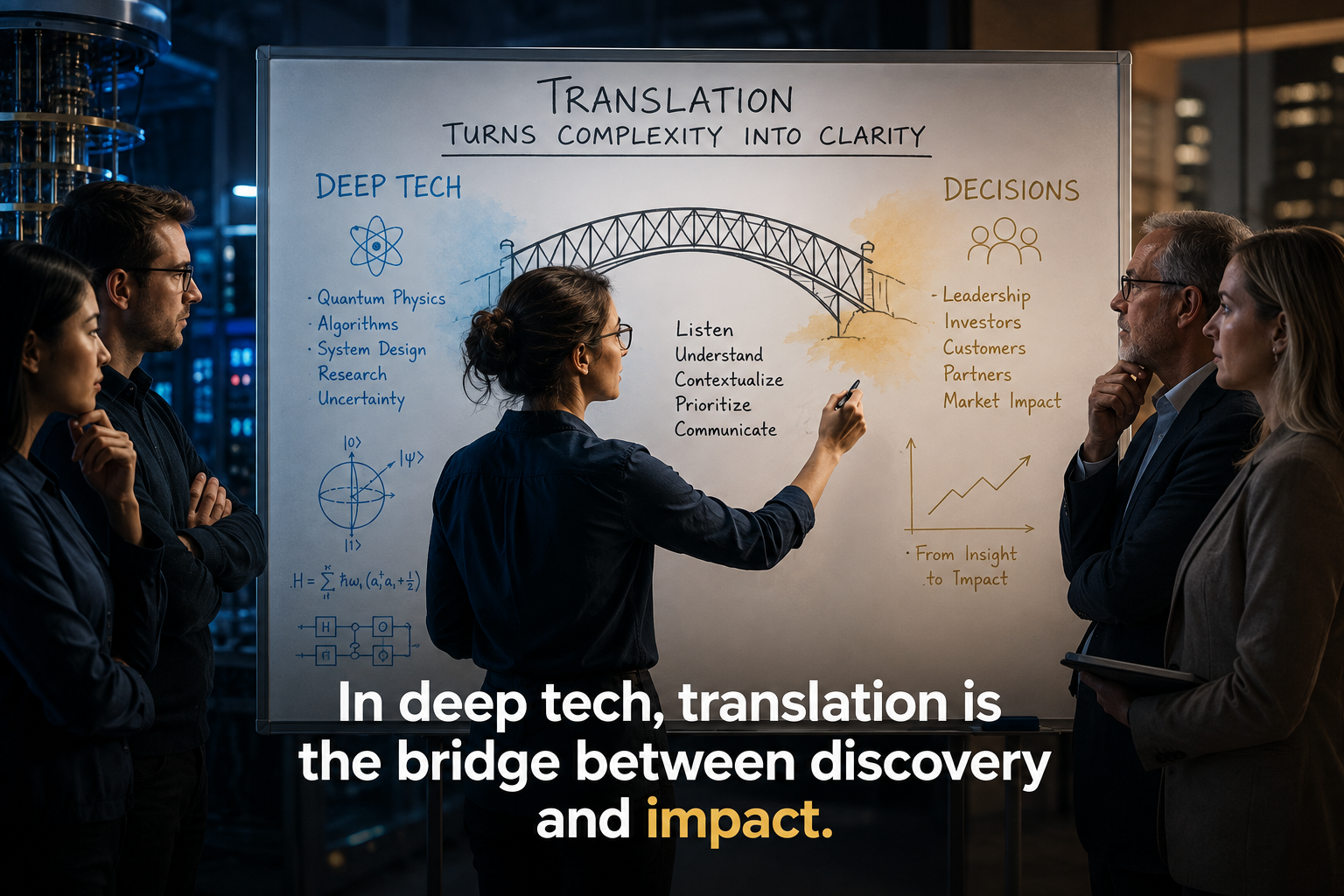
The companies that feel closest to the future aren’t necessarily the ones with the most advanced physics. They’re the ones who have started to translate that physics into something others can use. Something that fits. Something that doesn’t require belief to justify engagement.
There’s a quiet shift happening there.
From possibility to presence.
From “what if” to “how.”
And if you sit with that long enough, the question changes, too.
Not who will win.
But who is already, in small ways, beginning to work?