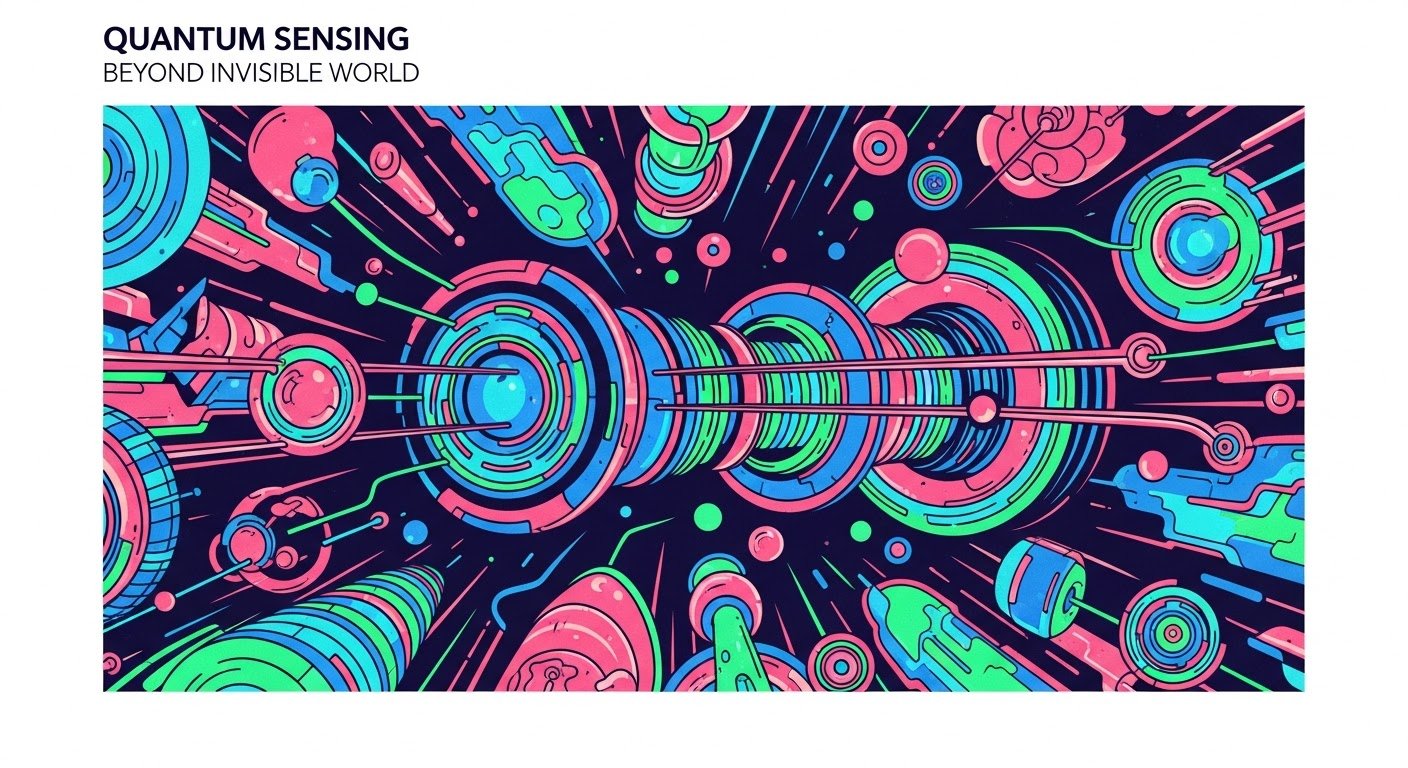
Quantum sensing extends human perception into the invisible, revealing magnetic fields, subtle vibrations, and gravitational shifts once thought undetectable. Explore how this revolutionary technology is transforming science, medicine, and our understanding of the world.
Beyond Human Perception
What if we could feel the heartbeat of a magnetic field or see the shimmer of gravity itself? For most of human history, our understanding of the world has been limited by our five senses: sight, hearing, touch, taste, and smell. They have been our primary translators of reality, but they capture only a thin slice of existence.
The electromagnetic spectrum spans from long radio waves to high-energy gamma rays, yet our eyes detect only a narrow range of light. Everything beyond that—the whispers of magnetism, the slow pulse of gravity, the tiny quivers of subatomic fields—hums beneath our awareness.
Consider magnetism. We can feel its tug but not its form. Or the vibrations beneath our feet, faint tremors hinting at the Earth’s restless interior. Even more elusive are the quantum-level interactions that shape everything: particles entangle, fields fluctuate, and probabilities collapse into outcomes. Most of the universe operates in realms too subtle, too small, or too fleeting for our biology to perceive.
Technology has always been our way of stretching those limits. Microscopes revealed cells. Telescopes unveiled galaxies. X-rays exposed the inner architectures of the body. Each invention became an extension of our senses. And now, standing at the edge of physics and computation, we are learning to sense not just further but deeper.
Welcome to the age of quantum sensing, where we begin to perceive the invisible threads that weave the fabric of reality itself.
Unveiling the Quantum Lens
At the heart of quantum sensing are two of physics’ most intriguing principles: superposition and entanglement.
Superposition allows particles to exist in multiple states simultaneously, much like a coin that is both heads and tails until it is observed. Entanglement is the mysterious link between particles that remain connected across any distance. Change one, and the other responds instantly, as though the universe were quietly keeping them in sync.
These principles are not just abstract curiosities. They are the foundation for a new way of measuring the world. Quantum sensors utilize the extreme sensitivity of quantum states to detect disturbances, such as magnetic fields, temperature shifts, or gravitational ripples, with an accuracy that no classical device can match.
Traditional imaging captures reflected light to form a picture. Quantum sensing, in contrast, reads the quantum signatures of reality itself. It does not simply sharpen our images. It reveals entirely new layers of information.
Imagine an MRI scanner that relies not on a massive magnet but on arrays of entangled atoms mapping the brain’s electrical activity in real time. Or a navigation system that needs no satellites because it senses the Earth’s gravitational fingerprint directly.
Quantum sensing does not take pictures. It takes readings of existence.
Invisible Forces, Tangible Impacts
Though still in its early years, quantum sensing is already reshaping science, medicine, and industry.
In geophysics, quantum gravimeters can detect the faintest variations in underground density, allowing for the location of hidden tunnels, water sources, or mineral deposits without drilling a single hole. These instruments can even sense magma moving beneath volcanoes or the subsurface shifts that precede earthquakes (MIT News, 2024).
In medicine, quantum-enabled magnetoencephalography (MEG) enables scientists to track the faint magnetic fields generated by neural activity. These real-time brain maps could unlock earlier diagnoses of epilepsy, Parkinson’s, and Alzheimer’s, or even reveal how consciousness arises from billions of synchronized electrical whispers.
In engineering and defense, quantum magnetometers can detect structural stress, hidden electronics, and subtle electromagnetic variations with atomic-level precision. Quantum accelerometers are being developed for navigation systems that can guide submarines, spacecraft, or autonomous vehicles without relying on GPS (IBM Research, 2023).
In astronomy, scientists are using quantum sensors to detect minute gravitational distortions that hint at unseen mass, such as dark matter or other phenomena not yet named (Nature Photonics, 2024). By mapping these invisible fluctuations, we may soon uncover the hidden architecture that shapes galaxies and defines the evolution of the cosmos.
Each of these breakthroughs reveals the same truth: when we peer through the quantum lens, the invisible becomes tangible.
Our Expanded Reality
Quantum sensing is not just another scientific tool. It is an expansion of perception itself. For the first time, we are building instruments that operate at nature’s limits of uncertainty, attuned to the faint vibrations of spacetime and matter.
It invites a deeper question. What else lies beyond what we can sense? If our idea of reality has always been bounded by biology, what happens when that boundary dissolves?
It is as if we have been living on the surface of a painting and suddenly discover entire worlds of texture beneath each brushstroke. The visible world becomes only one layer among many, woven from countless invisible interactions. Quantum sensing hands us the keys to explore those deeper layers, to listen to the hum beneath the visible.
This shift is not limited to science. Artists, philosophers, and technologists are exploring what it means to live in an era where machines can perceive what humans cannot. From the faint heartbeat of a distant star to the magnetic flutter of a single cell, each discovery brings us closer to an integrated understanding of existence, where consciousness, computation, and quantum physics begin to harmonize.
With greater perception comes responsibility. The more we can sense, the more thoughtfully we must interpret. Quantum sensing redefines not only measurement but also trust. From secure communication to the authenticity of data itself, it challenges us to handle the unseen with care.
The Next Leap
We stand at the threshold of a new sensory age. Quantum sensing does not replace human perception; it expands it, revealing what has always been there, quietly humming beneath our awareness.
So the next time you look at the world, remember that what you see is only the surface. Beneath it lies an ocean of unseen forces, quantum whispers shaping everything from the firing of a neuron to the dance of galaxies.
The invisible world is no longer beyond our reach. We are learning to listen to it.
💭 What excites you most about the possibilities of quantum sensing? Share your thoughts with us at Impact Quantum, where science meets imagination.