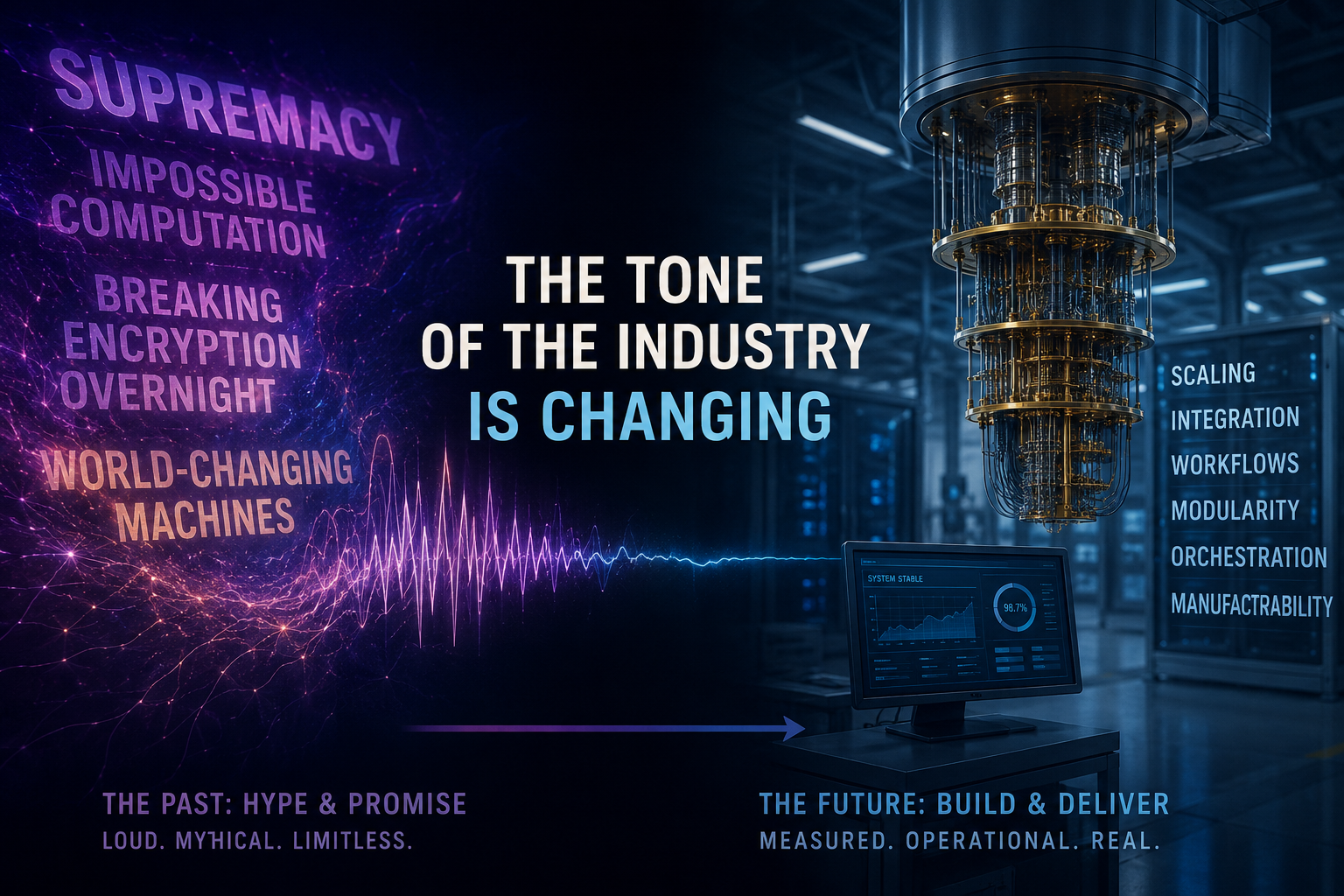
Imagine rewriting the entire script of technological progress like a maestro orchestrating a symphony of silicon and algorithms. That’s the vibe in the world of quantum computing today. Largely veering from the famous ‘Eureka!’ moments that punctuate history books with dramatic flare, quantum computing is unfolding through a series of quiet crescendos.
This video is from our ImpactQuantum YouTube Channel.
It’s fascinating to zoom out and look at the broader picture of quantum computing, which reveals three distinct threads each pulling the technology closer to something that’s not just inspiring but genuinely practical.
The first thread to tug at is one fashioned out of silicon—yes, the tried and tested element at the heart of our existing semiconductor technology. Over in Australia, a team is making strides with Silicon Quantum Computing (SQC), which recently executed Grover’s algorithm with an impressive 98.87% fidelity—without error correction. This feat isn’t just a step forward; it’s a declaration that the familiar territory of silicon might just be our gateway into the quantum age. We’re not reinventing the wheel; instead, we’re adding some serious upgrades to it. This could indeed mean that the future of quantum computers doesn’t necessarily lie in exotic materials and unfamiliar constructs, but in using what we already understand. Think of it as giving a turbo boost to a classic car while retaining its original charm.
Diving into the second thread, the narrative shifts from hardware to something almost entirely software-oriented. Picture this: a quantum algorithm that doesn’t need quantum hardware to run. This scenario is playing out in Poland with a startup called quantum.io, which has launched the Veloc Q1 — an algorithm inspired by quantum mechanics but operates on standard computers. This algorithm isn’t just matching the performance of actual quantum machines in certain tasks, but it’s surpassing them in fields like logistics, finance, and energy. Here’s the kicker: these aren’t theoretical experiments tucked away in research labs; they’re real-world applications solving everyday problems. This twist in the tale reminds us that sometimes innovation doesn’t necessarily involve creating brand new tools but rethinking how to use the existing ones. It’s like using the principles of aerodynamics to build a faster racing car, rather than inventing a new form of locomotion.
And what happens when you blend these quantum-inspired software solutions with advancing hardware? That brings us to the third fascinating thread. Over in the U.S., the Oak Ridge National Laboratory is pioneering hybrid architectures, which is just a technical way of saying they are integrating quantum and classical systems to work in tandem. The potential here is massive—they’re exploring ways to embed quantum processors directly within classical supercomputers. Imagine inserting a cutting-edge quantum chip into a powerful conventional computer, creating a supremely efficient system capable of tackling tasks that neither could handle on their own. It’s akin to adding a jet engine to hybrid cars and optimizing the system to switch between or combine power sources based on needs.
These hybrid setups show promise in areas that demand intense computational power, such as material science, AI development, and even climate modeling. This approach is not about displacing current technological systems, but enhancing them, highlighting a collaborative rather than combative relationship between quantum and classical computing. It’s not cannibalizing; it’s catalyzing.
In essence, the journey of quantum computing underscores a broader narrative in technological evolution: the most profound advances often don’t arrive with a flash and a bang. Instead, they build incrementally, each new development standing on the shoulders of the last, reaching slowly but surely towards something revolutionary.
As we navigate this fascinating era, the key takeaway might just be that innovation is as much about perspectives and approaches as it is about the technology itself. Quantum computing is redefining not only what computers can do but how we think about solving problems.