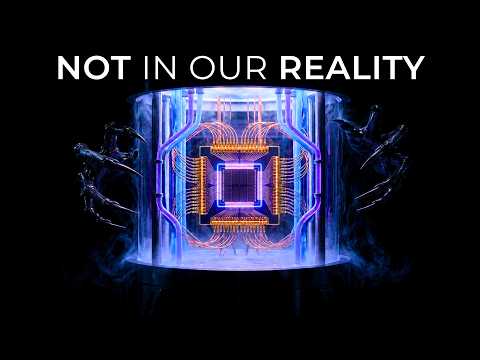
In the quiet digital corridors of its blog, Google dropped a beacon—modest in presentation but seismic in implication—revealing the Willow chip, a quantum technology not just pushing boundaries, but leaping them in a single bound. Like a page from speculative fiction suddenly made manifest, the Willow chip’s abilities rest stunningly on the edge of scientific possibility. Its core achievement? Solving a computational problem in about the time it takes to brew a cup of tea—mere minutes—not at the pace of eons.
Based on content from Vault of Discovery
This proclamation isn’t all shock and awe, though it might feel that way to those who watched with keen interest as quantum computing’s climb was fraught with obstacles. Specifically, the fragile dance of qubits, quantum bits existing in a harmonious superposition of states, often tripped by the faintest perturbance. Google’s achievement here is the application of below-threshold quantum error correction; a shift that demurs the historically exponential growth of errors.
The feat occurred when Willow performed what is surely an extraordinary computational leap—solving an arcane challenge, random circuit sampling, a problem so distilled for quantum knees that the fastest of classical supercomputers would languish for 10 septillion years attempting the same feat. Written numerically, it’s a number that boggles any attempted grasp, a figure casting Earth’s entire existence as an inchoate moment in the universal calendar.
As the dust settles, scientists vie for understanding: did the Willow chip truly peer into other realms, threading a computation across the tragicomically vast canvas of potential parallel universes? Or is its secret nestled in the intricate mathematics of quantum nature alone, an artful sleight rather than a cosmic cheat? This metaphorical multiverse discussion is, after all, perched precariously on theory rather than universally accepted fact. Yet, when the head of Google’s Quantum AI division reframes a known entity into the context of multiverses in an official blog, the conversation shifts from classrooms to boardrooms.
While David Deutsch and others postulate the many worlds interpretation where quantum computations happen across multiple realities, skeptics are quick to point out that similarly evocative explanations, like the Copenhagen interpretation, remain valid. There, it’s entirely feasible for our universe to host incredible computational feats without companions in the wings.
Yet, dismissive or not, there remains an unfurling curiosity about Willow’s mysterious wherewithal. Above and beyond its function, this development elucidates a horizon where quantum computing is more than a distant possibility—it’s a looming revolution. It suggests realms where the code of life, encrypted security, and climate models dance to new, unimagined orchestrations set by such computing advancements.
As the dialogue unfolds, commentators urge caution over claims large enough to eclipse their technical foundations, emphasizing the nuanced interplay between groundbreaking technical feats and responsible scientific assertions. It’s not just about solving a problem, but understanding the realm within which that solution appears—a maze where magnitude teases out the metaphysical from the empirical.
The new era introduced by the Willow chip is more than a single technological leap; it’s an invitation—a seemingly paradoxical blend of staggering possibility mingled with the sense that the universe itself is part of a wider storybook. And here we stand, on the precipice of understanding, waiting to turn the page and discover whether Willow merely illuminated a pathway of mathematics, or cast light on realities indefinitely blurred and abounding.
Now, as we look ahead, consider: if the boundaries of our reality are subtly flourishing into an infinite expanse, what tales might we yet tell of our own existence—our whispered inquiries becoming amidst a chorus of newly understood meanings? This isn’t merely a question written on the fabric of the algothe room floor, it’s spoken through silicon sands atop a Californian coastline in a lab where reality checks and expands. The echo of this technology’s query hints at what might be awaiting, still obscured, yet irreversibly close.
—