There exists an unspoken premise underlying most of what we accept about our world, woven so deeply into our thoughts that it escapes notice. Yet, it frames our understanding of every object, event, and encounter. This premise suggests that things exist independently, influencing one another through space in highly predictable ways. A cup remains on the table whether you’re gazing at it or not, and a signal travels strictly from one point to another, never violating the cosmic speed limit imposed by light. This worldview, for centuries, wasn’t merely philosophical—it was the bedrock of classical physics, a belief in a comprehensible, localized universe.
Based on content from Aperture
However, as 20th-century physicists probed deeper, a seismic shift occurred. Quantum mechanics emerged, not simply challenging but entirely dismantling our foundational perception of reality. One of its most disruptive tenets, quantum entanglement, threw even the brightest minds, including Einstein, into a realm of discomfort and skepticism. Could it truly be that the very concept of distance—an ever-reliable separator of objects in our everyday experience—is illusory at the most fundamental level?
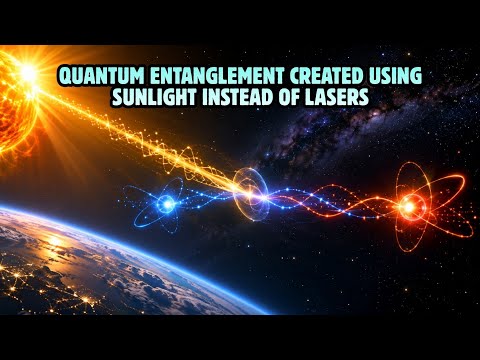
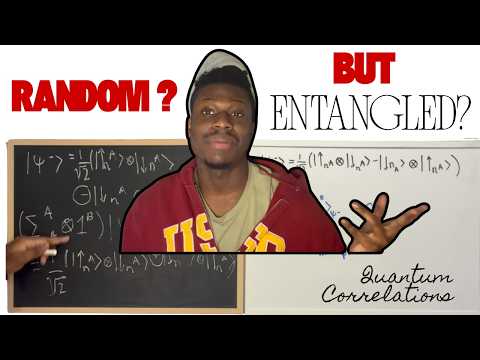
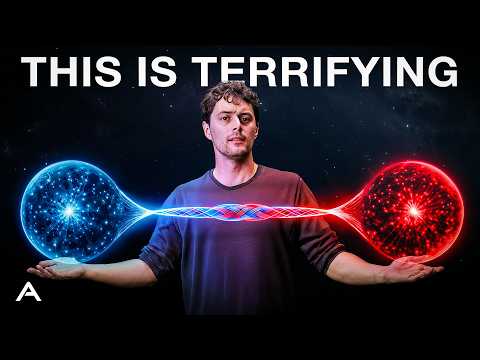
To grasp the unsettling aspects of quantum entanglement, consider its earliest philosophical skirmishes. The theory begins with superposition, where particles like electrons don’t settle into a single, defined state but rather hover within a spectrum of possibilities until observed. It’s akin to a coin tossed and hovering with both heads and tails simultaneously. What shreds reality, though, is not merely this—it’s when particles, once interacting, become entwined in such a manner that measuring one instantaneously dictates the state of its partner, no matter the distance.
Our classical intuitions falter here. If two particles emerge from a shared origin or come into close contact, their states cease to exist independently. Imaginatively, it’s like a pair of gloves: send one across the globe and observe the other, and you instantly deduce its counterpart’s state. Yet, unlike gloves, the partnered particles are not predefined. Instead, they coalesce into a transient state of superposition, defying the simplicity of predetermined outcomes. Upon measurement, they crystallize into opposites without traversing the space between them, aptly described by Einstein as “spooky action at a distance.”
This peculiar association shatters the classical assumption of local realism—the conviction that properties exist inherently and that influences travel across space over time. Entanglement leaves this dual belief fractured. It suggests that until measured, particles lack definitive attributes, and that their observed states can align across even vast separations instantaneously, sans detectable communication. Such implications troubled Einstein, who viewed these mechanics as incomplete, suspecting hidden layers beneath.
As debates circled, John Bell’s notable intervention arrived in the 1960s, providing a clarity that would later transform a philosophical quandary into testable science. Bell illustrated through mathematics that if hidden variables determined outcomes, they should not surpass specific correlation limits, delineated in Bell’s inequality. Quantum mechanics, however, predicted stronger correlations that transcended such constraints. Experiments, beginning in the 1970s and improving over decades, steadfastly confirmed this breach, erasing the semblance of local hidden variables and affirming the baffling non-local nature of our universe.
Non-locality suggests more than particles syncing mysteriously—it proposes that at the deepest level, separation is not a primary truth. Objects are not mere isolated entities but parts of an interconnected web, with entanglement revealing unity inconceivable in isolated analysis. This idea, unsettling for being out of step with how we intuitively segregate and comprehend our surroundings, challenges our understanding of location and independence.
As science continues to probe these quantum intricacies, the implications stretch beyond mere academic curiosity. They invite us to reconsider not just the foundations of physics but the philosophical and psychological implications for understanding existence itself. If separation is an emergent illusion, what does that suggest about our perceptions, relationships, and the universe we inhabit?
Upon this precipice of science and wonder, we find questions, not answers, but perhaps in these questions lies the path to deeper truths. How might accepting this non-local perspective reshape our approach to not just physics, but our place within the cosmos? The inquiry beckons us to look again, closer, at the minute yet profound mysteries quietly knitting together the fabric of reality.
—