For a long time, the story of quantum has been told in terms of capability, qubit counts, coherence times, and error rates. The conversation leaned heavily on what the machines could do, or might eventually do, if everything aligned just right.
But technology doesn’t scale on capability alone.
It scales on everything around it.
The invisible layers that allow something complex to function reliably, repeatedly, and—eventually—commercially.
And those layers are starting to take form.
Take QuantumCore.
On the surface, a funding announcement tied to readout challenges doesn’t seem likely to reshape the narrative. It’s not about building a bigger quantum computer or reaching a new qubit milestone. It doesn’t translate easily into a headline that signals immediate progress.
But if you pause there for a moment, the importance begins to sharpen.
Readout is one of those problems that sits at the boundary between theory and usefulness. You can build a quantum system that performs beautifully in isolation—but if you can’t measure its output cleanly, consistently, and at scale, the entire system becomes unstable in practice.
It’s like constructing a language without a reliable way to hear what’s being said.
So when a company chooses to focus there—not on expanding capability, but on stabilizing interpretation—it signals something deeper.
The ecosystem is no longer just asking, what can we build?
It’s asking, how do we make it usable?
A similar shift appears in the expanding collaboration between Quantinuum and BMW Group.
Partnerships between quantum companies and industry aren’t new. They’ve existed for years, often framed as exploratory—early-stage engagements designed to test potential use cases.
But there’s a difference between exploration and extension.
This partnership isn’t a first step. It’s a continuation. A deliberate deepening around materials research—an area where quantum computing has long promised advantage, but where practical application has remained just out of reach.
That continuation matters.
Because it suggests that value is no longer being evaluated in theory alone. It’s being tested, refined, and expanded in context. The relationship itself becomes a signal—not just that quantum might be useful, but that it’s becoming integrated into real workflows, even if quietly.
There’s a kind of trust embedded in that.
Not loud confidence.
But sustained attention.
Then there’s IonQ.
Their continued acquisitions, aimed at building a full-stack quantum platform, point to another layer of maturation—control over the system as a whole.
In earlier stages of emerging technologies, ecosystems tend to fragment. Different companies specialize in different components, innovation happens in parallel, and the landscape feels expansive but loosely connected.
Eventually, though, a shift begins.
Some players start to consolidate—not just to grow, but to reduce friction. To bring pieces together in a way that makes the system more cohesive, more navigable, more deployable.
Full-stack, in this context, isn’t just a technical ambition. It’s an ecosystem strategy.
It says: this is becoming complex enough that integration itself is now a differentiator.
And that’s a sign of maturity.
None of these developments, on their own, feels like a breakthrough.
There’s no singular moment where the field leaps forward.
But taken together, they form something else—something quieter, but perhaps more consequential.
They form scaffolding.
Scaffolding is rarely celebrated. It’s temporary by design, often removed once the structure it supports can stand on its own. But without it, nothing rises in a stable way.
In quantum computing, this scaffolding takes many forms:
- Measurement systems that translate fragile quantum states into reliable outputs
- Industry partnerships that ground theoretical advantage in real-world problems
- Platform strategies that reduce fragmentation and make systems usable end-to-end
Each piece solves a different kind of problem.
Not how to make quantum computers more powerful.
But how to make them work.
There’s a subtle psychological shift that comes with this stage.
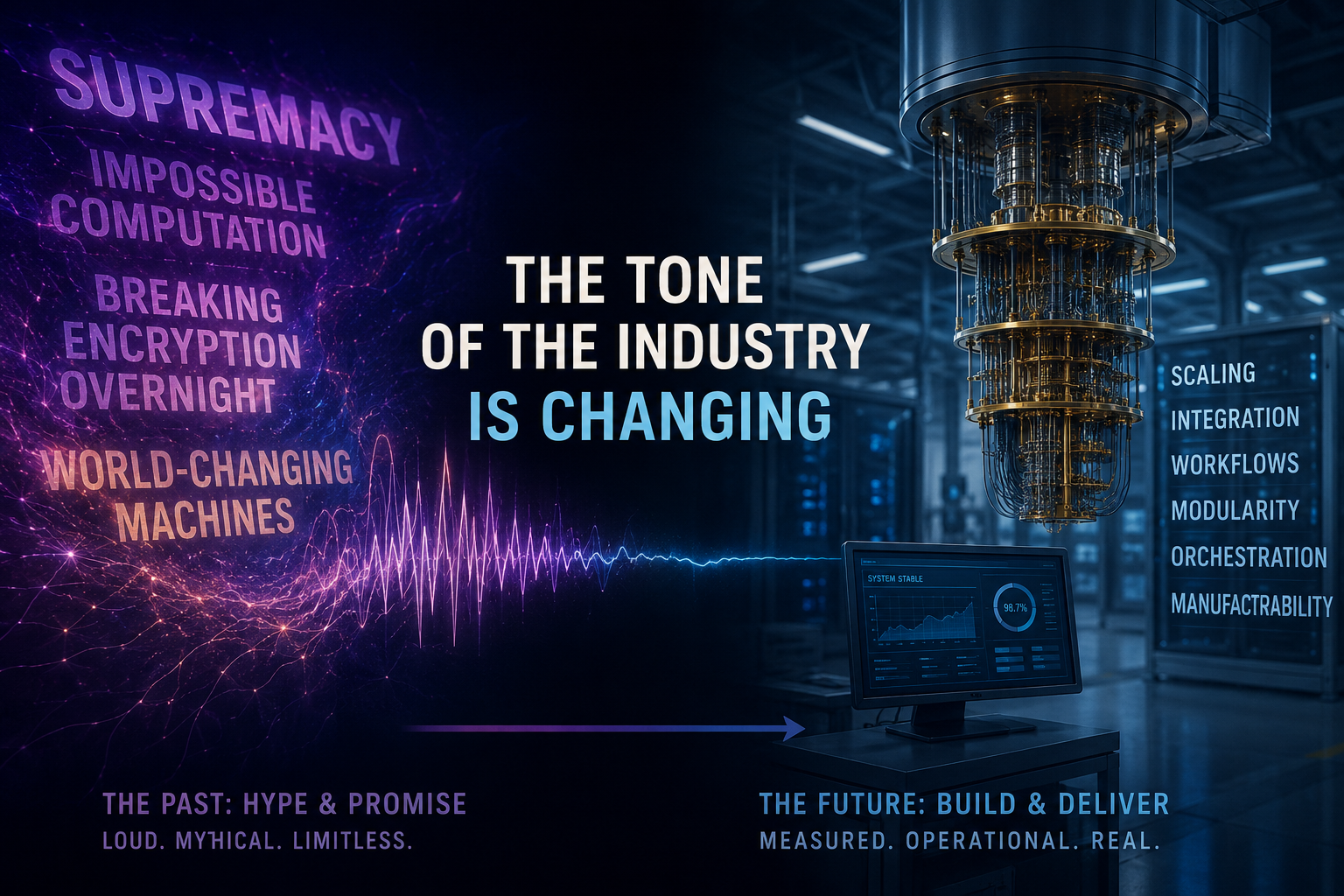
Earlier, the field was driven by possibility—the sense that something transformative could exist, if only the core challenges were solved. That energy still exists, but it’s beginning to share space with something more grounded.
Responsibility.
Because once systems begin to stabilize—once they start to integrate into industries, into workflows, into decision-making—the expectations change.
It’s no longer enough to demonstrate advantage in controlled environments.
The systems need to hold up under pressure.
To deliver consistently.
To fit into existing structures without breaking them.
And that requires a different kind of innovation.
Less about pushing boundaries.
More about reinforcing them.
What’s interesting is how easy it is to overlook this phase.
Breakthroughs are visible. They have edges. They give us something to react to, something to share, something to point at.
Structure doesn’t behave that way.
It accumulates.
Quietly.
And then, at some point, you realize that the field feels different—not because of a single event, but because everything underneath it has shifted just enough to support something larger.
If you step back, the pattern becomes clearer.
QuantumCore focuses on readout—making results interpretable.
Quantinuum and BMW deepen collaboration—making applications tangible.
IonQ builds vertically—making systems cohesive.
Different moves. Different layers.
But all moving in the same direction.
Toward stability.
And maybe that’s the real signal.
Not that quantum computing has arrived.
But that it’s learning how to hold itself together.
To move from isolated achievements to interconnected systems. From possibility to reliability. From something that works in parts… to something that can begin to work as a whole.
There’s still distance ahead. The challenges haven’t disappeared—they’ve just changed shape.
But this stage matters.
Because this is where technologies stop feeling experimental.
Not when they become perfect.
But when they become structured enough to carry weight.
And right now, that structure is forming—quietly, almost out of view.
The kind of progress you don’t always notice in the moment.
But later, when everything starts to accelerate, you realize it was this phase—this careful, structural layering—that made it possible.