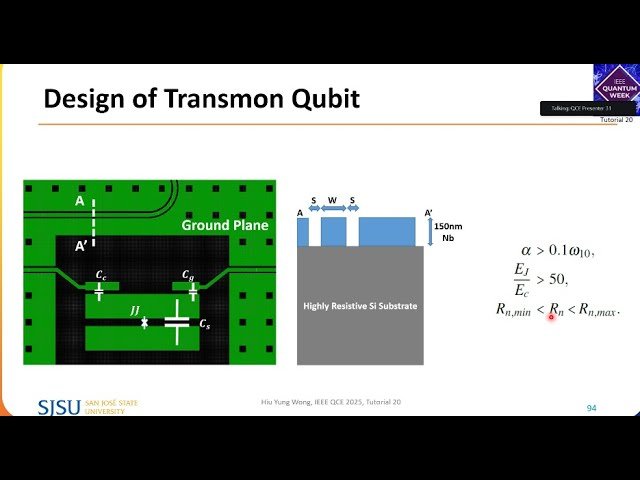
In our journey to unlock the future of computing, we are constantly drawn to the charm and complexity of quantum computing. The appeal lies not just in its potential to solve problems deemed unsolvable by classical means, but in its fundamental reliance on the principles that govern the smallest particles in the universe.
This video is from Introduction to Quantum Computing.
Quantum computing employs phenomena like superposition and entanglement, which feel almost magical in how they allow particles to exist in multiple states simultaneously or to be mysteriously linked, regardless of the distance separating them. But beyond the allure of these quantum oddities lies the real challenge: leveraging these phenomena to perform unprecedented computations.
Consider the simplest unit of quantum information, the qubit. Unlike a classical bit, which barring cosmic intervention is either a 0 or a 1, a qubit can be both at once (thanks to superposition). Imagine a spinning coin — it’s neither heads nor tails until it lands, but both. This capability enables quantum computers to handle exponentially more information than classical computers. If you have several qubits together, they can handle an immensely larger number of states simultaneously.
This rapid increase in potential combinations gives quantum machines their edge, especially for particular types of computations like factoring large numbers, simulating molecules, or optimizing complex systems which could revolutionize fields such as cryptography, materials science, and machine learning.
However, the same feature that gives quantum computers their power also makes them notoriously difficult to manage. The act of measuring a qubit’s state can collapse its superposition to either 0 or 1 randomly, erasing the other possible information. Therefore, smart algorithms are required to harness these states before they vanish, reminiscent of trying to understand the entire shape of a statue by looking at its shadow.
Integrating these concepts into a working machine involves mastery over the physical and the theoretical. At the hardware level, we’re talking about creating conditions that preserve fragile quantum states long enough to perform meaningful work — a significant challenge given quantum coherence (the preservation of quantum states) is easily disrupted by the slightest environmental noises, like temperature fluctuations or electromagnetic waves.
And there’s the matter of quantum gates, the building blocks of quantum circuits. Quantum gates manipulate the state of qubits using controlled operations. In this realm, we encounter not just practical challenges but philosophical ones: each gate operation must be reversible, embodying a fundamental symmetry in physics. If you send information forward through a series of quantum operations, you should theoretically be able to reverse it — reminiscent of flying from San Francisco to Tokyo and back.
Quantum error correction presents yet another layer of complexity. Due to quantum theory’s no-cloning theorem, you can’t simply copy a quantum state to safeguard against errors. Instead, quantum systems use entangled ancillary systems to diagnose and repair errors in a manner that classical computers don’t.
Despite these challenges, the potential rewards drive us onward. Each breakthrough in controlling quantum phenomena or designing more efficient quantum circuits not only brings us closer to a new era of computing but deepens our understanding of the fundamental rules that govern our universe.
Indeed, quantum computing stands as a powerful testament to human curiosity and ingenuity, linking tangibly abstract quantum mechanics with practical applications that could one day transform our society. As we continue exploring, developing, and theorizing, we remain guided by the basic yet profound understanding that our reach for knowledge, like the universe itself, expands ever outward.