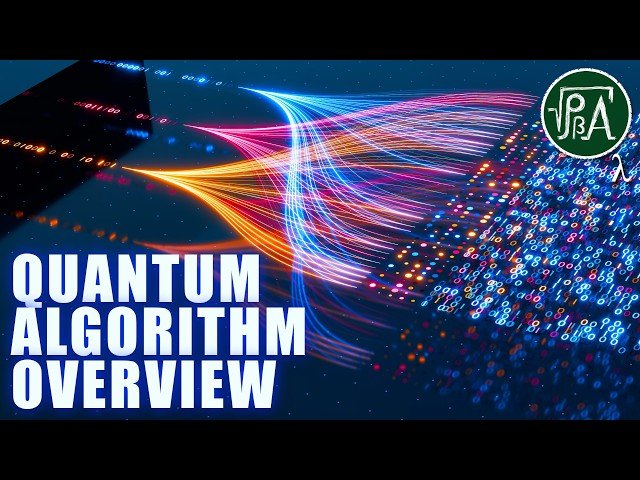
Imagine a world where calculations that currently take supercomputers billions of years could be done in mere minutes. This isn’t a fantasy—it’s the potential reality offered by quantum computing. However, before we get too carried away, it’s essential to note that this incredible speed isn’t universal; it applies only to specific tasks for which efficient quantum algorithms have been developed. Today, let’s dive into these algorithms to understand why they’re game-changers, echoing the transformative shift from horse-drawn carriages to cars and then to airplanes.
Let’s begin by setting the stage with a little historical perspective, comparing these monumental shifts in technology. Picture the ENIAC of 1946 as a horse-drawn carriage: fundamental but limited. Then envision the 1984 Apple Macintosh as a car, vastly faster and capable of more complex tasks. Now, enter the 2024 Google Willow quantum computer—not merely a faster car, but an airplane, opening new routes that were previously impossible.
This video is from Physics but Awesome.
Quantum computers aren’t inherently faster; they operate on a completely different architecture based on the principles of quantum mechanics. This architecture allows them to process multiple inputs simultaneously, a massive advantage for specific calculations. But there’s a catch: they can’t output all the results they compute; just one random outcome. This limitation is where the design of quantum algorithms comes into play, enhancing the probability of arriving at the correct solution.
Among the stars of quantum algorithms, Shor’s Algorithm shines brightest due to its potential impact on cybersecurity. It poses a formidable threat to current encryption techniques, like HTTPS and secure email, by allowing quantum computers to break them in potentially hours or days instead of thousands of years. The key lies in its ability to solve prime factorization exponentially faster than any classical algorithm.
Not far behind is Grover’s Algorithm, which offers a quadratic speedup—that might not sound as impressive as an exponential speedup, but it’s still significant. Often used for searching unsorted databases, Grover’s Algorithm optimizes the search process so effectively it could sift through vast amounts of data to pinpoint the exact information needed swiftly. Think of it like finding a needle in a digital haystack.
Quantum Phase Estimation (QPE) is another powerful tool in the quantum computing arsenal, pivotal for simulations and part of the backbone of Shor’s Algorithm. It handles tasks that require an understanding of quantum state transformations over periods, bridging the gap between theoretical quantum mechanics and practical applications with a focus on optimizing certain aspects of computational processes.
Then there’s the Harrow-Hassidim-Lloyd (HHL) Algorithm, designed for solving systems of linear equations—a staple in nearly all technical domains from engineering simulations to machine learning algorithms. While it doesn’t directly spit out all solutions due to quantum mechanics’ probabilistic nature, it’s incredibly adept at calculating certain global properties of these systems, thus facilitating faster, more efficient processing of complex calculations.
As wondrous as these algorithms are, it’s essential to temper our excitement with a dose of reality. These tools are incredibly specialized; just as airplanes haven’t replaced cars because they serve different purposes, quantum computers won’t replace classical computers but will rather complement them in specific, high-impact tasks.
In conclusion, the journey of quantum computing is just beginning. We’re currently at a stage similar to the early days of classical computing, where potential applications seem both boundlessly exciting and somewhat narrow. However, the critical takeaway is not to view quantum computing through rose-colored glasses but to understand and respect its capabilities and limitations.
Moving forward, as we build more powerful quantum computers and expand our repertoire of algorithms, we’ll likely find more and more ways to leverage this technology. For now, let’s keep our minds open to the possibilities that lie on the quantum horizon. As always, the key is to stay informed and stay curious.