Every once in a while, on Impact Quantum, I meet someone who does not simply explain quantum technology. They illuminate it. My conversation with Dr. Katanya Kuntz was one of those rare moments. I thought we would talk about satellites and encryption. Instead, I walked away feeling as though someone had handed me a new mental map of the quantum universe.
Katanya brings something unusual to the field. She is an experimental physicist, a member of a Canadian space mission, a quantum educator, and the CEO of Kubo Consulting. She is also a gifted translator of ideas that usually live in dense academic papers. Her ability to make these concepts clear, visual, and approachable is remarkable.
Here is what I learned.
Quantum Satellites Are Not Science Fiction. They Are the Backbone of the Future Internet
Before meeting Katanya, I had a high-level sense of what satellite-based quantum communication might involve. After speaking with her, I finally understood why it is so essential.
Quantum information is fragile. Send it through a fiber optic cable for more than about 500 kilometers, and the quantum state begins to collapse. Classical networks handle long distances with repeaters that clone the signal. Quantum systems cannot be cloned. This is the no-cloning theorem in action.
If you want globally secure quantum communication, you cannot rely solely on fiber. You must go through space.
Katanya explained how Canadian ground stations send single photons upward through telescopes to a satellite in low Earth orbit. The satellite carries those photons across long distances and sends them back down to another ground station. This is the early structure of a quantum internet. It is delicate, elegant, and genuine.
She also works on Canada’s Quantum Encryption and Science Satellite mission. Her research involves ground stations in Waterloo, Calgary, and Saint Hubert. Hearing her describe this work revealed something important. Quantum networking is not a future concept. It is underway right now.
The Boundary Between Classical and Quantum Is Not a Hard Line
One of the most fascinating insights Katanya shared involved the transition from classical physics to quantum physics. Researchers are actively probing this boundary. They take tiny quantum systems and scale them upward or take large classical light fields and scale them downward to see when quantum behavior appears.
The universe does not flip a switch. The transition is gradual and mysterious.
Listening to her describe these experiments felt like getting a glimpse behind the curtain of reality. She explained how probability distributions, wave functions, and the collapse of quantum states are not abstract ideas. They are measurable, testable, and still full of surprises.
Quantum Processes Already Exist Inside the Human Body
This part stunned me. I have written about quantum biology before, but this conversation made everything more immediate.
Many biological processes may already rely on quantum effects. Examples include photosynthesis, smell, and the way migratory birds sense Earth’s magnetic field. Katanya also discussed how electron tunneling may influence odor detection and how enzymes could rely on quantum processes.
She spoke about these topics with a calm confidence that made them feel obvious rather than speculative. It shifted the way I think about biology. These ideas are not far fetched. They are active areas of research that help explain how the natural world functions.
She also mentioned the ongoing inquiry into the possibility of quantum processes within the brain. She did not exaggerate or sensationalize. She acknowledged that researchers are exploring it and that we still have much to learn.
Translation Might Be the Most Valuable Quantum Skill
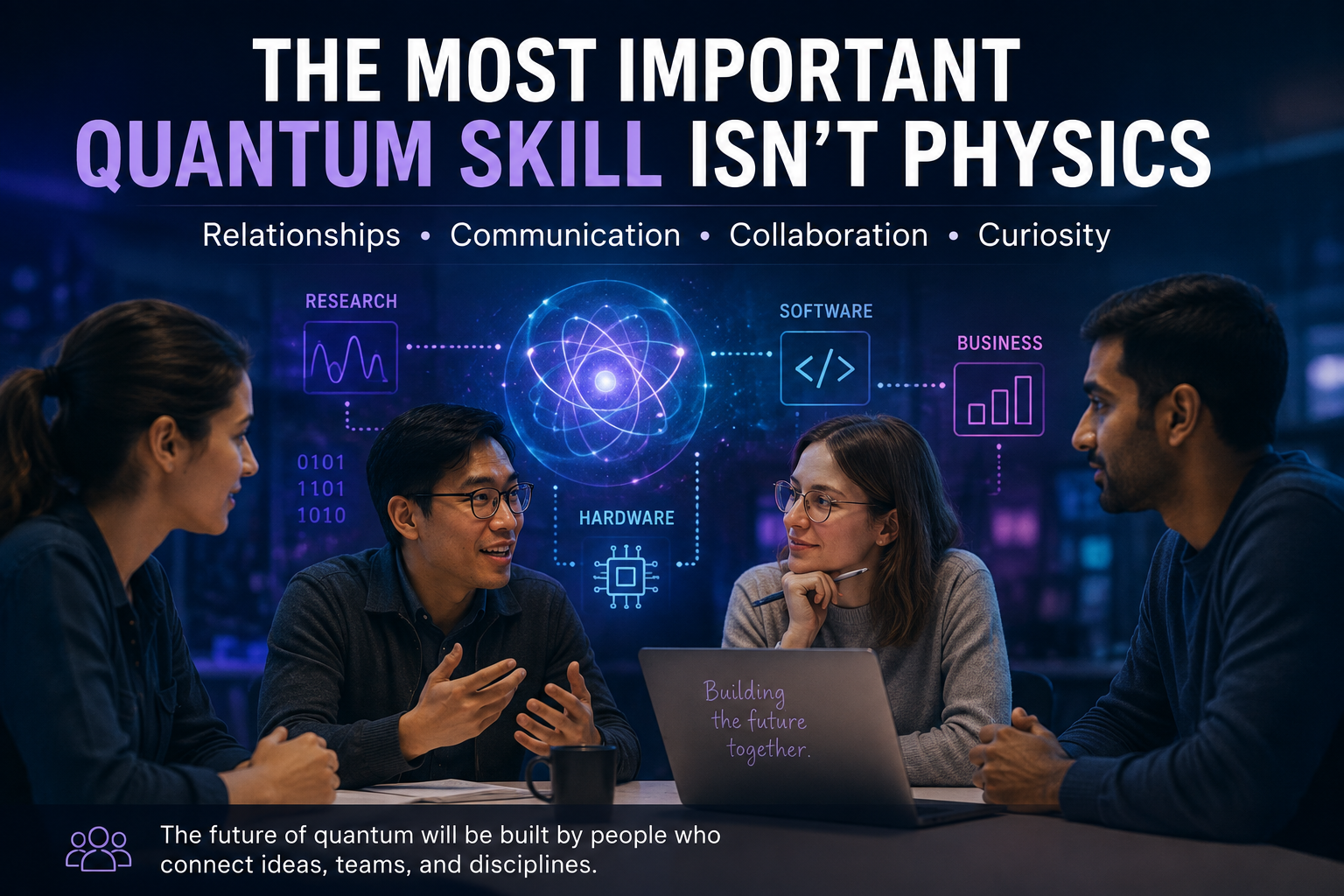
This was the insight that stayed with me the longest. The quantum workforce will not be built solely by physicists. It will rely on translators. People who can take quantum concepts and make them usable to industries, executives, policymakers, engineers, and communities.
Katanya lives in that space. She stays connected to research while helping businesses understand what quantum tools can realistically do today. She creates training for executives who want to enter the quantum industry without fear of jargon.
She told us that most people will never need a quantum computer in their home. They will, however, need to understand quantum security, post-quantum cryptography, and the impact of quantum optimization on global industries.
Her work helps make that possible and connects directly with Impact Quantum’s mission. The future of this field will be built by educators, communicators, and community builders as much as by researchers.
Quantum Is Not Exotic. It Is Everywhere Around Us
By the end of the interview, something shifted for me. Quantum technology no longer felt like a niche scientific field. It felt like a natural layer of the world that we are finally learning how to use. Katanya made that clear without hype, drama, or exaggeration.
Meeting her reminded me of why Impact Quantum exists. We want conversations like this to reach the people who will shape what comes next.