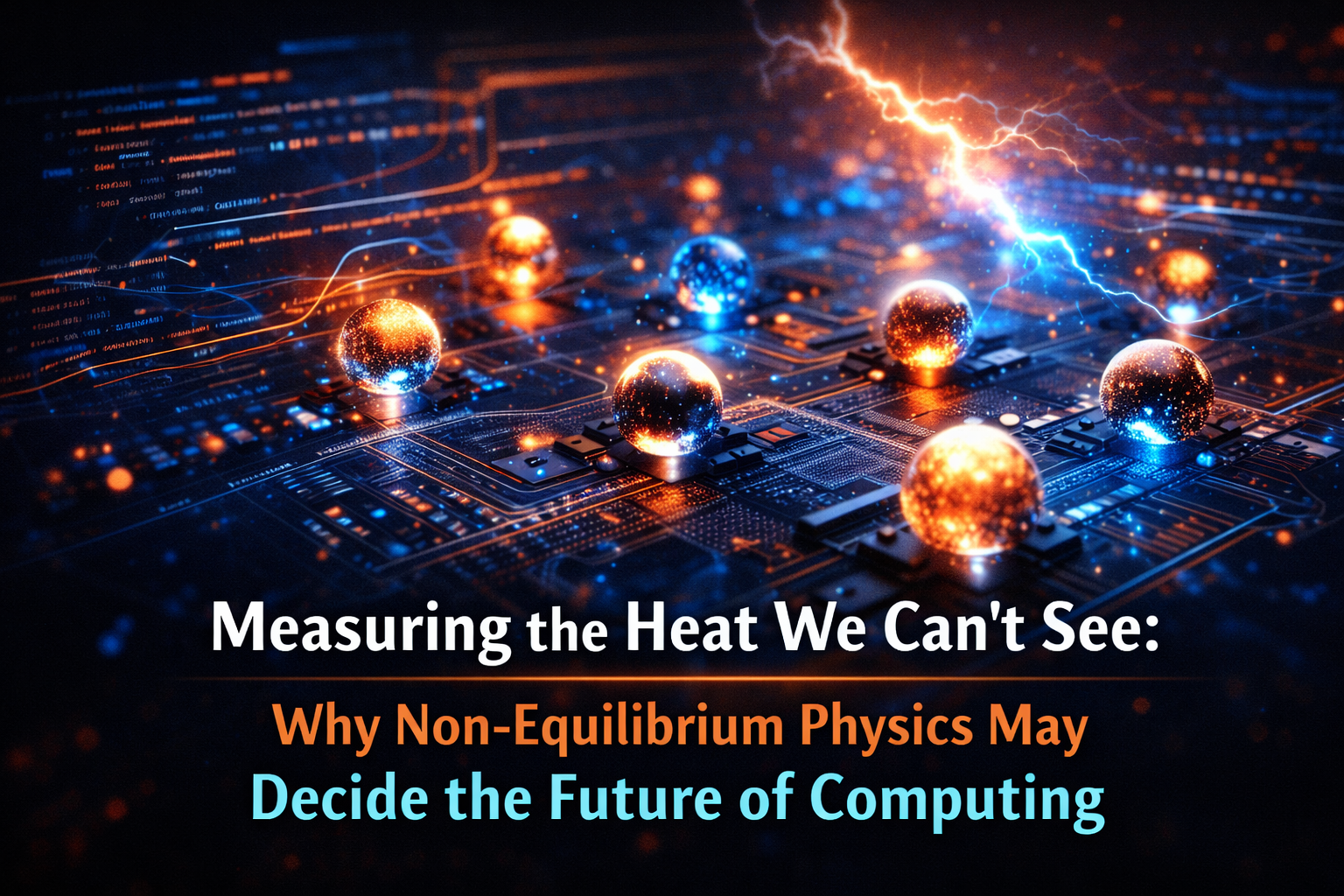
This research represents a significant advance in our understanding of the “hidden costs” of computing at its most fundamental level. To put this in perspective, measuring entropy in a nanoscale system is like trying to calculate the friction of a single grain of sand while it’s being tossed in a hurricane. It’s incredibly noisy and conceptually elusive.
Here is a breakdown of why this Stanford research is such a game-changer for the future of technology.
There’s a comforting assumption baked into much of classical physics: equilibrium. It’s the idea that systems eventually settle, that energy flows even out, that things calm down. A cup of coffee cools to room temperature. A pendulum stops swinging. Balance is restored.
But computers don’t live in that world.
A working computer, especially at the nanoscale, is never in equilibrium. It is always in motion, always processing, always shedding heat. As we push computing toward smaller, faster, and more energy-efficient systems, that lack of equilibrium stops being a detail and becomes the central challenge.
This is where things get interesting—and surprisingly philosophical.
The Hidden Cost of Information: Entropy in Action
Every time a computer processes information, an irreversible process occurs. In physics, we call this entropy production—a measure of how much disorder is created when energy is transformed. In a perfectly reversible universe, you could run every process backward and lose nothing. But that universe doesn’t exist.
In the real world, every bit flipped, every signal transmitted, and every calculation performed generates a tiny amount of entropy. That entropy shows up as heat. At large scales, we can measure it easily. At the nanoscale, where modern and future computing lives, it becomes almost impossible to isolate.
Here’s the problem:
At nanoscopic dimensions, random thermal noise is loud. The natural jiggling of atoms often overwhelms the very signal researchers are trying to measure. It’s like trying to hear a whisper at a rock concert.
And yet, if we can’t measure how much energy is being wasted at this scale, we can’t design systems that waste less.
Listening to Quantum Dots Blink
To get around this, researchers turned to an unlikely narrator: quantum dots.
Quantum dots are tiny semiconductor nanocrystals that flicker between “on” (bright) and “off” (dark) states. This blinking isn’t random; it carries information about the energy landscape the dot is navigating.
The experiment hinged on forcing these dots out of equilibrium.
By applying an external electric field, the researchers intentionally stressed the system. The dots were no longer just blinking naturally; they were responding to an imposed control. The team then compared two situations:
- How the dots blinked when the field was off
- How those blinking patterns changed when the field was on
The key insight came from the difference between those patterns.
That difference represents an information gap, a measure of how much information is dissipated as the system responds to external control. In other words, the blinking became a proxy for entropy production.
But there was still a problem.
Where Machine Learning Becomes the Translator
Raw experimental data at this scale is messy. Noisy. Unforgiving. Traditional analysis methods simply can’t extract clean, reliable measurements from it.
This is where machine learning quietly becomes the hero of the story.
Rather than trying to force the data to behave, the researchers used ML algorithms to adapt their theoretical physics model to the real-world messiness of the experiment. The algorithm iteratively adjusted the model’s parameters until its output matched the observed blinking patterns, noise, and all.
Once the model was tuned to reality, something remarkable happened:
For the first time, the researchers could calculate the entropy production rate with precision.
Not approximately. Not statistically hand-wavy. Precisely.
This wasn’t just a physics breakthrough. It was a measurement breakthrough.
As Grant Rotskoff put it:
“We’re very much at the beginning of starting to think about how to measure dissipation and energy efficiency in systems that are externally controlled.”
That sentence should land heavier than it looks.
Why This Changes the Trajectory of Technology
If you can’t measure inefficiency, you can’t fix it. Until now, nanoscale systems operated in a kind of thermodynamic fog. We knew energy was being lost—we just didn’t have a ruler small enough to measure where, when, or how much.
This work provides that ruler.
The implications ripple outward:
- Ultra-fast computing
There is a fundamental speed limit to how fast atoms can move before heat dissipation overwhelms the system. Measuring entropy production tells us where that limit actually is. - Battery technology
Charging and discharging batteries involves microscopic structural changes. Pinpointing where energy is lost during those transitions could reshape how we design next-generation storage. - Sustainable AI hardware
The human brain is astonishingly efficient. If we want AI hardware that even approaches that efficiency, we need to minimize entropy production at the physical level—not just optimize algorithms in software.
The Bigger Picture
This research isn’t about quantum dots. It’s about visibility.
It’s about finally being able to see the energetic cost of control in systems that never rest, never equilibrate, and never stop computing. As we move deeper into an era defined by AI, edge computing, and nanoscale devices, those costs cease to be merely abstract physical concepts and become design constraints.
We are learning, slowly and carefully, to listen to the noise rather than fight it.
And in that noise, the future of computing is quietly revealing its limits and its possibilities.
I read about this content here.