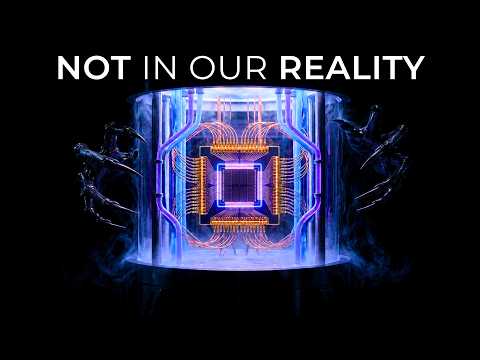
There’s a particular allure to numbers so grand they challenge comprehension. Consider the Herculean figure of 10 septillion years—a span that dwarfs cosmic history like a blip, yet Google’s latest quantum chip, the Willow, accomplished the ostensibly impossible: a computation meant to consume those winding eons reduced in a nondescript laboratory in Santa Barbara, California, it stirred seismic thoughts within to mere minutes. As the Willow chip buzzed quietly within a nondescript laboratory in Santa Barbara, California, it roused seismic thoughts in the scientific community. Quantum computing, a field still veiled in intricate mystery, seemed to hint at something beyond the numbers.
Based on content from Luminox Zenith
It was Hartmut Neven, the well-regarded founder of Google Quantum AI, whose words provoked curiosity and skepticism alike. They spoke of power siphoned not from our universe alone, but perhaps from many—a dance of computations across parallel paths reflected in the quiet agreement of data. Just like that, a thought once reserved for speculative fiction instantaneously intertwined with the fabric of serious scientific discourse.
At the core of this discussion lies quantum mechanics, a realm where uncertainty and possibility have always reigned sovereign. Many have speculated that quantum computing could bring us unprecedented clarity about the fundamental nature of reality itself—a reality where multiple universes coexist, brushing up against each other, only to diverge gracefully as independent ribbons of possibility. The many-worlds interpretation, proposed by Hugh Everett III back in 1957, gives this narrative a formal framework, proposing a universe branching from every quantum decision point where all possibilities, rather than just one, become real in their own branches.
Yet, the Willow chip’s accomplishment doesn’t outrightly validate this interpretation. The Copenhagen interpretation—a school of thought familiar to those who tread the corridors of quantum physics—offers a competing narrative. It suggests that quantum mechanics only describes probabilities that resolve into defined outcomes upon observation, forswearing the complexity of parallel branches in favor of a tidy collapse. Here, the magic of quantum computing lies in the orchestrated interference of probabilities—a symphony played by amplitudes—against the chaos of running simultaneous computational paths.
These differing views represent the dual nature of humanity’s intellectual appetite: the desire for elegant mathematics explaining the armature behind reality, and the yearning to unearth a truth that feels intuitively whole. Distinguished physicists like David Deutsch champion the many-worlds perspective, arguing it represents a purer expression of quantum mathematics devoid of arbitrary collapses. Meanwhile, critics argue that such grand claims skirt the realm of untestable fiction and risk confusion over what quantum computers, particularly the Willow, genuinely achieve.
What remains is the intricate dance of how we interpret quantum mechanics, tinged with philosophical hues, as much as it is governed by physical laws. Sabine Hossenfelder, a voice of critical reason, reminds us that Willow’s computational leap primarily showcases quantum mechanics’ challenge to classical simulations, not proof of multiverse reality.
As quantum advancements spiral forward, the balance between machine capability and theoretical interpretation teeters on a knife’s edge, edging toward a reconciliation that may reshape or wholly affirm our universe-centric perspective. Perhaps the implications of Willow, profound in their infancy, couldn’t neatly bind or unravel such a deep-seated scientific struggle just yet.
As we stand on this precipice, peering over the horizon of the known and the speculative, the question shifts focus. Beyond the computational leap, what other truths could quantum technology illuminate? Will we find conclusive evidence pointing firmly to our singular existence or shared infinities? Or, in our quest, will we find ourselves permanently dwelling in delightful uncertainty?
For now, Google’s quantum chip offers more than performance—it is both a challenge and an invitation: an urging to contemplate what lies beyond our observational reach, to debate the essence of reality itself, provoked not by science fiction, but by the steady pulse of our most daring technology.
—