There’s a moment in every emerging technology when the lights shift. It’s subtle at first, like watching dawn creep across a laboratory bench, but suddenly you realize the room is bright enough for builders rather than theorists. Quantum technologies are poised to take center stage in 2026. For decades, this field was the province of physicists, national labs, and patient government funding. Now, private capital is arriving not as a hopeful visitor but as a primary engine pushing the industry toward commercialization.
Over the last ten years, global quantum investment has expanded 17-fold. By the third quarter of 2025, U.S. quantum startups experienced their strongest funding quarter in history, reaching 2.8 billion dollars in venture investment. The striking detail is that more than two billion dollars went to only three companies. It’s an unmistakable signal: quantum is beginning to resemble an oligopolistic race, one where a few deep-pocketed contenders are absorbing the resources required for hardware scale and manufacturing depth.
But investors leaning into 2026 aren’t simply chasing momentum. They’re responding to a genuine inflection point that arrived mid-2025, when several technical achievements reshaped the industry’s risk profile. Historically, quantum investments lived or died on the feasibility of physics: Would qubits behave as expected? Could error rates ever fall low enough to matter? Could anyone build a machine that held its breath longer than a dragonfly wingbeat? In 2025, the answers shifted from maybe to almost certainly.
The New Shape of Risk: Engineering, Not Physics
One of the most important leaps came from the heart of the qubit itself. Operation error rates dropped to the realm of 0.000015 percent, a figure that would have sounded like science fiction a decade ago. Superconducting qubits stretched their coherence times to 0.6 milliseconds, a tiny eternity in quantum terms. When you talk to quantum engineers, they often compare coherence to keeping a soap bubble intact while you try to measure it with tweezers. Extending the lifetime of that bubble changes everything.
At the same time, researchers discovered new algorithmic shortcuts that dramatically reduce the overhead of fault tolerance. Some of these techniques minimize error-correction costs by as much as 100 times, making practical quantum computation far more attainable. QuEra’s progress in magic-state distillation, reducing physical qubit requirements nearly ninefold, added another crucial building block to the stack.
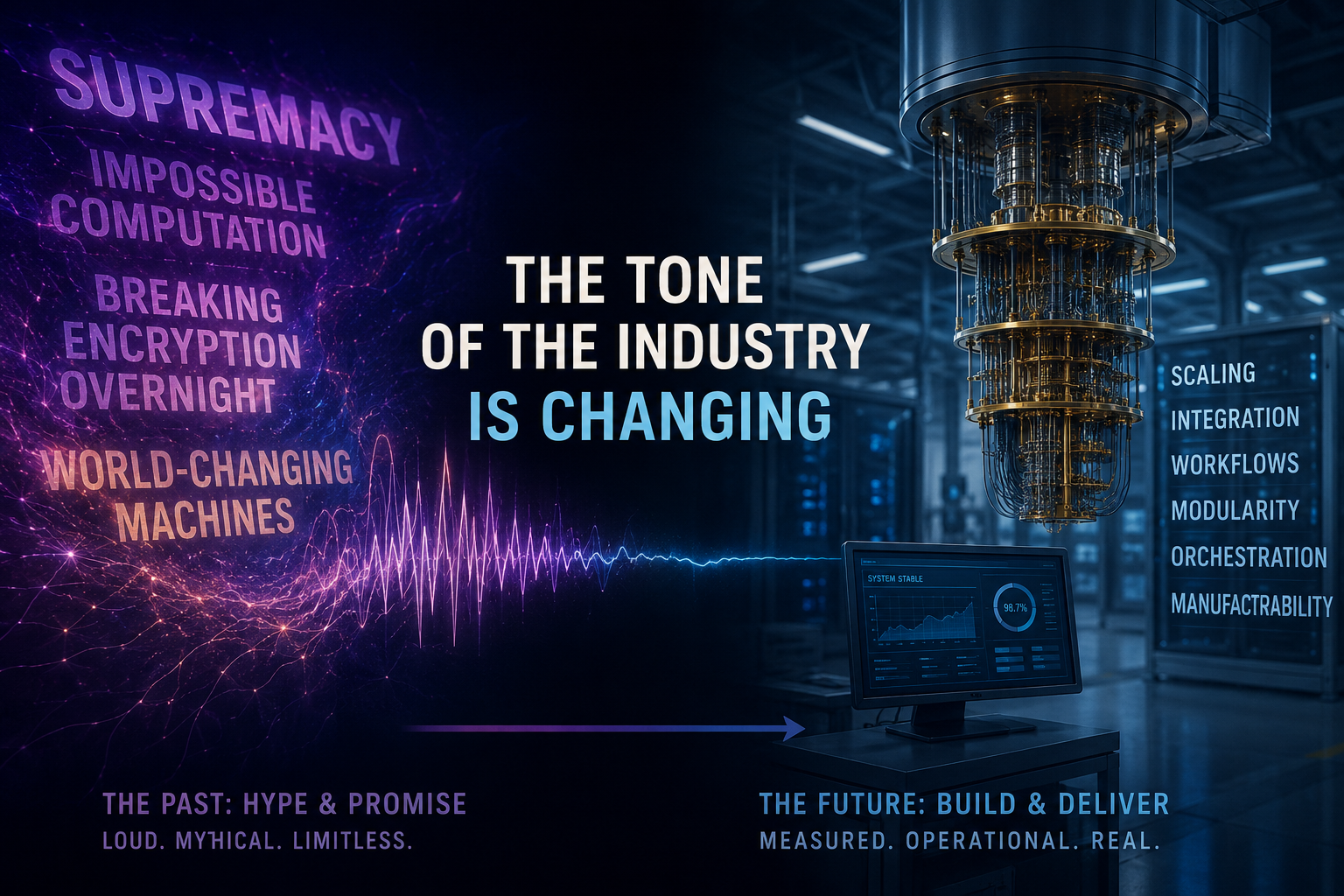
Suddenly, the bottleneck wasn’t physics. It was engineering, encompassing fabrication yields, system integration, control software, and supply chain maturity. Investors know this territory. It’s the familiar landscape of semiconductor scaling and advanced manufacturing. When the frontier moves from “Can this exist?” to “Can this scale?”, capital becomes more confident, more structured, and faster.
The Fault-Tolerant Horizon
Every industry has a Wright Brothers moment. In quantum, that moment is the first fully validated fault-tolerant logical qubit. Most roadmaps point toward a 2026 to 2028 window, with IBM’s forthcoming Kookaburra architecture aiming to demonstrate integrated logical qubit operations. The first wobbling flight won’t change the world overnight, but it will prove that physics is real enough to build on.
When that happens, valuations will likely undergo their own shift in altitude. Investors who position capital before fault tolerance is achieved are effectively operating at the steepest part of the returns curve.
We’re already seeing hints of practical quantum advantage. A 36-qubit system achieved measurable speedups in medical device simulation. D-Wave’s annealing systems outperformed classical models on portfolio optimization problems. And enterprise-grade randomness generation—validated at exascale levels—has begun creeping into financial cybersecurity workflows. These aren’t the dramatic, all-or-nothing breakthroughs once promised. They’re incremental footholds. And footholds are how revolutions accumulate.
The Quantum Startup Map: A Multi-Modal Terrain
The quantum ecosystem entering 2026 is a vibrant yet uneven landscape, filled with competing qubit modalities that each carry their own strengths and scaling challenges.
Superconducting qubits are the speedsters with mature fabrication pipelines, but cryogenic cooling remains a stubborn constraint. Trapped ions offer the world’s highest fidelities but scale slowly because laser architectures don’t easily multiply. Neutral atoms excel at large, programmable arrays, though their optical systems must mature before hitting industrial scale. Photonics whisper promises of room-temperature operation and elegant networking. And annealing systems, while not universal, deliver real commercial value right now.
Investors increasingly realize they can’t place a single bet. Diversification across at least three modalities is the new strategic baseline, not because the field is chaotic but because it’s rich with valid paths.
Beyond hardware, another layer quietly commands most of the near-term revenue: software and algorithms. Companies like Multiverse Computing have demonstrated that quantum-inspired optimization can thrive long before fault tolerance arrives. Meanwhile, cloud providers such as Amazon Braket have become essential gatekeepers; any hardware startup that isn’t integrated risks being sidelined regardless of technical merit.
The 2026 Investment Thesis
For deep-tech venture capital, three sectors stand out as high-priority allocations.
Post-Quantum Cryptography (PQC)
This is the compliance engine of the quantum era. Global regulators are already mandating enterprise migration to quantum-safe standards by the early 2030s. Because PQC adoption doesn’t depend on quantum hardware arriving “on time,” it offers predictable revenue with long-term visibility.
Quantum Sensing and Metrology (QSM)
If quantum computing is still stretching its wings, quantum sensing is already airborne. Applications in navigation, biomedical imaging, and environmental diagnostics outperform classical tools today. The 2025 quantum-health investment wave signaled that sensing is enterprise-ready and scalable.
Quantum AI and Optimization (QAI)
NISQ-era hardware is imperfect but surprisingly useful for specific optimization, logistics, and simulation problems. Financial institutions have already woven quantum-enabled routines into their workflows. QAI sits comfortably in the mid-risk, mid-reward band.
Structural Hurdles Investors Can’t Ignore
Quantum IP is a fortress—if it’s clean. In some startups, 80–95% of the enterprise value resides within the patent portfolio. Investors must scrutinize university spin-out rights, global enforceability, and freedom to operate. Defense agency grants often serve as quiet stamps of legitimacy.
Talent remains the scarcest resource. Experts who can navigate both quantum physics and scalable engineering are still rare enough that entire investment rounds often hinge on the technical team’s quality. Add geopolitical friction around export controls, and you get a landscape where governance choices matter as much as scientific ones.
A Portfolio for the Quantum Decade
For institutional investors, a balanced 2026 portfolio is composed of 30% PQC for stability, 25% quantum software for near-term traction, 25% hardware for long-term upside, and the remainder allocated to sensing and infrastructure. The theme is equilibrium: combining dependable revenue paths with exposure to transformational breakthroughs.
The Road Ahead
Quantum’s transition from theory to engineering isn’t just a technological shift. It’s a cultural one. The field is learning to speak a more interdisciplinary language: physics meeting manufacturing, cloud architecture meeting algorithmic finesse, and compliance frameworks wandering into conversations once reserved for decoherence times.
The story of 2026 is simple: the quantum future no longer belongs solely to laboratories. Investors, engineers, ethicists, and policymakers are now co-authors. And the draft they’re writing is no longer science fiction, it’s a blueprint.