
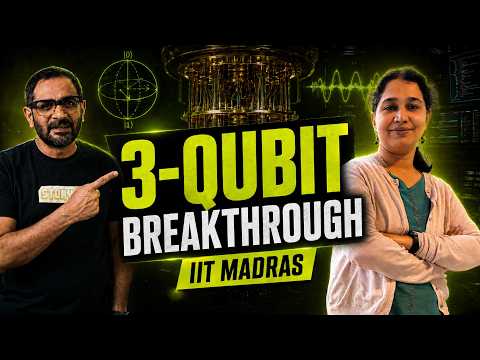
In the labyrinthine world of quantum computing, where the mystique of qubits holds the promise of unprecedented computational power, a remarkable breakthrough is lighting the way forward. At the forefront of this development is Professor Prabha Mandayam and her team from IIT Madras, who have challenged conventional paradigms with a stunning simplification in the realm of quantum error correction.
Based on content from IIT Madras Tech Talk
Watching the video on this breakthrough, one cannot help but ponder the intricate dance of qubits—those quantum bits that, unlike the binary certainty of classical bits, dwell in the hazy domain of probabilities. Imagine a coin not simply lying flat as heads or tails but spinning in a state where it hovers between possibilities. This volatile balancing act is at the heart of quantum computing’s potential and its inherent fragility.
For decades, scientists have grappled with qubits’ proneness to errors, mainly through amplitude damping, where their energetic states dissipate, and information fades to nothingness. This decay has been a significant roadblock to harnessing quantum computers’ capabilities fully. Enter quantum error correction: a method to protect the delicate quantum state by combining multiple physical qubits into a single, more reliable logical qubit. Google’s approach requires about 100 such qubits to establish one stable, logical qubit, revealing the complexity and resources involved.
Yet, what happens when innovation peers through the complex veil to simplify? The IIT Madras team’s insight demonstrates that under specific conditions, a mere three qubits—augmented by two helper qubits—could accomplish the same task as Google’s hundred. They achieved this through a focused approach, addressing just one type of error: amplitude damping. This narrowing of scope allows for a leaner, more efficient system.
Such specificity might seem limiting—like trying to capture a perfect photograph of a bird with limited shots, knowing some will inevitably blur. Yet, this method’s elegance resides in its adaptability and precision for the task at hand. Unlike error-correcting systems that need to anticipate a barrage of probable errors, this focused methodology thrives within its defined parameters.
Of course, scaling down to fewer qubits presents new challenges. When the team set their sights beyond theory, deploying this reduced code on a working quantum computer, they encountered interference from neighboring qubits. The solution was innovative: a dynamic pulse sequence akin to active noise cancellation—silencing the extraneous clamor and stabilizing the logical qubit’s integrity.
The culmination of these efforts is what’s known as “break-even performance”—where the logical qubit outlasts its unprotected predecessors. This achievement not only marks a milestone in quantum research but also underscores the profound impact of specialized, noise-aware strategies in technology development.
As quantum computing edges closer to practical application, the work being done at IIT Madras sets a contemplative example: sometimes, solving big problems involves narrowing the scope, not broadening it. This insight opens up fascinating questions about the future directions we might take. Could similar focused methodologies unlock further potential across other domains in computational science?
Such accomplishments from Professor Mandayam and her colleagues prompt a reflection on the broader tapestry of innovation, where each thread of discovery is distinct yet interwoven with the global fabric of scientific advancement. As we stand on the precipice of quantum computing’s vast horizon, this journey continues to inspire awe and endless curiosity.
—










Leave a Reply