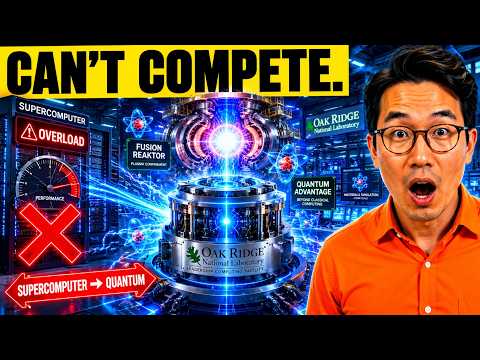
In the quiet frontier where quantum computing meets nuclear fusion research, a complex pas de deux unfolds—a dance shaped by both harmony and uncertainty. At the heart of this narrative lies Oak Ridge National Laboratory’s recent initiative to model fusion reactor material through the lens of quantum computing. It’s a story that irresistibly beckons attention, but requires careful contemplation of the steps taken and promises made.
Based on content from Hardware Grid
The intrigue begins as quantum computing, emerging from its infancy, mingles with the rigorous demands of simulating fusion reactor materials. Here, traditional supercomputers face their own limitations, grappling as they do with the daunting calculations required to predict how materials behave under extreme temperatures and radiation. Headlines capture the challenge dramatically, yet clarity comes from understanding not only the promise of quantum computing but its current tandem role with classical high-performance systems. Dive deeper, and you’ll find researchers at national labs and universities seeking synergy, not substitution, hoping quantum capabilities will enhance—with a not quite audible yet palpable anticipation—the power of our conventional machines.
Within such endeavors, patience is a virtue. Quantum computing, though showing promise in areas like molecular modeling and energy research, remains on the steepest parts of its adoption curve. Oak Ridge, like many laboratories, acknowledges this duality, advancing high-performance computing while prudently exploring quantum technologies’ potential. Summoning quantum mechanics to scale their models into realms classical computing alone cannot reach, they toe a careful line between aspiration and current capability.
As the stirring prospect of fusion energy—a clean, virtually limitless power source—looms tantalizingly close, it reminds us that speculation can become a seductive siren. It’s why carefully grounded announcements and peer-reviewed publications should guide our evaluations over more speculative takes. In these slow unfolding stories, tangible increments mark progress as much as any explosive breakthrough.
Such caution is not without precedent. Microsoft’s recent claims of realizing topological qubits, dubbed “quantum computing’s transistor moment,” ignited excitement before it met skepticism—a reminder of the razors’ edge in cutting-edge science. Their ambitious leap past traditional error-prone qubits to a more robust design represents, metaphorically, stepping on an as-yet uncertain path through the experimental fog. Quantum bits—qubits as they are—far from being reliable, still demand intricate layers of error correction to withstand environmental noise. Here, the concept of Majorana zero modes emerges; a curious dance partner posited to bear its own antiparticle, theoretically immune to such noise.
Yet the science is not settled. Majorana zero modes, theoretically isolated in superconducting nanowires, blur with ordinary Andreev bound states under scrutiny, provoking physicists’ critique of Microsoft’s bold claims. The persistent questions of visibility, obscured by the whispers of interference and assumptions unchecked, ultimately cast a long shadow.
This cautious intrigue threads through attempts to visualize fusion-bound materials—a choreography of computational prowess. Scientist Sankar Das Sarma’s observations suggest the undercurrents of fragility and inconsistency still at work, amid promise realized and unfulfilled. If modeling fusion reactor materials via quantum computing represents a step forward, it is nonetheless tentative, an iterated pas de deux aware of its own faltering steps.
In this narrative, rather than a curtain call, a sustaining motif emerges: hybrid computing strategies that blend quantum with classical coordination. The interplay between overwhelm and clarity, beneath temporal patience and inquisitive persistence, defines the pace. As we look toward a future lit by fusion’s clean energy promise, the question of how—or when—it becomes reality invites deeper reflection.
The juxtaposition of overwhelming computational challenges and clear breakthroughs continues to weave through this quietly unfolding tapestry. As you pause, consider not only the steps taken , but also those yet required, in the ongoing dance toward understanding and harnessing the world’s elemental forces. In the balance of hope and realism, knowledge and questioning coalesce, urging us not just to watch, but to participate in writing this evolving stanza of scientific pursuit.
—