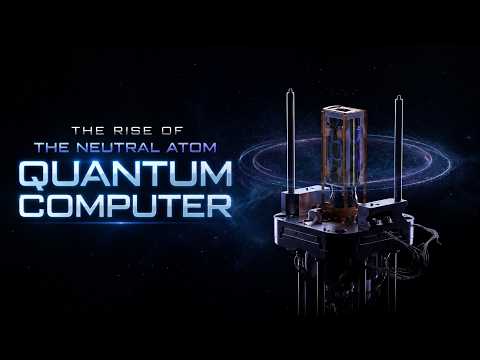
In the dimly lit rooms where cutting-edge technology meets abstract quantum theories, neutral atom quantum computing is quietly yet rapidly redefining the landscape. The historical preference for superconducting circuits and trapped ions was ushered into the mainstream with much fanfare, yet quietly beneath the surface, neutral-atom computing is forging its own formidable path. Its allure? The enticing promise of realizing scalable and fault-tolerant quantum computing is like the unfolding of a delicate, perfectly formed origami, revealing a new geometric wonder.
Based on content from The Quantum Bull
A recent bold claim by QuEra has added tangible excitement to this narrative. By 2028, they plan to introduce a cloud-accessible fault-tolerant quantum computer through their Libra system, in collaboration with Amazon Web Services. Such moves are more than mere milestones; they inadvertently capture the imagination of investors and the technology sector at large, as terms such as “fault tolerance” and “commercialization” transform from distant possibilities into actionable insights.
Let’s take a step back and examine how this architecture integrates the disparate threads of quantum mechanics into a single coherent modality. Neutral atom computing stands apart because of its unique combination: large qubit arrays, desirable microscopic uniformity, dynamic optical reconfigurability, and the luxury of operating at room temperature. It’s akin to composing a symphony where each note is a precisely measured qubit, finely tuned via laser cooling to produce an orchestral harmony of quantum entanglement.
The elegance of laser cooling, in which lasers trap and manipulate atoms’ quantum states, highlights the ingenuity of this approach. By extracting heat—which we might visualize as a frenzied dance of particles—atoms can be slowed into stasis, primed for intricate quantum operations as they transition into a world that dances to the rhythm of probability and entanglement.
As swirling clouds of consideration surround quantum computing methodologies, it becomes necessary to compare neutral atoms to their peer technologies: superconducting circuits boast speed but are burdened with intricate wiring; trapped ions offer elegant coupling but falter in scalability; photonics promises fast networks, yet lacks qubit determinism. Neutral atoms rise as strong contenders, offering a plausible path to modular, data-center-ready quantum solutions. Theirs is a journey rooted in potential and precision.
Startups such as QuEra, Atom Computing, and Pasqal—alongside established names like Google—form the vanguard in this field. They walk the tightrope between ambition and realizable milestones, knitting together public interest and research credibility with each announcement and progress report. Yet, not all efforts are created equal; Infleqtion, for instance, combines different technological elements which could prove critically underappreciated by the market’s current eye.
Neutral atoms, no longer hidden in the niche recesses of quantum exploration, are emerging with clear narratives. They connect theoretical constructs with practical applications across simulation, optimization, hybrid high-performance computing, materials science, chemistry, and beyond. Each advance ripples outward, altering perceptions of what’s possible and urging stakeholders to reconsider where they place their faith—and their funding.
In examining these developments, one must avoid the trap of seeing fault-tolerance as another tick-box on an innovation checklist. It is a beacon toward which the quantum community sails, steering into technical headwinds and past the shoals of doubt. Even as the tides change and companies announce new pathways, each fold in this fabric reveals that neutral atom computing isn’t merely joining a quantum race—it is reshaping its very course.
With each development, the question shifts from if neutral atom quantum computing will become the cornerstone of the quantum revolution to when. As we venture deeper into this decade, the emerging roadmap suggests not a distant dream, but an evolving reality, where quantum capabilities advance from research labs into high-impact realms. For those keeping a pulse on this innovation, the neutral approach promises to be not just another option, but perhaps the very future we’ve been awaiting.
—