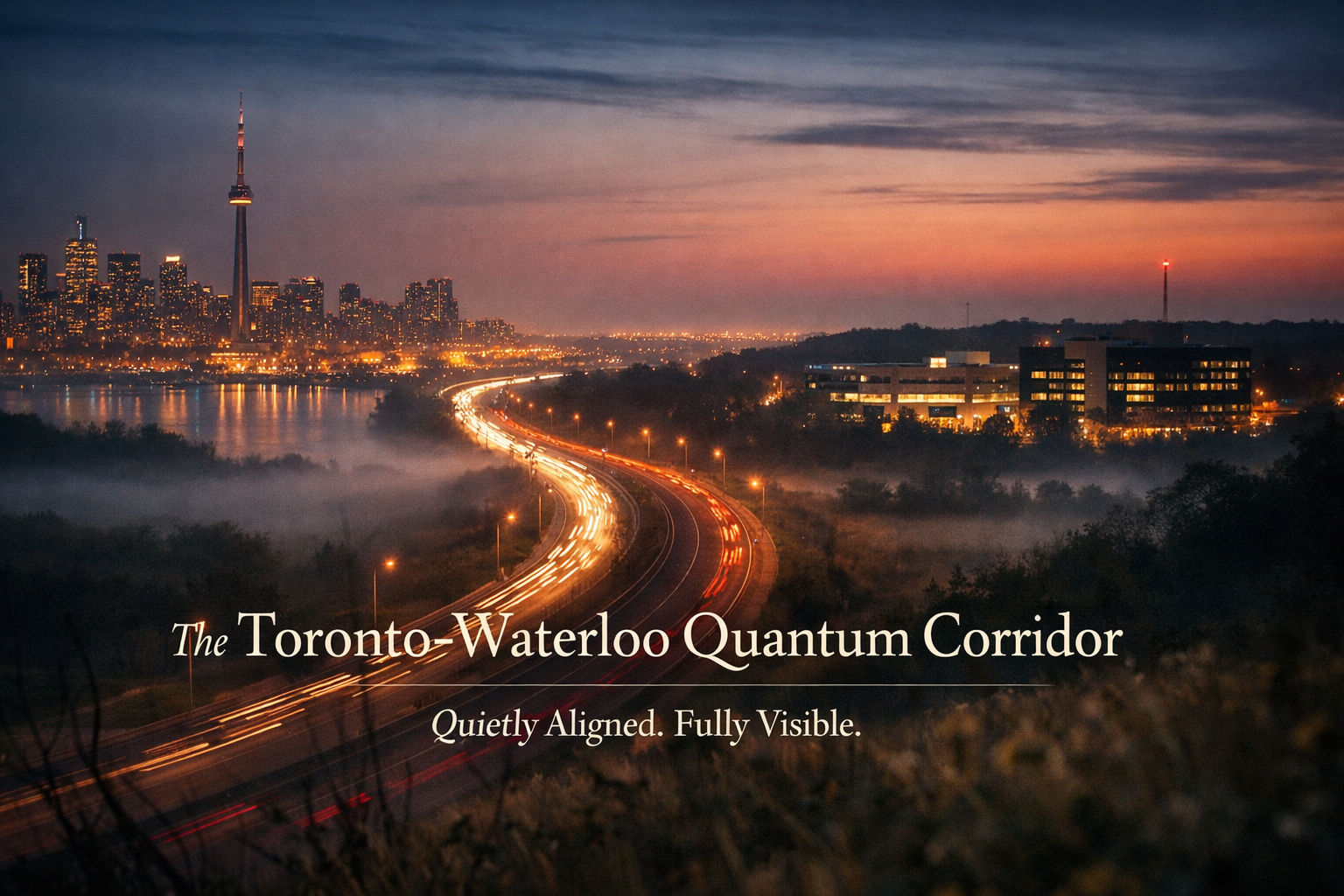
There’s something about a corridor that doesn’t immediately announce itself.
Not in the way a city does: loud, vertical, insisting. This one feels… stitched. A quiet stretch of intention between Toronto and Waterloo. About 110 kilometers, give or take, depending on how you measure distance. Or attention.
View the full interactive report at https://impactquantum.com/Reports/QuantumStartupLandscape/
At first glance, it almost underwhelms. Three companies. That’s all. And there’s a moment where the mind reaches for something larger. More names. More density. Something that feels like proof. But if you stay with it, just a little longer, the shape begins to shift. It isn’t the number. It’s the pattern.
You can feel it in the funding first. Not the total, but the clarity of it. $157.6 million, fully visible. No gaps. No quiet omissions.
There’s something calming about that kind of completeness. Like looking at a map where nothing is smudged or missing. You don’t have to guess where the edges are. You don’t have to fill in the blanks yourself. Most ecosystems don’t give you that. They flicker. Partial disclosures. Numbers that feel more like approximations than signals. Here, the signal holds.
And within it, a center of gravity forms subtly at first, then unmistakably. One company is pulling harder than the others. Not dominating loudly, but anchoring. Giving the corridor weight. Direction. You can almost feel the pull of it, the way people might orbit without realizing they are.
Then there’s the mix. Software, everywhere. Not as a feature, but as a condition. It threads through each company, quietly binding them together. And it changes the feeling of the whole corridor. Because software doesn’t just build; it translates. It softens the edges of something complex, making it usable before it’s fully understood. It creates small points of entry into systems that would otherwise feel impenetrable.
In a space like quantum, that matters more than it first appears. It means the work here isn’t waiting for perfection. It’s already moving.
Hardware is still present. You can sense it beneath the skin, like a structure beneath the skin. Necessary. Foundational. But not the only story being told. And then, almost quietly, there’s security.
Not dominant. A single thread of cryptography woven into the mix. It feels intentional, even if it isn’t framed that way. Because security tends to arrive early in ecosystems like this—not as a final layer, but as a quiet insistence. A reminder that what’s being built will eventually matter enough to protect.
The maturity is what lingers, though. Two out of three companies are operating at the production stage. Not experimenting. Not a circling possibility. Executing. That ratio shifts something internally. You stop thinking of this as a place that might become something. It already has.
And there’s a subtle kind of tension in that realization. Especially if you’re used to ecosystems that live in the future tense. Always becoming. Rarely arriving. This one feels different.
More grounded.
A little quieter.
Less interested in proving itself.
And maybe that’s what makes it easy to miss. Because it doesn’t overwhelm you with scale. It doesn’t flood the map with names. It doesn’t try to win attention through sheer volume. It just… holds its shape.
Three companies.
Full visibility.
A software-defined core.
A maturity profile that leans forward instead of waiting.
It’s enough.
Not in a way that shouts. In a way that settles. There’s a moment, if you sit with it long enough, where the corridor stops feeling like geography. And starts feeling like time. Not early. Not late. Just… aligned. And that’s harder to see. Harder to measure. But once you notice it, it’s difficult to unsee.