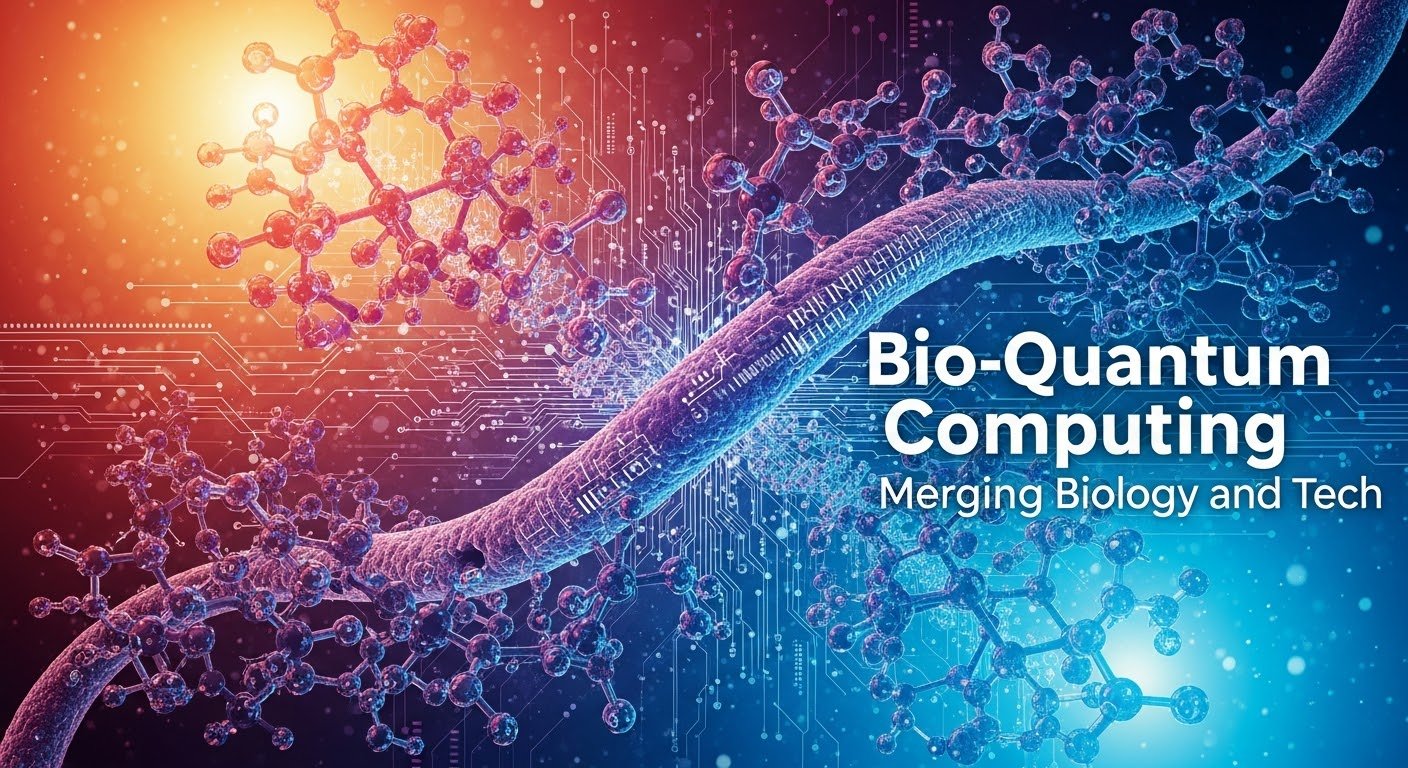
As science approaches understanding life at the quantum level, the boundary between observer and observed, technology and organism, and invention and evolution itself becomes increasingly blurred. Quantum biology has evolved from a fascinating hypothesis to an active research discipline, with billions of dollars in global investment. However, beneath the excitement lies a quieter question: what does it mean when life begins to compute?
We’ve seen this pattern before. Every leap in technology from the printing press to artificial intelligence forces a cultural reckoning about what counts as knowledge, creativity, or even consciousness. Now, as researchers learn to manipulate quantum coherence inside biological systems, the conversation extends beyond code or circuitry. We’re talking about modifying life’s own informational substrate.
The Living Circuit
At the University of Chicago, the 2025 creation of the first “biological qubit,” a protein molecule engineered to hold quantum information inside a living cell, was hailed as a scientific milestone. It also sent a ripple through the bioethics community.
If a cell can process quantum information, is it merely a component in a computer, or is it a new kind of participant in computation? Unlike a silicon chip, a living system evolves. It can adapt, mutate, and respond to its environment. The possibility that biological matter could “think” in quantum terms, entangling and decohering in patterns shaped by evolution, forces us to rethink what agency means in a lab-grown system.
MIT philosopher and cognitive scientist Thomas Poggio once noted that “understanding intelligence may require understanding the physics of life itself.” The inverse may also be true: understanding the physics of life might reveal new forms of intelligence. That realization can inspire awe—or unease—depending on who controls the petri dish.
The Ownership Paradox
In the era of synthetic DNA, data sovereignty was already a complex issue. Add quantum information to living cells, and the boundaries of ownership dissolve even further. Who owns a bio-quantum construct that evolves beyond its initial programming? The researcher? The institution? The organism itself?
Bioinformatics has long relied on massive datasets of genomic information, often sourced from communities with limited consent or benefit. The quantum turn magnifies this ethical tension. If a biological qubit carries both genetic and quantum information, each potentially unique and unpredictable, how do we safeguard privacy, consent, and intellectual property?
Organizations such as the OECD and the U.S. National Quantum Initiative have begun drafting principles for responsible quantum innovation; however, bio-quantum systems present unprecedented challenges. A classical dataset can be copied or deleted. A living quantum system can reproduce, adapt, and perhaps one day decide.
Observers and Participants
Quantum mechanics famously teaches that observation changes the observed. In quantum biology, that principle becomes literal: scientists manipulating coherence in photosynthetic proteins or neuronal tissue are altering the very phenomena they study.
This is not just a technical issue it’s philosophical. When a human experimenter influences a living system’s quantum state, we participate in its informational reality. The observer is no longer separate from the experiment; we become entangled, figuratively and perhaps literally, with the biology we seek to understand.
That realization calls for a new kind of humility. As IBM researcher Talia Gershon recently said in a panel on ethical AI and quantum, “We’re not just building systems that compute; we’re building systems that interact with nature’s own computation.” The shift from control to collaboration could be the defining moral pivot of the next decade.
The Temptation of Control
History shows how easily curiosity turns into conquest. CRISPR began as a bacterial immune defense mechanism; within a few years, it evolved into a billion-dollar gene-editing industry. The risk in bio-quantum research is similar: when quantum coherence in biological systems can be tuned, optimized, or enhanced, the incentive to “upgrade” life becomes almost irresistible.
Imagine engineered microbes capable of quantum sensing, able to detect molecular changes with subatomic precision. Now imagine those microbes escaping containment—or being repurposed for surveillance or defense. Every new quantum capability invites both wonder and weaponization.
That doesn’t mean we halt progress. It means we cultivate ethical foresight equal to our technical ambition. Quantum ethics cannot be retrofitted later, as AI ethics too often has been. It must be embedded from the first equation.
Learning from Nature’s Code
One way forward is to view quantum biology not as an industry to exploit but as a teacher to learn from. Life already operates with astonishing efficiency, coherence, and resilience. Instead of engineering life to fit our computational models, perhaps the moral path is to study how life already computes and to let those lessons guide our design.
Photosynthetic systems, for example, achieve near-perfect energy transfer because of quantum coherence, not despite it. Evolution discovered quantum optimization long before humans did. By understanding those mechanisms respectfully, we may design technologies that coexist with, rather than compete against, biological intelligence.
Toward a Code of Quantum Conduct
Emerging conversations in quantum ethics suggest a few guiding principles:
- Transparency and consent – Living quantum systems derived from natural organisms should be traceable, with open disclosure about origin, purpose, and potential risks.
- Ecological integration – Bio-quantum experiments must consider ecosystem effects, not just lab-scale safety.
- Shared benefit – Quantum biotechnology should advance planetary health and equitable access, not just proprietary advantage.
- Philosophical humility – Researchers must accept that not all quantum biological phenomena will—or should—be fully controlled.
These principles won’t stop misuse, but they can ground a culture of responsibility before the gold rush accelerates.
The Quantum Mirror
Ultimately, quantum biology reflects us to ourselves. It reveals that life’s deepest mechanisms are not deterministic circuits but fluid, probabilistic dances of possibility. In learning to manipulate those dances, we face an old ethical question in a new key: just because we can, does that mean we should?
Perhaps the most profound lesson of quantum life is that intelligence—human or otherwise—emerges not from domination but from coherence, connection, and entanglement. The next generation of quantum scientists may discover that the most advanced computation in the universe was never about control. It was about participation.