Quantum Sensors: The Diagnostic Revolution in Healthcare
Every so often, science gifts us a new lens that changes how we see ourselves. Quantum sensors are one of those gifts—a technology born from the wonderfully strange world of quantum mechanics, where particles can exist in two places at once and dance together across space in perfect sync. It sounds like science fiction, but these principles, superposition and entanglement, are giving rise to a new kind of medical vision: diagnostics that peer into the molecular whispers of disease long before it becomes visible to the human eye.
This isn’t a minor upgrade. It’s a complete reframing of medicine, from reactive to proactive, from “let’s treat what’s gone wrong” to “let’s listen for the earliest murmurs of imbalance.”
The Power of Sensitivity
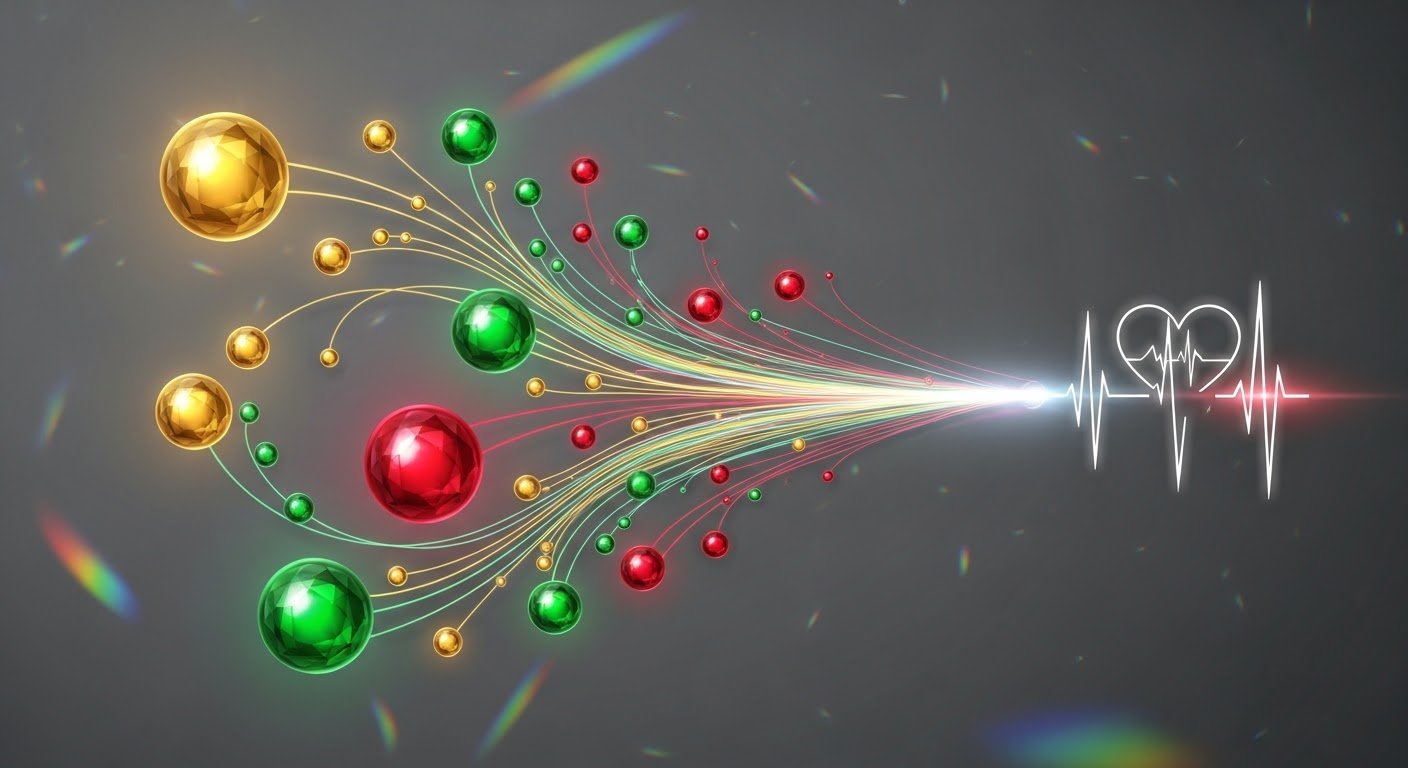
At the heart of this revolution is sensitivity, an almost poetic capacity to feel what was once unfelt. Classical sensors are limited by noise, heat, and the ordinary limits of physics. Quantum sensors, on the other hand, utilize fragile quantum states to detect infinitesimal changes in magnetic fields, temperature, or chemical composition. They can detect what others miss, like hearing a single violin thread its melody through the roar of an orchestra.
One of the most striking examples is found in nitrogen-vacancy (NV) centers, tiny atomic flaws inside diamonds that trap individual electrons. With a flicker of laser light, scientists can read these electrons’ quantum “spins,” which respond to even the faintest magnetic or thermal changes. Imagine it: a diamond so sensitive it can pick up the magnetic sigh of a single molecule.
This level of precision could revolutionize early diagnosis. Quantum biosensors built around NV centers can detect minuscule traces of biomarkers associated with cancer, Alzheimer’s, or heart disease long before symptoms appear. Instead of waiting for visible signs of damage, clinicians could intervene while the disease is still in its early stages, a whisper in the bloodstream. For patients, that means a future where treatment begins in the calm before the storm, not in its aftermath.
Reimagining Medical Imaging
Imaging has always been medicine’s superpower, the ability to look within without breaking the surface. But quantum technology is reshaping that power, making it smaller, sharper, and more humane.
Traditional MRI and MEG machines depend on superconductors cooled to near absolute zero, a logistical and financial nightmare. Enter Optically Pumped Magnetometers (OPMs), a new breed of quantum sensor that uses atomic vapors and polarized laser light to measure magnetic fields with equal or greater precision, all at room temperature.
No more bulky helmets or immobilized patients. OPM-based MEG systems can be worn like a cap, even by children. They allow people to move, talk, and express themselves while their brain activity is recorded in exquisite detail. For researchers and clinicians studying epilepsy, Parkinson’s, autism, or brain injury, that’s transformational. We’re no longer capturing still photos of the mind—we’re filming it in motion.
And this same technology is extending into other realms, including fetal development, heart function, and metabolic activity. It’s like switching from a foggy window to a crystal-clear lens, revealing the subtleties of life in real time.
From the Hospital to the Home
Quantum sensing isn’t confined to high-end labs. Its miniaturization opens the door to something even more revolutionary: continuous, real-world health monitoring.
Imagine wearing a small patch that measures your blood glucose or lactate levels without ever needing to pierce your skin. Or clothing woven with fiber-optic quantum threads that quietly track your heart rhythm or neural activity. Instead of the occasional checkup, your body could offer a constant flow of insight—gentle alerts when something drifts out of balance.
Quantum microscopes are also emerging, capable of visualizing the interior of living cells with molecular precision. By using entangled photons to sharpen their view, they can reveal how drugs interact with cells in real time. Combined with techniques like quantum hyperpolarization, which amplifies faint MRI signals thousands of times, clinicians could watch tumors metabolize and respond to treatment almost instantaneously, eliminating the need to wait months to determine if a therapy is working.
The Road to Reality
Of course, transforming this from laboratory brilliance into everyday healthcare takes time. Quantum sensors must become durable, affordable, and intuitive enough for hospital staff and even home users to handle with confidence. Regulatory pathways are long, and rightly so. But momentum is building fast.
Governments in the U.S., U.K., and across Europe are heavily investing in quantum medical research. Startups and established medical device companies are racing to translate quantum prototypes into portable diagnostics. And here’s where the story gets even more interesting: the fusion of quantum sensing with artificial intelligence.
Quantum devices generate enormous amounts of data: terabytes of subtle, high-dimensional readings from the body. AI is the translator, the one who finds meaning in the noise. Together, they form the foundation for “digital twins,” computational models of individual patients that simulate how organs function, how diseases progress, and how treatments may work before a single dose is administered. It’s the ultimate in personalized medicine: medicine that listens, learns, and adapts in real time.
The Quantum Leap Ahead
At its core, this isn’t just about new machines or measurements. It’s about a shift in perspective. For centuries, medicine has focused on healing what’s broken. Quantum sensing invites us to sense before breaking occurs—to catch the first flicker of imbalance at the atomic scale.
The future of diagnostics won’t be cold or mechanical. It’ll be intimate, continuous, and deeply human—powered by the physics of the tiniest particles, yet serving the largest story of all: our health.
Quantum sensors are moving beyond the lab and into the clinic, hospital, and soon, the home. They promise a world where disease is no longer something we discover too late but something we prevent with quiet precision and compassion.
It’s not just a leap in technology. It’s a leap in empathy—one that could redefine what it means to be well.