There is a very specific moment that happens in technical conversations.
You can almost see it happen in real time.
Someone begins explaining something they genuinely care about. Their hands move a little faster. Their eyes brighten. The ideas begin arriving faster than language can comfortably carry them. The explanation starts simple enough, but then comes the terminology. Then the abstractions. Then the assumptions about prior knowledge.
And suddenly the other person’s face changes.
Their attention doesn’t disappear all at once. It drifts.
A slight pause.
A polite nod.
The eyes soften just enough to signal retreat.
The room is gone.
During a recent episode of the Impact Quantum Podcast, University of Victoria researcher Thomas Baker described this phenomenon perfectly while discussing quantum computing:
“You’ve pretty much lost everybody by the time you get to quantum computing.”
It was funny because it was true. But beneath the humor was something much larger, quietly sitting beneath the entire quantum industry.
Quantum computing does not just have a hardware problem.
It has a communication problem.
And in many ways, that problem may become just as important as the physics itself.
For decades, technical industries have operated under the assumption that the work should speak for itself. If the science is good enough, eventually people will understand. Eventually, adoption will happen, and businesses, governments, and the public will catch up.
But history rarely works that way.
The technologies that shape society are often the ones people can understand emotionally first.
Not fully understand.
Not mathematically understandable.
Not an engineer.
Understand emotionally.
The Internet succeeded because people understood the connection.
Smartphones succeeded because people understood convenience.
Artificial intelligence exploded because people immediately understood its leverage, speed, and potential for replacement.
Quantum computing is different.
Most people cannot anchor quantum concepts to everyday experience. There is no intuitive emotional reference point for superposition or entanglement. Even the language sounds distant from ordinary life. The terminology itself creates friction before the conversation even begins.
Quantum mechanics already carries decades of cultural baggage. The public associates it with paradoxes, science fiction, impossible mathematics, and vague philosophical mystery. Somewhere along the way, quantum became synonymous with “too complicated for normal people.”
That perception matters more than many researchers realize.
Because industries are not built entirely on breakthroughs.
They are built on trust.
And trust is built through understanding.
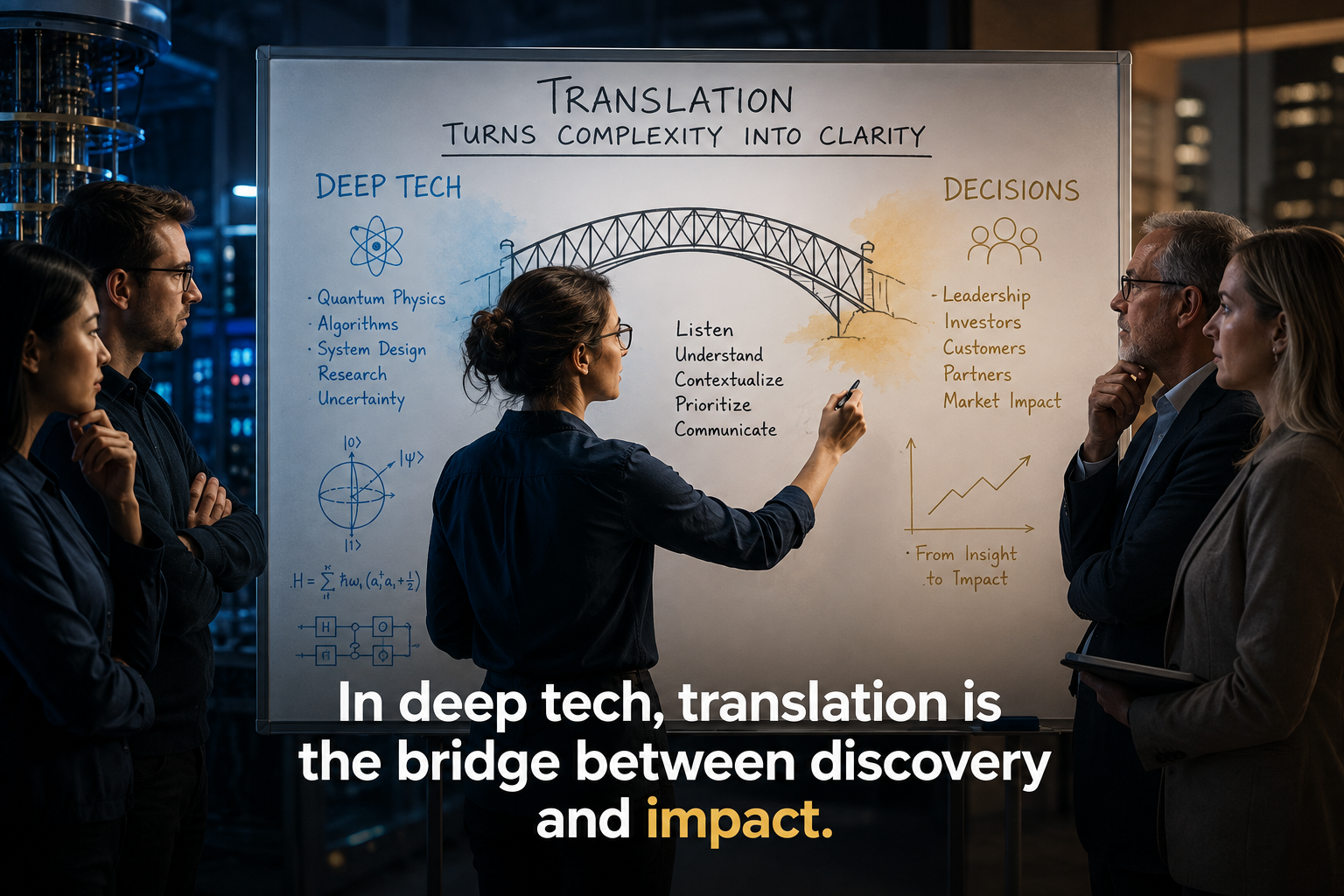
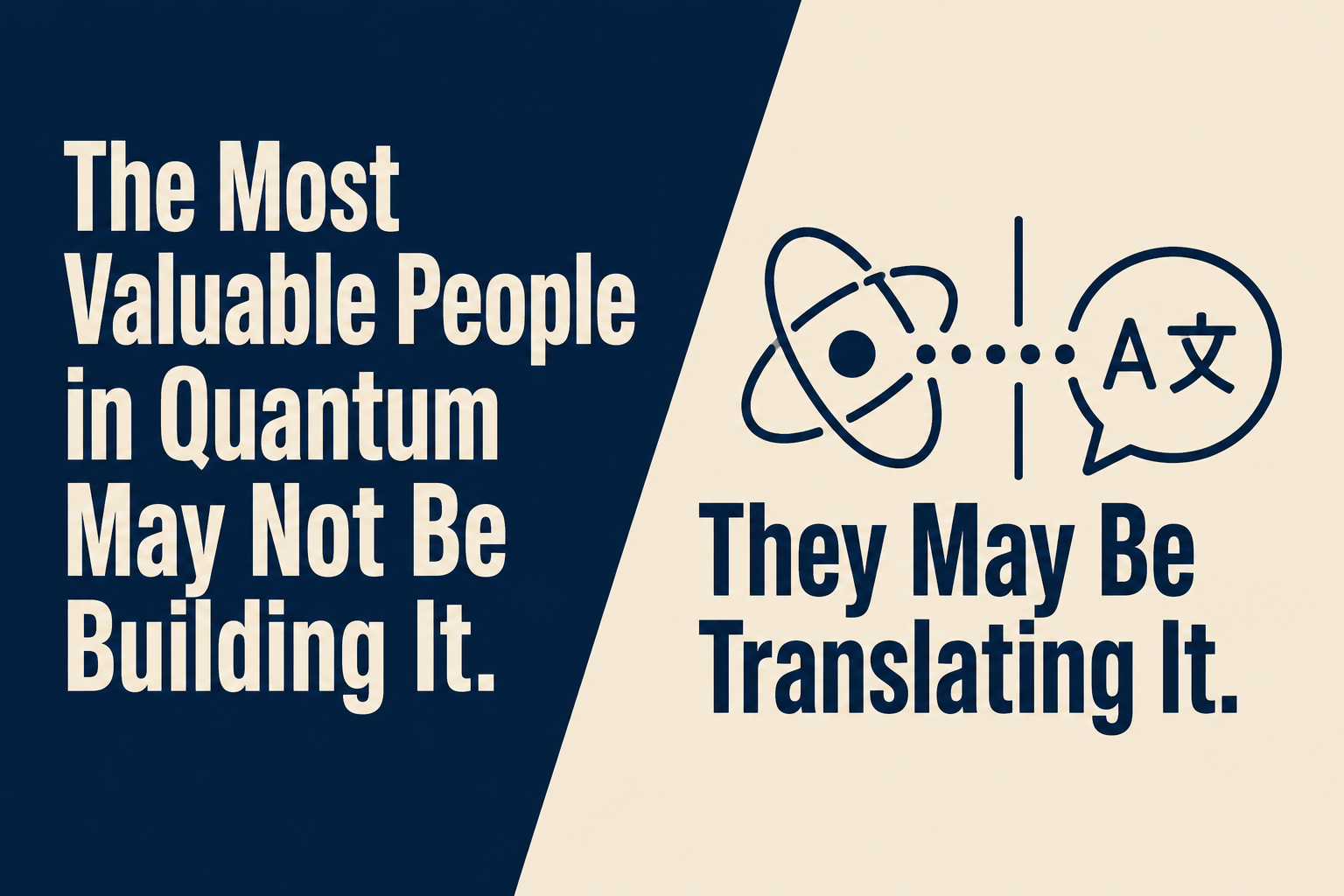
This is where the quantum industry finds itself in an unusual position. The field does not simply need physicists, engineers, mathematicians, and computer scientists. It needs translators.
Not translators in the literal language sense.
Human translators.
People capable of standing between complexity and clarity without destroying the integrity of either.
That is much harder than simplification alone.
Oversimplification can be dangerous in quantum because it creates hype cycles detached from reality. We have already seen this happen repeatedly over the last several years. Headlines promising broken encryption overnight. Claims of instant revolutions. Sensationalism replacing nuance.
The result is often confusion instead of adoption.
People either become intimidated by quantum computing or suspicious of it.
Sometimes both.
Good translation avoids both extremes.
The best communicators in deep technology do something subtler. They reduce emotional friction before they reduce technical complexity. They create familiarity first.
Thomas Baker did exactly this during the conversation.
Instead of opening with quantum mechanics, he began with something everyone already understands: ordinary computers. Phones. Everyday devices. From there, he gently shifted into the idea that quantum computers operate differently because they use properties of physics itself to compute information.
The brilliance of that explanation was not technical.
It was psychological.
He gave listeners somewhere safe to stand before asking them to walk further into abstraction.
That matters enormously.
Because most people are not afraid of intelligence.
They are afraid of feeling stupid.
Technical communication often fails because experts unconsciously optimize for precision instead of connection. They forget what it feels like not to know the vocabulary. They forget the emotional experience of entering a new domain for the first time.
Quantum computing amplifies this problem because the field itself is inherently interdisciplinary. Physics, mathematics, chemistry, materials science, computer science, engineering, cryptography, and increasingly AI all intersect inside the same ecosystem.
Even researchers within quantum physics often struggle to communicate across subfields.
So, expecting the public to instantly understand it was never realistic.
And yet this communication gap may ultimately determine which companies, institutions, and countries emerge as leaders in the next decade.
Because commercialization requires comprehension.
Investors need to understand enough to deploy capital intelligently.
Policymakers need to understand enough to regulate and fund responsibly.
Students need to understand enough to imagine themselves entering the field.
Businesses need to understand enough to recognize where quantum may actually create value.
Without translation, adoption slows.
The irony is that quantum computing may eventually become invisible in the same way classical computing became invisible.
Most people using cloud infrastructure today do not understand semiconductor fabrication, transistor physics, distributed systems, or memory architecture. They simply use the tools because someone successfully translated complexity into utility.
That is the future that quantum computing is moving toward.
Not endless public fascination with qubits.
Usability.
Integration.
Quiet infrastructure.
The moment technology becomes ordinary is often the moment it becomes truly transformative.
But to reach that point, the industry must first survive this transitional phase, in which the science remains difficult, business models are still forming, and public understanding lags behind technological progress.
This is where translators become essential.
Not as marketers spinning narratives disconnected from reality.
But as bridge-builders.
People capable of preserving scientific rigor while making the ideas emotionally accessible. People who understand that communication itself is infrastructure. People who can move between technical depth and human understanding without diminishing either side.
The quantum industry is beginning to realize this.
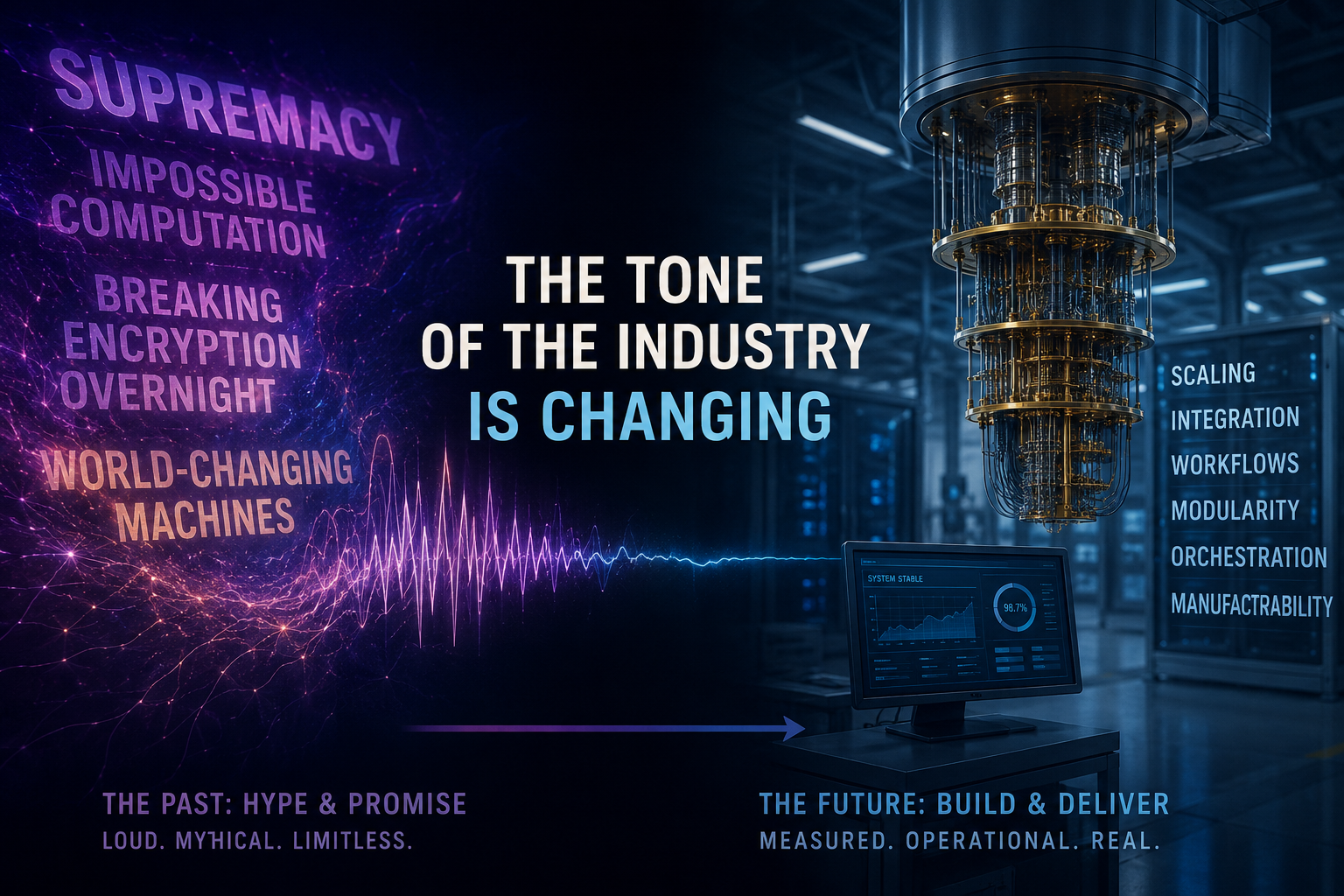
You can hear it in the language shift already happening across the ecosystem. Conversations are becoming less mythological and more operational. Less focused on impossible futures and more focused on workflows, chemistry, sensing, optimization, infrastructure, and integration.
The field is maturing.
And with maturity comes a different challenge.
Not merely building quantum systems.
Building understanding around them.
Because eventually the winning companies may not simply be the ones with the most stable qubits or the most scalable architectures.
They may also be the ones who can explain why any of it matters in the first place.
And somewhere inside that realization is a quieter truth that extends far beyond quantum computing itself.
Most breakthroughs are not rejected because people hate innovation.
They are rejected because people do not yet know where to place them inside their understanding of the world.
That moment when the room disappears halfway through an explanation is not failure.
It is a signal.
An invitation to communicate differently.
Listen to the full episode here: https://player.captivate.fm/episode/7bb8aef7-c917-4e32-90f8-cbeab9dc7adc