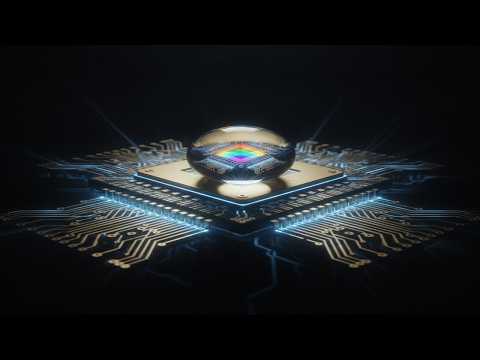
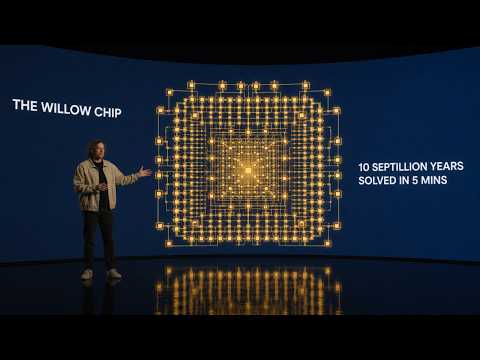
There’s a moment early in the video where the question isn’t really technical.
It sounds simple—what is quantum computing? But underneath it sits something heavier. Not just what it is, but what it might quietly rearrange.
The explanation begins where most of these conversations do: with bits. The small, familiar language of classical computing. Ones and zeros. Certainty. Either/or.
And then, almost gently, that certainty starts to loosen.
Quantum computing introduces something that doesn’t behave the way we expect. Instead of choosing between one or zero, a quantum bit—a qubit—can exist in multiple states at once.
At first, it sounds like a trick of language. A clever abstraction.
But if you sit with it a little longer, it feels more like a shift in how reality itself is being handled. Not simplified. Not reduced. But allowed to remain complex.
Where the explanation becomes something else
The video moves through familiar ideas—superposition, entanglement—but there’s a subtle transition that happens without being announced.
It stops being about definitions.
And starts becoming about possibility.
Because when a system can hold multiple states simultaneously, it doesn’t just calculate faster. It explores differently. Problems that would take classical systems years to brute-force can, in theory, be approached in parallel—like walking multiple paths at once instead of choosing just one.
And that’s where something quiet but important begins to emerge.
This isn’t just about speed.
It’s about how problems are approached at all.
The part that’s easy to overlook
There’s a line of thought in the video that could pass by quickly if you’re listening for conclusions instead of patterns.
Quantum computing is still in its early stages.
Still unstable.
Still, in many ways, not ready for broad, everyday use.
But the fact that it’s being built anyway—that countries, institutions, and companies are investing in it now—suggests something else entirely.
This isn’t reactive.
It’s anticipatory.
There’s a kind of patience embedded in that. A willingness to build something before its full shape is visible.
And if you’ve ever worked in spaces where clarity doesn’t come all at once—where you move forward with partial understanding—that feeling is familiar.
Uncomfortable, but also… necessary.
A quieter shift: from understanding to positioning
One of the more grounded moments in the video comes when it references real-world movement—India’s growing interest in quantum systems and the inauguration of new infrastructure.
At first, it reads like progress. Development. Expansion.
But if you sit with it a little longer, it begins to feel more like positioning.
Because quantum computing isn’t just a tool waiting to be used. It’s something that reshapes the systems around it—security, materials science, pharmaceuticals, optimization.
And when something has that kind of reach, the question becomes less about what it does…
and more about who has access to it first.
The tension between clarity and complexity
There’s a quiet friction running through the entire explanation.
On one side, there’s the desire to make quantum computing understandable. To break it down into analogies, to make it feel approachable.
On the other hand, there’s the reality that it doesn’t fully translate.
Quantum systems don’t behave intuitively. They resist simplification. The more you try to pin them down into classical thinking, the more something essential slips away.
And that tension feels familiar in a different way.
Because it mirrors how some people process the world—not linearly, not step-by-step, but in layers. Holding multiple possibilities at once. Seeing patterns before they’re fully formed.
There’s a kind of thinking that doesn’t rush toward resolution.
It stays with the ambiguity a little longer.
And strangely, that kind of thinking feels aligned with what quantum systems require.
What changes—and what doesn’t
The video leans into the idea that quantum computing could transform industries: cryptography, medicine, and logistics.
And that’s true.
But what it doesn’t say directly—and what lingers—is that transformation rarely arrives all at once.
It accumulates.
Quietly.
First in research labs. Then in hybrid systems. Then, in niche applications, the advantage becomes undeniable.
And only later, when you look back, does it feel like a shift.
Not because it was loud.
But because it was steady.
The human layer inside the machine
There’s something else sitting underneath all of this that doesn’t get stated explicitly.
Quantum computing is often framed as something beyond human intuition. Too complex. Too abstract.
But it’s still being built by people.
People who are learning how to work within uncertainty. Who are designing systems that don’t behave predictably? Who are navigating error rates, decoherence, and instability—concepts that don’t resolve neatly.
And there’s something quietly human about that.
Because it reflects the way we already experience complexity in other parts of life. Not everything is binary. Not everything resolves cleanly. Sometimes the work is simply learning how to stay with something long enough for it to make sense.
Or to realize that it won’t.
And to move forward anyway.
What this really leaves you with
By the end of the video, the technical explanation is there. The definitions, the potential applications, the trajectory.
But what stays isn’t the mechanics.
It’s the feeling that something foundational is shifting—not abruptly, not dramatically, but in a way that’s already underway.
Quantum computing doesn’t arrive as a single breakthrough moment.
It emerges through layers.
Through investments that seem early.
Through systems that seem incomplete.
Through conversations that don’t quite resolve.
And maybe that’s the point.
Because the future of computing, like the systems themselves, isn’t settling into one clear state.
It’s holding multiple possibilities at once.
And we’re learning—slowly, unevenly—how to exist inside that.
Not by forcing clarity too quickly.
But by recognizing that sometimes, the most important shifts don’t announce themselves.
They just… begin.