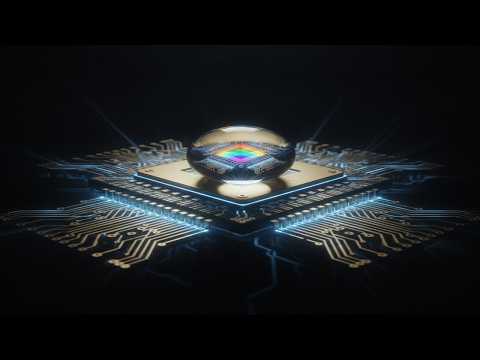
Stanford University’s recent breakthrough in quantum computing has the tech world buzzing with potential. By constructing a ‘house of mirrors’ around a single atom, they’ve managed to capture light one photon at a time, a move that might just be the key to unlocking computers with a million quantum bits or qubits.
Back in September 2025, a significant milestone was reached when Caltech assembled a vast array of 6,100 qubits. While stabilizing these qubits was a massive achievement, a hidden obstacle persisted: reading them efficiently. Stanford’s innovative optical cavity array now reads all qubits simultaneously, offering a new path forward for the field.
Based on content from Julia McCoy
The Readout Wall: A Decades-Old Barrier
The readout wall has been a longstanding barrier in quantum computing. Built to scale, Caltech’s assembly of qubits faced a monumental challenge. Without the ability to read information from these qubits swiftly and simultaneously, even the most polished quantum machines become expensive paperweights. The difficulty lies in catching the light atoms emit, dispersed in unpredictable directions.
Introducing Microlenses: Reducing Light Bounces
Stanford’s team ingeniously created miniature optical cavities, resembling a funhouse mirror setup, placing single atoms inside. These cavities incorporate specialized microlenses that narrowly focus light onto an atom. Traditional methods involved bouncing light numerous times to extract information, but this novel approach minimizes the bouncing, enhancing efficiency remarkably.
With arrays of 40 to over 500 such cavities, Stanford demonstrated a prototype capable of reading each quantum bit in parallel, a feat previously deemed impractical. This breakthrough enables the potential expansion of the technology to handle tens of thousands of qubits, eventually paving the way for million-qubit machines.
From Lab to Market
This breakthrough is not mere theoretical work. With patent disclosures indicating quick movement from lab to commercial application, Stanford researchers, including John Simon and Adam Shaw, are already gearing up for market integration. Their approach could revolutionize not just computing, but also other fields like biosensing, microscopy, and even astronomy, leading to telescopes that might let us observe planets around distant stars directly.
Stanford’s accomplishment isn’t just about surpassing what supercomputers do today over thousands of years. It embodies humanity’s pursuit to bend light at a quantum level, revealing deeper insights into our universe long veiled in mystery.
In the words of Adam Shaw, “As we learn to manipulate light at a singular particle level, it will transform our ability to see the world.” This sentiment emphasizes the dual nature of such technology—not to overshadow life’s wonder, but to enhance and deepen it.
This is just one chapter of a larger narrative where we use tools to unlock deeper understandings of our world. So what comes next? Watch as these scientific breakthroughs continuously transform our understanding of the universe and the tools that we use to explore it.