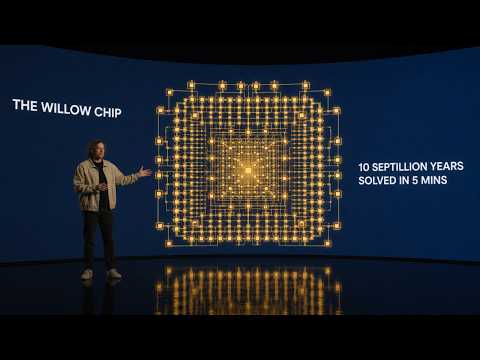
Picture a chip, no larger than the palm of your hand, performing a calculation in under five minutes that would require the world’s fastest supercomputer 10 septillion years to complete—a number so vast that it stretches our comprehension beyond familiar cosmic timelines. Meet Willow, Google’s latest leap in the landscape of quantum computing.
Based on content from Untold space file
But what does that mean, really? To understand, let’s resist the gravitational pull of sensational headlines suggesting multiverses, and instead ground ourselves in the tangible advances happening within Google’s quantum labs.
The Core of the Breakthrough
Introduced in December 2024, Willow represents a significant milestone, not just for Google, but for the field of quantum computing at large. With 105 superconducting transmon qubits, Willow surpasses its predecessors in both qubit count and coherence time. This latter enhancement is crucial—longer coherence times mean more stability for qubits, allowing complex computations to complete while remaining accurate.
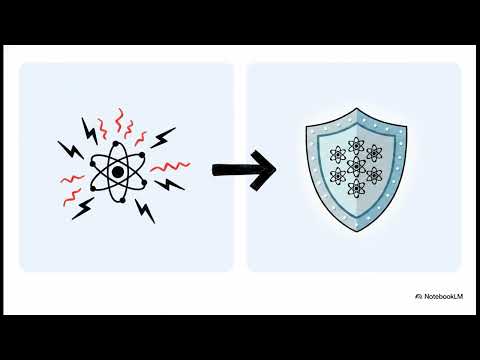
Yet, the real turning point lies in the realm of quantum error correction. Google’s researchers have pieced together a puzzle that specialists have grappled with for decades. The concept is rooted in addressing the fragility of qubits—these quantum bits are notoriously sensitive, prone to errors through interference from the slightest environmental noise.
Below Threshold Error Correction: A Quiet Revolution
The task of integrating more qubits has historically compounded these errors. However, Willow has inverted this challenge. It demonstrated for the first time that in scaling up the number of qubits for error correction, the error rate didn’t balloon; instead, it decreased exponentially. This new below threshold regime transforms how scientists approach quantum computing, creating a roadmap towards a fault-tolerant quantum computer capable of practical applications in AI, cryptography, and beyond.
Professor Javad Shabbani from New York University remarked on this as one of the standout advancements of its decade. It draws a line in the quantum sand, demarcating proof-of-concept engineering from tools of pragmatic potential.
Into Speculative Territories: Many Worlds
The crinkle that caught mainstream intrigue comes from Willow’s performance and Hartmut Neven’s hypothesis. Neven, head of Google Quantum AI, speculated that such rapid computation lends weight to the Many Worlds Interpretation—a theory positing that each quantum event splinters reality into various simultaneous universes.
The scientific community’s reaction was mixed, highlighting a perennial clash between imagination and empirical solidity. As captivating as parallel universes might be, their existence is far from confirmed by this achievement and remains a hypothesis amid several interpretations of quantum mechanics.
Quantum Echoes and A Broader Horizon
Post-Willow, Google continues its quantum journey with new strides. In 2025, an algorithm named Quantum Echoes achieved a 13,000x speed increase for specific tasks. This underscores a shift in strategy: a dual approach combining superconducting circuits and novel neutral atom qubits to diversify their path to fault-tolerant computing.
Why this matters transcends any single company or theory. It marks quantum computing’s maturing beyond theoretical exercises and niche demonstrations toward becoming an indispensable tool for solving some of our most perplexing computational challenges.
A Future Gazing Forward
The narrative isn’t just about quantum supremacy or potential multiverses; it’s the tangible reality of foundational science moving painstakingly from theory to impactful science. For these reasons, Google’s continuing exploration—plausibly complementary with IBM, IonQ, and various startups—renders the future exhilaratingly open.
As you reflect on this, deliberate over where the fusion of practical engineering and theoretical curiosity might lead. Can quantum computing illuminate paths for unraveling today’s complex riddles, or perhaps, something even more unimaginable awaits?
—