In the quiet, sterile corridors of modern physics labs, there’s a particular kind of moment I’ve learned to watch for.
It’s the moment when something that once sounded like science fiction quietly crosses the line into engineering reality.
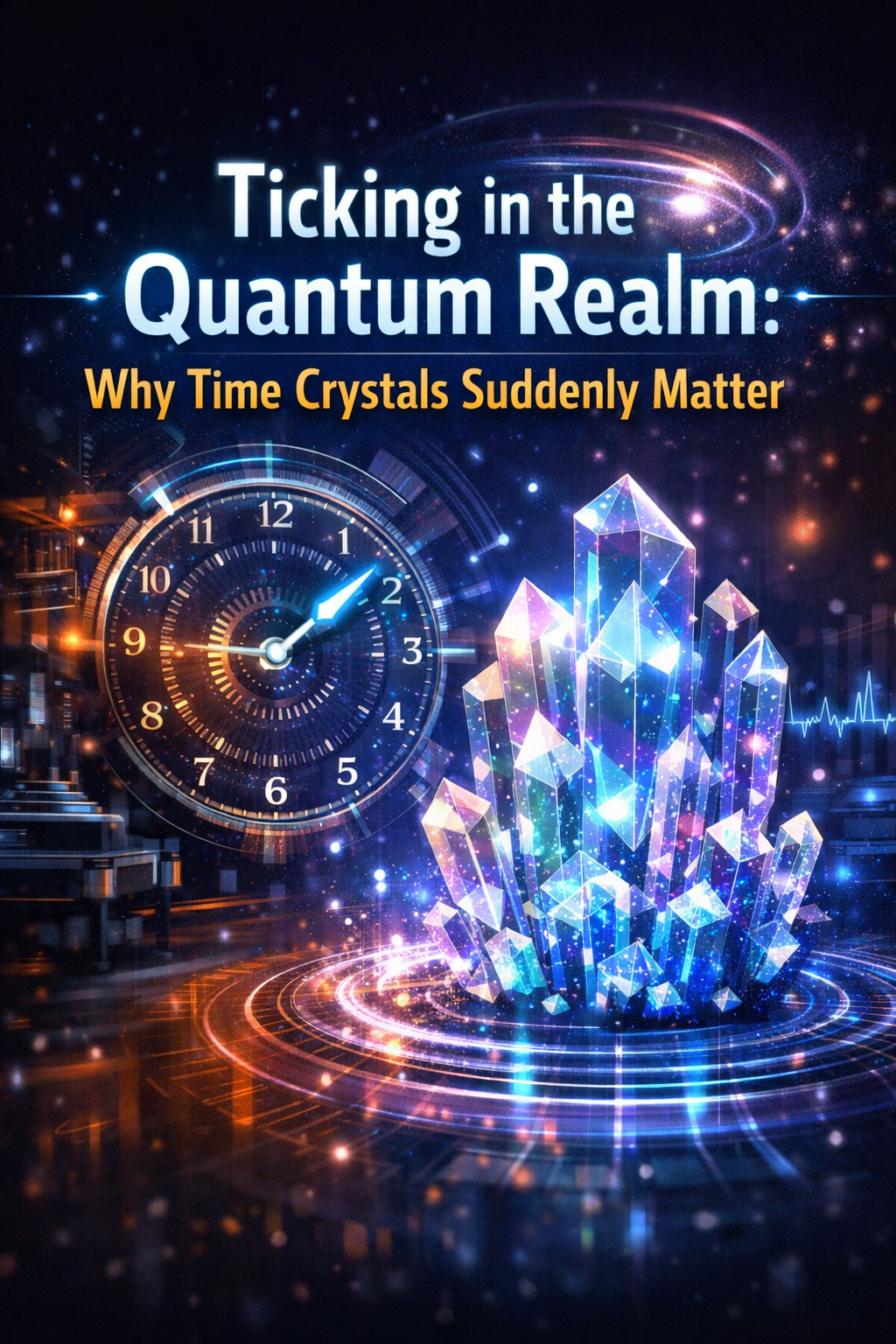
Time crystals have just had one of those moments.
For years, the idea lived mostly in theory, a mathematical ghost first proposed by Nobel laureate Frank Wilczek back in 2012. It was one of those concepts that made physicists lean in, and skeptics lean back. Because on the surface, a structure that repeats in time, not just space, sounds suspiciously like it is poking the laws of thermodynamics in the eye.
But according to recent reporting highlighted by Popular Mechanics, researchers have now created a time crystal with unprecedented detail, pushing this exotic phase of matter into its clearest experimental focus yet.
And if you’re watching the quantum ecosystem closely, as we do at Impact Quantum, this is not just a curiosity. It is a signal.
The Architecture of the (Previously) Impossible
Let’s ground this for a second.
When most of us think about crystals, diamonds, salt, and quartz, we are really thinking about order in space. Atoms are arranged in neat, repeating patterns across three dimensions.
A time crystal keeps the spatial order and then does something wild.
It repeats in time.
Instead of a static lattice, you get a system that naturally oscillates in a stable, repeating rhythm, even in its lowest energy state. No battery. No winding. No external “keep going” push in the classical sense.
If your first reaction is, Wait, isn’t that just perpetual motion? You are not alone. That was the early skepticism, too.
But here is the subtle and very quantum, truth.
Time crystals do not generate energy.
They simply refuse to settle into stillness.
They exist in a kind of locked, rhythmic motion that does not violate the laws of thermodynamics. It just lives in a corner of physics that we are only now learning how to engineer.
From Physics Curiosity to Quantum Hardware Reality
What makes this latest milestone different, and why my antenna went up, is the shift from fragile demonstration to high-fidelity control.
Earlier time crystal experiments were, let’s be honest, a bit delicate. Small systems. Short lifetimes. Prone to “melting” back into disorder after only a few cycles.
This new work changes the texture of the conversation.
Using advanced quantum simulations and real quantum hardware platforms, including systems from IBM Quantum, researchers built a discrete-time crystal from interacting qubits and drove it with precisely calibrated pulse sequences.
Here is the magic detail.
The system responded at a different frequency than the driving pulses.
That is the hallmark of true time crystalline behavior.
Think of pushing a swing once every second, but the swing completes its full motion every two seconds, perfectly, predictably, and indefinitely. The system has its own internal rhythm that refuses to simply mirror the outside world.
That is not just clever physics.
That is emergent quantum order.
Seeing the Gears, Not Just the Tick
What really elevates this breakthrough is the phrase that keeps coming up, unprecedented detail.
For the first time, researchers were not just observing the surface tick of the time crystal. They were able to track the internal dynamics of many interacting quantum particles at once, watching the microscopic choreography that keeps the system locked in rhythm.
And this matters more than it might seem.
Because one of the biggest open questions around time crystals has been stability in the messy, noisy reality of actual quantum hardware. It is one thing to demonstrate exotic phases in pristine theory. It is another to keep them alive inside real devices.
In this case, the team demonstrated that the time crystal maintained its internal beat even under realistic noise and hardware constraints.
Translation for the Impact Quantum crowd.
We are moving from the physics demo to the engineering pathway.
Why This Quietly Matters for Quantum Tech
Now, before anyone starts imagining time travel headlines, the real implications here are much more grounded and arguably more powerful.
Time crystals are interesting because they are naturally robust oscillators. And in the quantum world, stability is everything.
Two areas where this could matter.
1. Quantum memory
Quantum information is notoriously fragile. If time-crystalline phases can help store or stabilize quantum states, they could become part of the architecture of more resilient quantum systems.
2. Next generation timekeeping
Atomic clocks currently underpin GPS, telecom, and global synchronization. But systems based on ultra-stable quantum oscillations, including time crystals, could eventually push precision even further.
We are not there yet.
But the direction of travel is getting clearer.
Expanding the Map of Matter
Zooming out, this moment is about something bigger than one exotic experiment.
For decades, we taught the canonical phases of matter: solid, liquid, gas, plasma. Then came topological phases, Bose-Einstein condensates, and other quantum surprises that kept stretching the map.
Time crystals add another reminder.
Nature still has undiscovered neighborhoods.
Phases of matter that do not just sit in space
but live through time.
And what strikes me most, wearing my Impact Quantum lens, is how quickly the field is shifting from “is this real?” to “how precisely can we control it?”
That is always the inflection point to watch.
Because the moment physics becomes engineerable, the roadmap to real technology quietly begins to draw itself.
And somewhere inside a carefully pulsed array of qubits, a tiny quantum system is already keeping time in a way we once thought impossible.
Tick by tick.