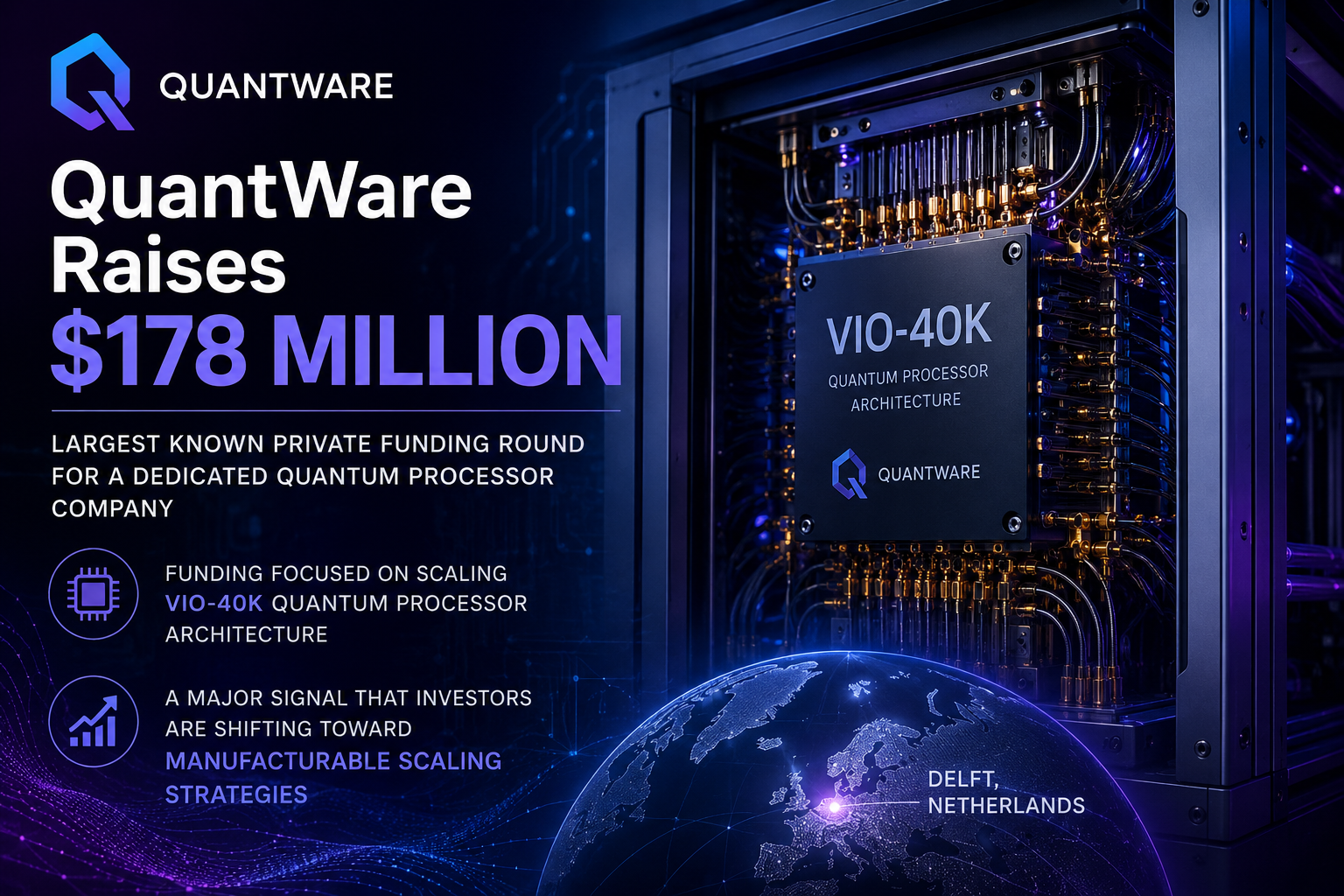
QuantWare raised $178 million in what is being described as the largest private funding round ever for a dedicated quantum processor company. The funding is centered on scaling the company’s VIO-40K architecture, a modular system designed to push quantum processors toward much larger qubit counts without collapsing under the physical realities that emerge at scale.
And that last part matters more than people realize.
Because the real challenge in quantum computing is no longer proving that qubits can exist.
The challenge is manufacturing.
Something strangely familiar is happening in the quantum industry right now. The field is beginning to resemble the semiconductor industry decades ago, when the conversation shifted away from theoretical possibility and toward fabrication yield, reliability, packaging, heat management, interconnects, and production consistency.
The emotional texture changes when an industry enters that phase.
It becomes less mystical.
More operational.
For years, quantum computing lived comfortably inside abstraction. It was a technology that could still survive on future potential because most people outside the field understood only fragments of what it actually required to function. The language itself created distance:
superposition,
entanglement,
decoherence,
error correction.
Beautiful words. Difficult words.
But underneath all the physics is an engineering problem that becomes brutally physical very quickly.
Quantum systems are fragile. Extremely fragile.
The moment researchers attempt to scale them, new problems emerge almost immediately:
noise,
signal degradation,
cooling complexity,
fabrication inconsistencies,
control wiring density,
cross-talk between qubits,
and the sheer nightmare of maintaining coherence across larger systems.
Adding qubits is not like adding memory to a laptop.
It is closer to balancing spinning glass sculptures in the middle of an earthquake.
Which is why QuantWare’s funding round feels important beyond the number itself.
The investment signals that the market is beginning to prioritize manufacturable scaling strategies instead of purely experimental milestones.
That distinction is subtle, but enormous.
The company’s VIO-40K architecture is built around modular scaling principles. Rather than constructing a single monolithic quantum processor that becomes increasingly difficult to stabilize and manufacture, the architecture focuses on interconnected modules that scale more realistically over time.
In many ways, this mirrors what happened in classical computing.
Eventually, the future stopped belonging solely to single gigantic processors. It moved toward distributed systems, modular architectures, parallelization, networking layers, and scalable infrastructure.
Quantum appears to be drifting toward the same reality.
And honestly, that makes the field feel more believable.
There is a peculiar moment in emerging technologies when investors stop chasing spectacle and start chasing infrastructure. You can feel it happening now across quantum computing globally.
A few years ago, the industry rewarded theoretical breakthroughs almost exclusively. Investors wanted the future in its purest form:
fault-tolerant quantum computers,
millions of qubits,
world-changing disruption.
Now the questions sound different.
How do you repeatedly manufacture these systems?
How do you scale them economically?
How do you integrate them into existing compute environments?
How do you reduce engineering friction?
How do you create systems that survive outside pristine laboratory conditions?
Those are industrial questions.
And industrial questions tend to arrive when an industry begins transitioning from scientific curiosity into infrastructure development.
There is also another layer beneath this funding round that feels significant.
Europe is becoming increasingly assertive in quantum infrastructure.
For a long time, conversations around quantum computing often centered heavily on the United States and China. But Europe has quietly built a remarkably serious ecosystem across the Netherlands, Germany, Finland, France, Switzerland, and the United Kingdom.
What is interesting is that many European quantum companies seem especially focused on engineering pragmatism.
Not only ambitious science.
Operational science.
Manufacturing science.
Systems science.
The kind of work that rarely produces viral headlines but often determines who survives long term.
And survival matters in quantum right now because the field is entering an awkward middle stage.
The technology is no longer hypothetical enough to live entirely inside research grants and optimism. But it is also not mature enough yet to deliver widespread commercial transformation at scale.
That middle territory is uncomfortable.
It creates pressure.
Companies now have to prove not only that their hardware works, but that it can eventually become economically viable, manufacturable, maintainable, and integrated into real-world workflows.
That is a much harder story to tell investors.
Which is why a $178 million funding round becomes psychologically important for the industry itself.
It tells the broader market that there is still institutional belief in long-term quantum infrastructure despite the noise, skepticism, and inevitable hype fatigue that have begun to surround the sector.
And the timing is important.
Because quantum computing is slowly entering a phase where progress becomes less visually dramatic but far more technically meaningful.
A new qubit record is easy to explain in a headline.
A manufacturable modular architecture is harder.
But the second may matter far more than the first.
There is also something fascinating about how quantum conversations are changing culturally.
The field used to sound almost cinematic. People talked about quantum computing as a magical machine that would emerge fully formed and suddenly replace classical computing overnight.
That narrative is fading.
Instead, the future increasingly looks hybrid.
Quantum systems, besides classical supercomputers.
AI is integrated into quantum workflows.
Specialized accelerators handling niche computational problems.
Distributed architectures instead of singular machines.
Messier.
More layered.
More realistic.
And perhaps because of that, more credible.
The deeper truth underneath QuantWare’s funding round is not simply that investors believe in quantum computing.
Investors are beginning to believe in the industrialization of quantum computing.
Those are not the same thing.
Believing in quantum theory is easy now. Science has already crossed that threshold.
Believing in scalable infrastructure is harder.
Infrastructure requires patience. Supply chains. Engineering discipline. Manufacturing consistency. Operational realism. Long timelines. Physical resilience.
It requires moving beyond the seduction of possibility and into the far less glamorous work of building systems that can survive contact with reality.
And oddly enough, that may be the clearest sign yet that quantum computing is beginning to grow up.