There is a moment when a technology company stops feeling like a startup and starts feeling like infrastructure. It becomes harder to describe in a single sentence. The edges blur outward. New acquisitions appear. Adjacent systems begin to attach themselves to the core business almost organically, like roots searching for water beneath concrete.
That is increasingly how IonQ feels.
For years, the company was primarily discussed through the narrow lens of quantum hardware. Trapped-ion systems. Qubit fidelity. Gate performance. Benchmark numbers. The usual language that surrounds quantum computing companies trying to prove they belong in a race that still feels partially undefined.
But something shifted this week.
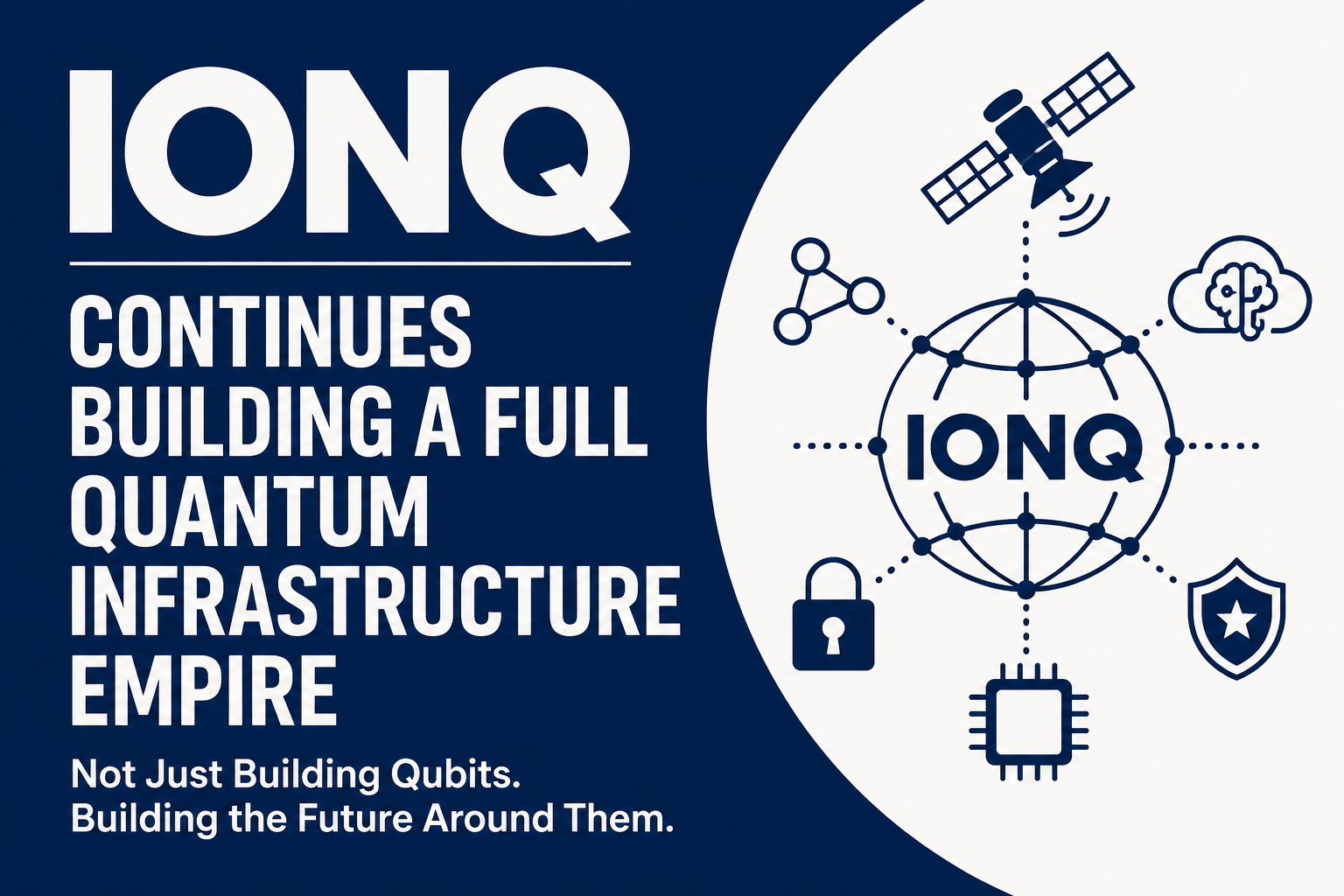
IonQ moved aggressively across networking, AI infrastructure, communications, and defense-oriented positioning in a way that no longer resembles a company simply trying to build a better quantum processor. Instead, it resembles a company assembling an ecosystem around quantum before the broader industry fully realizes that ecosystems may matter more than hardware alone.
Several developments stood out simultaneously.
The company completed its acquisition of Skyloom, expanding into space-based optical networking. It deepened AI-driven infrastructure scaling efforts through Seed Innovations. It continued to push into quantum-secure communications while strengthening its position in sovereign and defense-related infrastructure discussions.
Individually, each move sounds strategic.
Together, they reveal something larger.
IonQ no longer behaves like a pure quantum hardware company.
It behaves like an infrastructure company.
And that distinction may end up defining the next decade of the quantum industry.
There is a tendency in emerging technology fields to focus obsessively on the visible layer. The processor. The chip. The benchmark. The headline number. But history suggests that the companies shaping entire industries are often the ones building the connective tissue underneath everything else.
Cloud computing was never just about servers.
It became:
networking
distributed orchestration
data centers
security layers
developer tooling
communications infrastructure
global deployment systems
The processor mattered, of course. But infrastructure ecosystems became the true moat.
Quantum computing may be approaching the same realization.
What feels fascinating about IonQ’s recent direction is how intentionally broad the strategy appears. Communications. Photonics. Satellites. AI orchestration. Manufacturing pipelines. Networking infrastructure. Defense positioning. These are not isolated experiments. They are layers.
And layers create resilience.
The uncomfortable truth surrounding quantum computing is that commercially useful systems are still difficult, expensive, and operationally fragile. Even optimistic timelines acknowledge that fault-tolerant quantum systems capable of transforming entire industries remain years away from full-scale deployment.
So companies face a difficult question:
How do you build long-term relevance while the core technology is still maturing?
IonQ’s answer appears increasingly clear:
Own the ecosystem forming around quantum before the ecosystem becomes obvious to everyone else.
The Skyloom acquisition is especially revealing in this context. Optical networking in space sounds futuristic until you realize what quantum systems ultimately require: ultra-secure communications, distributed entanglement, synchronization across distances, and infrastructure capable of supporting future quantum networking architectures.
The future quantum economy may not revolve around isolated machines sitting quietly in laboratories.
It may revolve around interconnected systems:
quantum cloud infrastructure
distributed processing
secure communications
hybrid classical-quantum orchestration
satellite-linked networking
In that world, networking becomes inseparable from computation itself.
And suddenly, a quantum company buying optical networking infrastructure no longer seems unusual at all.
There is also something psychologically important happening inside the industry right now. The language surrounding quantum computing is maturing. A few years ago, companies competed largely through spectacle. Every press release hinted at world-changing breakthroughs just around the corner. The tone often felt inflated, almost cinematic.
Now the vocabulary sounds more grounded:
deployment
integration
manufacturing
infrastructure
security
scalability
The field is slowly transitioning from scientific theater into industrial planning.
IonQ seems unusually aware of that transition.
Its growing focus on defense and sovereign infrastructure reflects another emerging reality: governments increasingly view quantum technologies as strategic national assets rather than purely commercial experiments. Quantum-secure communications, sensing systems, and advanced networking architectures all intersect with cybersecurity, intelligence, and geopolitical competitiveness.
The quantum industry is beginning to overlap with national infrastructure conversations.
That changes investment patterns. It changes partnerships. It changes urgency.
And perhaps most importantly, it changes timelines.
Governments do not wait for technologies to become fully mature before positioning themselves around them. They build relationships early. They secure infrastructure early. They shape ecosystems early.
IonQ appears to be moving directly into that space.
At the same time, the company’s emphasis on AI-driven orchestration through Seed Innovations hints at another critical convergence forming quietly beneath the surface: quantum computing and artificial intelligence are becoming increasingly intertwined.
Not because quantum systems will magically replace AI infrastructure overnight. That narrative remains wildly overstated. But because future computational environments are likely to become deeply hybridized.
AI systems already require massive orchestration layers:
distributed compute
optimization frameworks
resource scheduling
network coordination
energy management
Quantum systems entering that environment will need orchestration too. The companies capable of integrating these worlds seamlessly may gain enormous strategic advantages long before fully fault-tolerant quantum systems arrive.
That is why IonQ’s recent activity feels less like expansion and more like preparation.
Preparation for a future where quantum computing is not a standalone machine but part of a much larger computational ecosystem.
There is also a subtle emotional shift happening in how the industry perceives success itself.
For years, the assumption was simple:
the company with the best qubit wins.
But reality is beginning to look more complicated.
Because history rarely rewards isolated technical superiority alone. Industries are often won by companies capable of building entire operational environments around the technology:
developer ecosystems
deployment frameworks
communications layers
integration pipelines
manufacturing relationships
security architectures
The companies shaping the future of quantum may not simply build the most advanced processor.
They may build the infrastructure that other quantum systems eventually depend on.
And infrastructure has a strange habit of becoming invisible once it succeeds. People stop noticing it because it becomes part of the environment itself. Electricity. Internet routing. Cloud computing. GPS satellites. The systems quietly holding modern life together are rarely the ones generating daily excitement.
But they are the ones everything else relies on.
That may ultimately be what IonQ is trying to become.
Not merely a company building quantum hardware.
But a company helping define the architecture surrounding the quantum era itself.
And in many ways, that is a far larger ambition.