More than $2B flowed into quantum hardware companies: PsiQuantum, Quantinuum, IQM, QuEra, and Maybell Quantum. The fundraising numbers are astonishing—$1 billion for PsiQuantum, $600 million for Quantinuum, and €275 million for IQM—but what matters more is the way these companies now discuss their future. For the first time, the conversation has shifted. It’s no longer just about how many physical qubits a company can build. It’s about when logical qubits—enabled by error correction—will finally outperform physical ones. That pivot tells us something important about where the field stands.
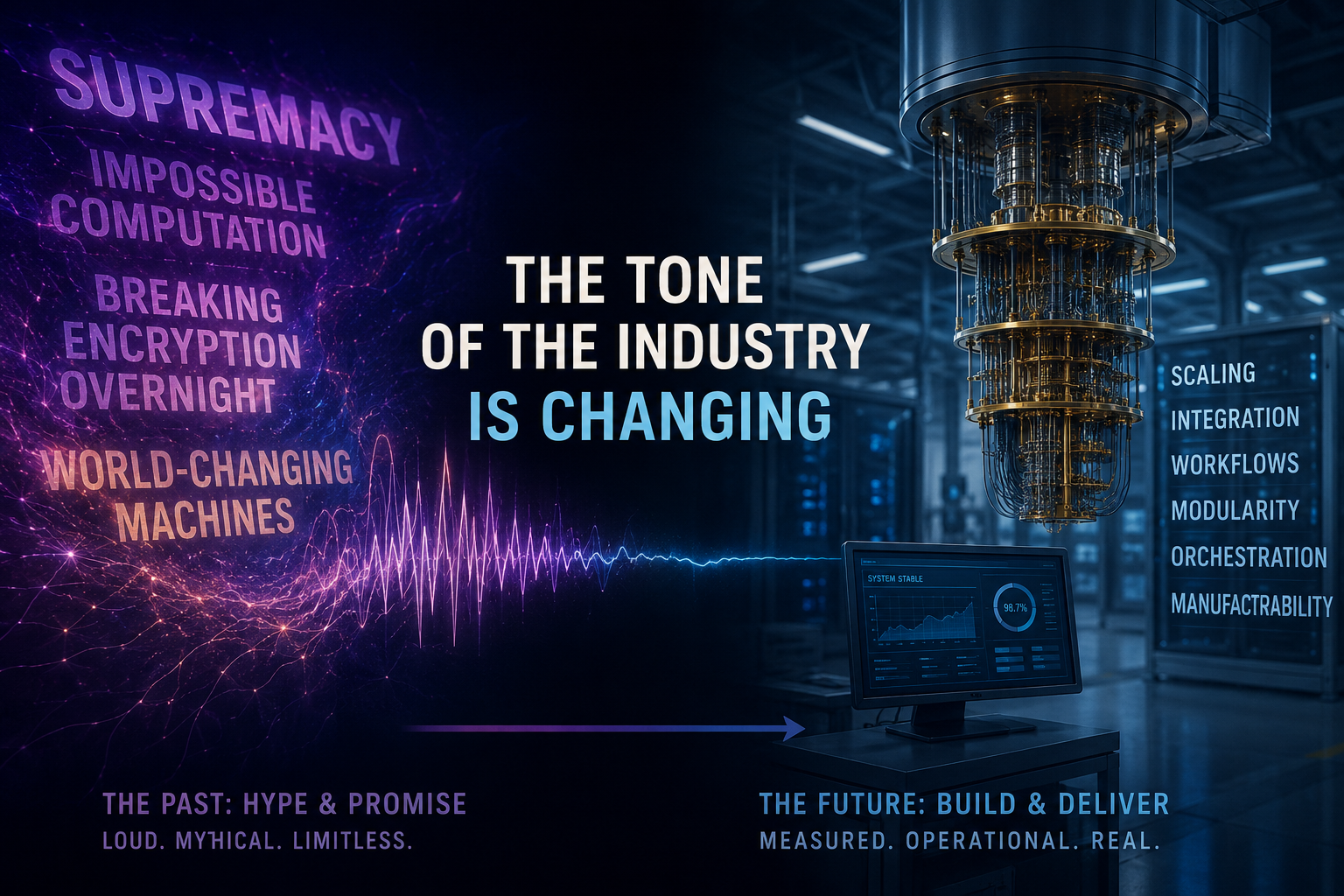
For years, “quantum advantage” was treated like a cliff edge: once you crossed it, everything would change. The promise was that a quantum system, somewhere around a few hundred qubits, would leapfrog classical computers spectacularly. But the field has matured. Today, the focus is far less dramatic and far more engineering-driven: physical error rates, surface code thresholds, and scaling curves. It feels less like waiting for a magic trick and more like aerospace or semiconductor design—incremental progress toward a highly complex system.
Several tensions shape this next phase. The first is psychological. Quantum research is no longer framed in terms of breakthrough moments but in the grind of getting error rates down and logical fidelity up. This is where investor excitement meets engineering reality. Then there is the cross-modality competition. Photons, ions, atoms, superconductors—each technology has its strengths, its bottlenecks, and its marketing pitch. Photonics promises scalability. Ions emphasize fidelity. Neutral atoms point to parallelism. Superconductors lean on ecosystem maturity. The real question isn’t which platform is “best.” It’s which bottleneck emerges first and how costly the workaround will be.
A third challenge is the metrics gap. When companies announce progress toward “logical qubits,” they aren’t always talking about the same thing. Some measure gate error, others resource overhead, and others benchmark problem-solving. Without a shared standard—logical error per gate, qubit overhead, time-to-solution—investors, policymakers, and researchers are comparing apples to oranges. And finally, there is strategic silence. The new roadmaps are bold, but what they leave unsaid may be just as important as what they declare. PsiQuantum envisions million-qubit photonic systems but stays cautious about gate fidelity assumptions. Quantinuum aims for hundreds of logical qubits by 2030 but hasn’t tied those to specific applications. IQM sets milestones at logical error rates of 10⁻⁵ to 10⁻⁹, but the path from there to real-world workloads is still open. These silences shape expectations as much as the milestones themselves.
So now the quantum race is less about how many physical qubits and more about when logical qubits truly deliver. Will the first significant milestone be 10 reliable logical qubits, proving the error-correction threshold has been crossed? 100 logical qubits, making small-scale applications possible? Or the first practical algorithm solved with logical qubits, no matter how many it takes?
The $2B week signals that capital markets are ready to bet big on error correction as the foundation of practical quantum computing. The real challenge ahead is aligning on metrics that allow us to track progress across modalities—and to separate real engineering progress from marketing optimism. Until then, the “logical race” will be measured not just in qubits, but in the credibility of the roadmaps themselves.
Stay Connected
Follow our journey and be part of the conversation:
🔗 Find us on LinkedIn
📬 Join our mailing list
📺 Subscribe to our YouTube channel