When you send an email, log into your bank, or connect through a secure VPN, your data feels protected. And right now—it is.
That security comes from encryption systems like RSA or Diffie-Hellman, which rely on solving incredibly complex math problems. Today’s computers can’t crack those equations fast enough to be a real threat.
But that protection isn’t permanent.
Attackers don’t have to break your encryption today. All they need to do is capture your encrypted data now and hold onto it.
Because once quantum computers reach a certain level of power, they’ll be able to solve those same math problems exponentially faster—tearing through cryptographic defenses like wet paper.
Emails. Trade secrets. Financial records. Health data.
All of it could be decrypted years from now, long after you thought it was safely locked away.
It’s like someone photographing your house key today, patiently waiting for the day they invent the ultimate lockpick.
Instead of relying on complex math, quantum secure communication uses the laws of physics—specifically, quantum entanglement.
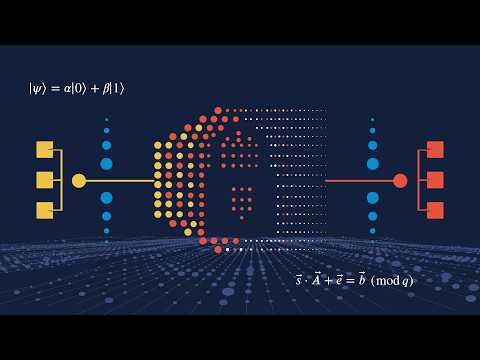
Here’s a simplified version: Pairs of light particles, or photons, are created in an entangled state and sent to two different endpoints. These particles are linked so that measuring one instantly reveals something about the other, no matter the distance.
Each endpoint uses the measurement results to create the same encryption key at the same time.
The key is never sent across the network.
There’s nothing for hackers to intercept. No key in transit, no copy to steal.
And if someone tries to eavesdrop on the quantum exchange, the act of observing those photons disrupts them—alerting the system instantly. That compromised key is discarded, and the data stays safe.
It’s not just secure. It’s self-defending.
Here’s where it gets practical. You don’t need to rip out your firewalls, routers, or VPNs. Your existing internet infrastructure stays right where it is.
What changes is how encryption keys are generated and shared.
Instead of math-based key exchanges that quantum computers will eventually be able to break, you shift to physics-based key creation, immune to those future threats.
It’s like upgrading the lock on your house without having to rebuild the house.
To integrate quantum-secure communication into existing systems, several new components are required.
Simulation software allows your team to model quantum setups virtually—testing everything from photon loss to signal noise before you invest in physical infrastructure.
An orchestrator acts like the conductor of your quantum network. It manages timing and key exchanges and synchronizes quantum devices with your classical systems to ensure smooth operation.
A specialized operating system handles the ultra-fast operations that occur at the quantum level and translates them into secure keys that your systems can use in real time.
Quantum-secure communication doesn’t replace your network. It replaces the part of encryption that’s vulnerable—the way keys are created and exchanged.
By shifting from math to physics, you future-proof your data against the quantum era.
Because security shouldn’t expire.
And in a world where data has memory, your encryption strategy shouldn’t just protect today—it should protect tomorrow too.
Stay Connected
Follow our journey and be part of the conversation:
🔗 Find us on LinkedIn
📬 Join our mailing list
📺 Subscribe to our YouTube channel