For years, quantum computers have been treated like exotic laboratory instruments.
Delicate machines are kept in deep-freeze environments.
Highly specialized devices used by physicists running carefully controlled experiments.
Remarkable technology—but largely disconnected from the broader computing world.
That era may now be ending.
On March 12, 2026, IBM released something that many in the industry are calling a watershed moment: the first official blueprint for quantum-centric supercomputing.
At first glance, it reads like a technical architecture document. But if you zoom out, it represents something much bigger.
It’s a roadmap for how quantum processors will move out of isolated labs and into the heart of modern supercomputing infrastructure, working alongside the processors that power today’s data centers.
To understand why that matters, we have to look at the limits of the computers that brought us here.
The Wall of Classical Computing
Classical supercomputers are extraordinary machines.
They rely on two primary types of processors:
• CPUs, which manage logic and system operations
• GPUs, which handle massive parallel calculations
Together, they power everything from weather prediction and aircraft simulations to the training of modern AI systems.
But even the most powerful classical systems eventually hit a wall.
Certain problems—especially those involving quantum interactions grow exponentially complex.
Take something like drug discovery. Simulating how a new molecule interacts with a protein might require representing an astronomical number of possible quantum states.
At a certain point, the number of variables becomes so large that a classical computer would require more bits of memory than there are atoms in the observable universe.
This is where quantum processors enter the picture.
But not as replacements for classical computers.
Instead, as specialized collaborators.
The Quantum-Centric Model
IBM’s architecture introduces a new way of thinking about computing systems.
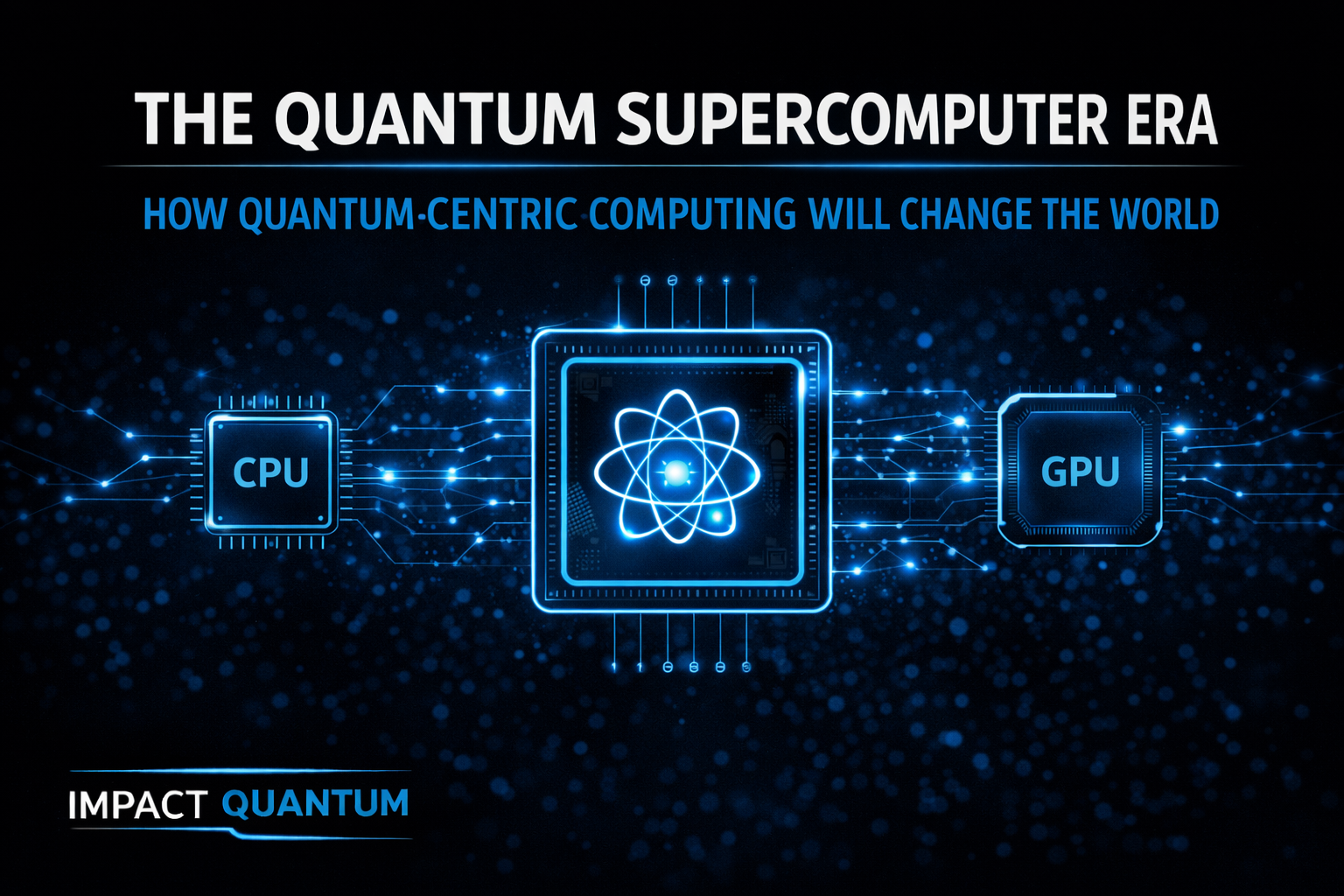
Instead of treating quantum processors as standalone devices, the blueprint proposes a quantum-centric supercomputing environment where three processor types work together.
Think of it like a massive construction project.
The CPUs act as project managers, handling scheduling and coordination.
The GPUs are the heavy machinery, processing huge volumes of data simultaneously.
And the QPU—the Quantum Processing Unit—is the specialist capable of solving mathematical structures that classical machines struggle to represent.
Each processor plays a different role.
The power comes from how they collaborate.
A Real-Time Computing Loop
Historically, communication between classical and quantum systems has been slow and cumbersome.
You would send instructions to a quantum processor, wait for results, then return to the classical system for analysis.
IBM’s architecture introduces something far more dynamic: closed-loop computing.
In this model, classical processors and quantum processors exchange information continuously.
Data moves between systems in milliseconds, allowing the machines to iterate on complex problems together in real time.
This creates a hybrid computing environment where classical and quantum resources effectively form a single integrated system.
From Theory to Scientific Discovery
What makes this announcement particularly compelling is that IBM didn’t just present a theoretical architecture.
They also demonstrated real scientific applications running on this hybrid framework.
One example involved a collaboration with the Cleveland Clinic, where researchers used the system to simulate a 303-atom protein.
To someone outside the field, 303 atoms might sound modest.
But in quantum chemistry, accurately modeling that many interacting particles represents a massive computational challenge.
This work brings researchers closer to a future in which drug development can be achieved through precise atomic simulations, dramatically accelerating the discovery of new treatments.
Another example involved an international research team studying the electronic structure of a half-Möbius molecule.
By combining IBM’s Heron quantum processor with Japan’s Fugaku supercomputer, one of the largest classical computing systems in the world, scientists were able to analyze complex biological molecules with unprecedented accuracy.
Fugaku alone contains more than 150,000 classical compute nodes.
When paired with quantum processing, it becomes something entirely new: a hybrid scientific instrument capable of exploring nature at its most fundamental level.
Making Quantum Usable
One of the biggest barriers to quantum adoption has always been the software.
Historically, interacting with a quantum processor required deep expertise in physics and specialized programming models.
IBM’s architecture addresses this challenge through Qiskit, its open-source quantum development framework.
The goal is what IBM calls “invisible integration.”
Developers write code using familiar tools and programming environments. Behind the scenes, the system’s orchestration layer decides how to distribute the workload.
Some parts of the computation go to the GPU.
Some remain on the CPU.
And the most complex pieces are sent to the quantum processor.
It’s similar to an orchestra.
The conductor of the orchestration layer decides when each instrument should play.
The result is a system where quantum capabilities become accessible to scientists, engineers, and analysts who may never need to understand the underlying physics.
The Shift from Supremacy to Utility
For years, the quantum industry revolved around one phrase: quantum supremacy.
The goal was to demonstrate that a quantum computer could outperform a classical computer at some task—even if that task had little practical value.
IBM has shifted the conversation toward something more meaningful: quantum utility.
The question is no longer whether quantum computers can win benchmark tests.
The question is whether they can help solve real-world problems.
Problems like:
• designing new battery materials
• discovering more efficient catalysts
• improving climate simulations
• optimizing complex supply chains
Quantum processors don’t need to replace classical computers to create value.
They simply need to solve the parts of problems that classical systems cannot.
The Beginning of the Quantum Supercomputer Era
The release of this architecture signals an important development for research institutions, cloud providers, and enterprise technology leaders.
The quantum era is no longer theoretical.
It’s becoming infrastructure.
Instead of waiting for perfect quantum machines, the industry is building hybrid systems that combine the strengths of classical and quantum computing today.
In many ways, this mirrors the evolution of GPUs in the early days of AI.
At first, GPUs were niche accelerators.
Then they became essential components of modern computing.
Quantum processors may now be entering a similar phase.
The Blueprint for the Next Scientific Revolution
Richard Feynman once imagined a computer capable of simulating nature directly.
For decades, that vision felt distant.
Today, we may finally be assembling the systems capable of making it real.
IBM’s blueprint for quantum-centric supercomputing doesn’t just describe a new architecture.
It describes the beginning of a new kind of computing environment—one where quantum processors operate as part of the broader supercomputing stack.
For scientists, this means new tools for exploring the fundamental structure of the universe.
For industry, it opens the door to entirely new classes of discovery.
And for the rest of us, it signals something quietly profound.
The computers capable of solving nature’s hardest problems may already be running.
Not in isolated laboratories.
But inside quantum-centric supercomputers connected to the cloud.