Have you ever felt like you were finally making progress—finally stepping into a new version of yourself—only to have your old anxieties, habits, and self-doubts roar back with a vengeance?
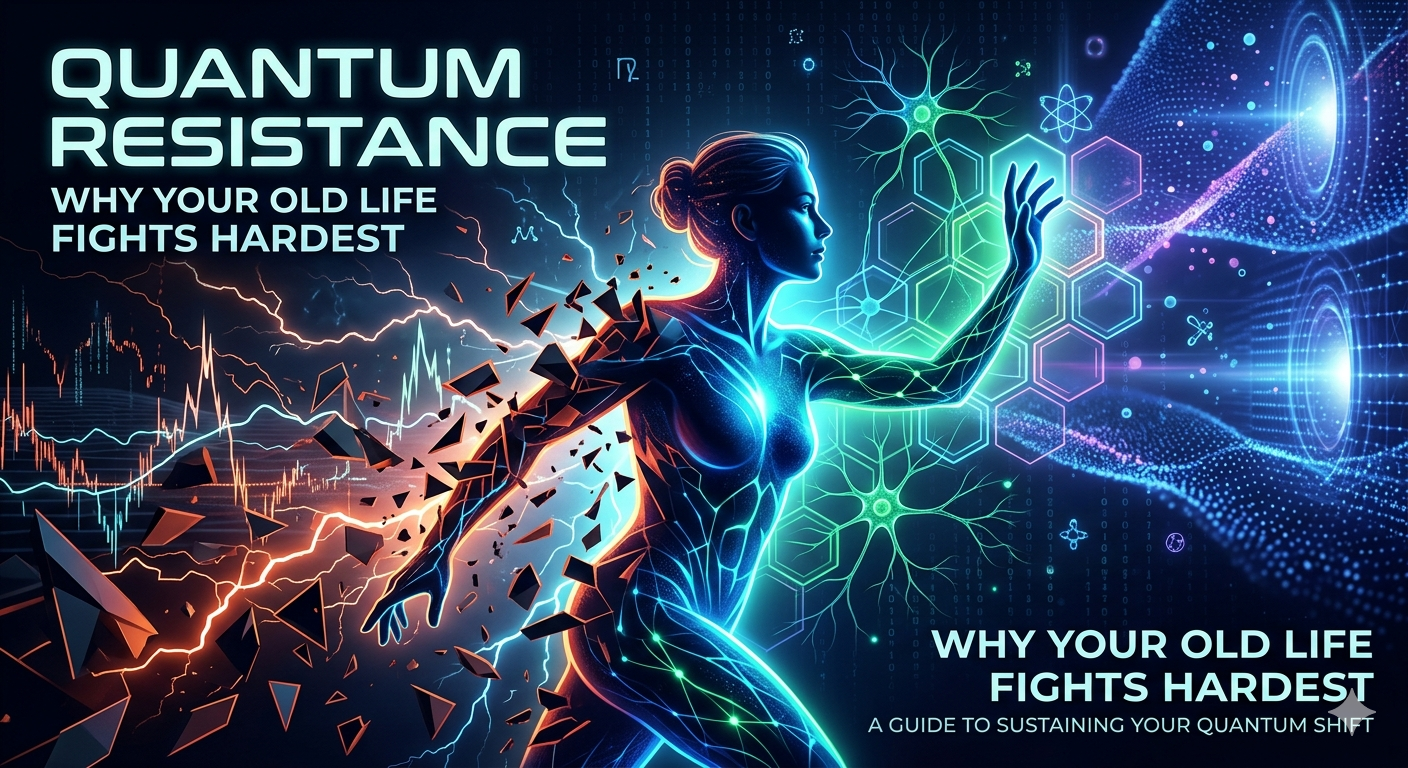
In the world of personal growth, we often interpret this as failure. We think, “If I’m still feeling this way, I must not have changed at all.” But according to a fascinating perspective from the “Quantum Shift” channel, this isn’t a sign of regression. It’s a sign of a system losing its stability.
In quantum mechanics and complex systems theory, right before a structure reorganizes into a new state, it enters a phase of peak instability. This is the moment where the old life fights the hardest because it is losing its grip.
The Biological Baseline: Predictability Equals Safety
To understand why this happens, we have to look past psychology and into biology. Your identity isn’t just a collection of ideas; it is a physical, neurological, and chemical network. It consists of neural pathways, hormonal responses, and behavioral loops that have been reinforced for years.
From a survival standpoint, your brain’s priority isn’t your happiness or your transformation—it’s your continuity. Familiarity, even if it’s painful or limiting, is predictable. And to the primitive parts of your brain, predictability equals safety.
When you start to change—when you stop reacting to that toxic email or start believing in your own worth—you are destabilizing a system that has organized your reality for a long time. Systems do not dissolve quietly. As you move toward a “Quantum Shift,” the old system detects a loss of predictability and interprets it as a threat.
The Illusion of Regression
This is where most people get pulled back into their old lives. As the old system struggles to regain coherence, it intensifies its signals.
Suddenly:
- Thoughts you thought you’d conquered return with more volume.
- Emotional patterns you believed were resolved resurface.
- The “old you” feels louder and more convincing than the “new you.”
Because these signals are familiar, your mind assigns them an unearned authority. You assume that because a feeling is intense, it must be true. You assume that because a thought is accessible, it must be accurate.
In reality, accessibility is just a measure of conditioning. A thought isn’t “true” just because it has a well-worn neural pathway; it’s just easy for your brain to find. This spike in noise is actually the final “rebound effect” of an old identity that no longer has a dominant position.
The Quantum Observer: Choosing Coherence over Chaos
In quantum physics, the state of a system is often determined by the observer. Before a system collapses into a defined reality, it exists as a range of probabilities.
Your identity works in much the same way. During this unstable transition phase, two versions of you are temporarily available:
- The Old System: Fast, automatic, emotionally charged, and highly practiced.
- The New System: Quieter, more stable, less reactive, and still being formed.
The direction your life takes depends entirely on which system you treat as the authority. If you treat the “loud” old thoughts as truth, you participate in them. When you participate, you reinforce the pathways. When you reinforce the pathways, the old system regains its coherence and your “old life” is restored.
However, if you recognize the intensity as residual activity rather than guidance, the dynamic changes. You move from being the participant to being the Observer.
The Subtlety of the “Reasonable” Voice
As you get better at ignoring the loud, emotional surges, the old system often shifts its strategy. It stops trying to overwhelm you with force and starts trying to convince you with “logic.”
It begins to speak in a tone that feels rational and protective. It asks:
- “Are you sure you aren’t moving too fast?”
- “Maybe you need more certainty before you make this move?”
- “Shouldn’t we analyze this one more time?”
These thoughts don’t feel like resistance; they feel like responsibility. But their function is the same: to pull you back into a mode of over-analysis. The old identity needs you to analyze and interpret because that is how it maintains its organizing power. The moment you stop over-interpreting your experience, that identity loses its fuel.
The End of Participation
Real transformation doesn’t happen when you finally “defeat” your old self in a dramatic battle. It happens when the old system becomes irrelevant.
Think of it like a radio station. You don’t have to blow up the tower to stop hearing the music; you just have to change the frequency. When you stop reacting to the old triggers, you are effectively “starving” the old system of the reinforcement it needs to survive.
The final stage of a reality shift feels surprisingly undramatic. It feels stable, clear, and unforced. You aren’t “trying” to be someone new anymore—you simply no longer participate in the habits that defined who you were.
Final Thought: Don’t Misread the Fight
If your old life feels like it’s fighting you right now—if the doubts are screaming and the pull of the past feels like a physical weight—take heart.
That intensity isn’t a sign that you are failing. It’s a sign that the old system has lost its ability to control you through subtle means. It is shouting because it is losing access to you.
Stay in the position of the Observer. Recognize the noise for what it is: the final, erratic signaling of a system that is losing its coherence. Once it loses your participation, it cannot sustain your reality. The shift is already in motion. Keep going.