By the time the world marked the International Year of Quantum Science and Technology in 2025, something remarkable was already happening in France.
Quantum was no longer confined to research papers and academic labs at CNRS and CEA. It had crossed a threshold.
It had gone industrial.
Between 2025 and 2026, France invested in quantum. It operationalized it. It built factories, launched sovereign clouds, secured infrastructure, and aligned research with real economic outcomes.
This was the moment when quantum stopped being “interesting” and started being strategic.
1. Quantum as Sovereignty: Why PROQCIMA Matters
France’s National Quantum Strategy, backed by more than €1.8 billion, hit its stride in early 2025 with the acceleration of PROQCIMA.
This wasn’t a symbolic program. It was a high-stakes national mission to deliver two universal quantum computer prototypes by 2030.
By 2026, a small group of “national champions” had emerged. These companies were receiving deep state support to scale hardware, talent, and infrastructure.
The motivation was simple and serious:
France does not want its most sensitive calculations running on foreign systems.
Defense. Energy. Healthcare. Climate modeling.
These are sovereign assets now.
And France is treating them that way.
2. Hardware Leadership: Betting on More Than One Winner
One of France’s biggest strategic advantages is that it never puts all its quantum eggs in one basket.
Instead, it built a diversified hardware ecosystem.
Photonics: Quandela
Quandela made global headlines in 2025 with a 20,000x acceleration in quantum simulations using NVIDIA’s CUDA-Q platform.
By 2026, its MosaiQ processors were integrated into OVHcloud’s sovereign infrastructure.
Translation: European companies could finally access real quantum hardware through the cloud, at scale.
Not demos. Not pilots.
Production access.
Error Correction: Alice & Bob and the Cat Qubit
Paris-based Alice & Bob has become one of the most important players in global quantum.
Why?
Because they cracked one of quantum’s hardest problems: error correction.
In 2025, they showed that their “cat qubit” architecture could reduce error-correction overhead by up to 200x.
This is foundational.
Without scalable error correction, quantum computers remain fragile science projects.
With it, they become infrastructure.
Alice & Bob is building infrastructure.
Neutral Atoms: Pasqal
Pasqal quietly became a global heavyweight.
By 2026, its systems were being used by industrial leaders like Airbus and BMW for optimization and simulation.
Pasqal also expanded aggressively into Asia and the Middle East, exporting French neutral-atom technology as a global standard.
This is what technology diplomacy looks like in practice.
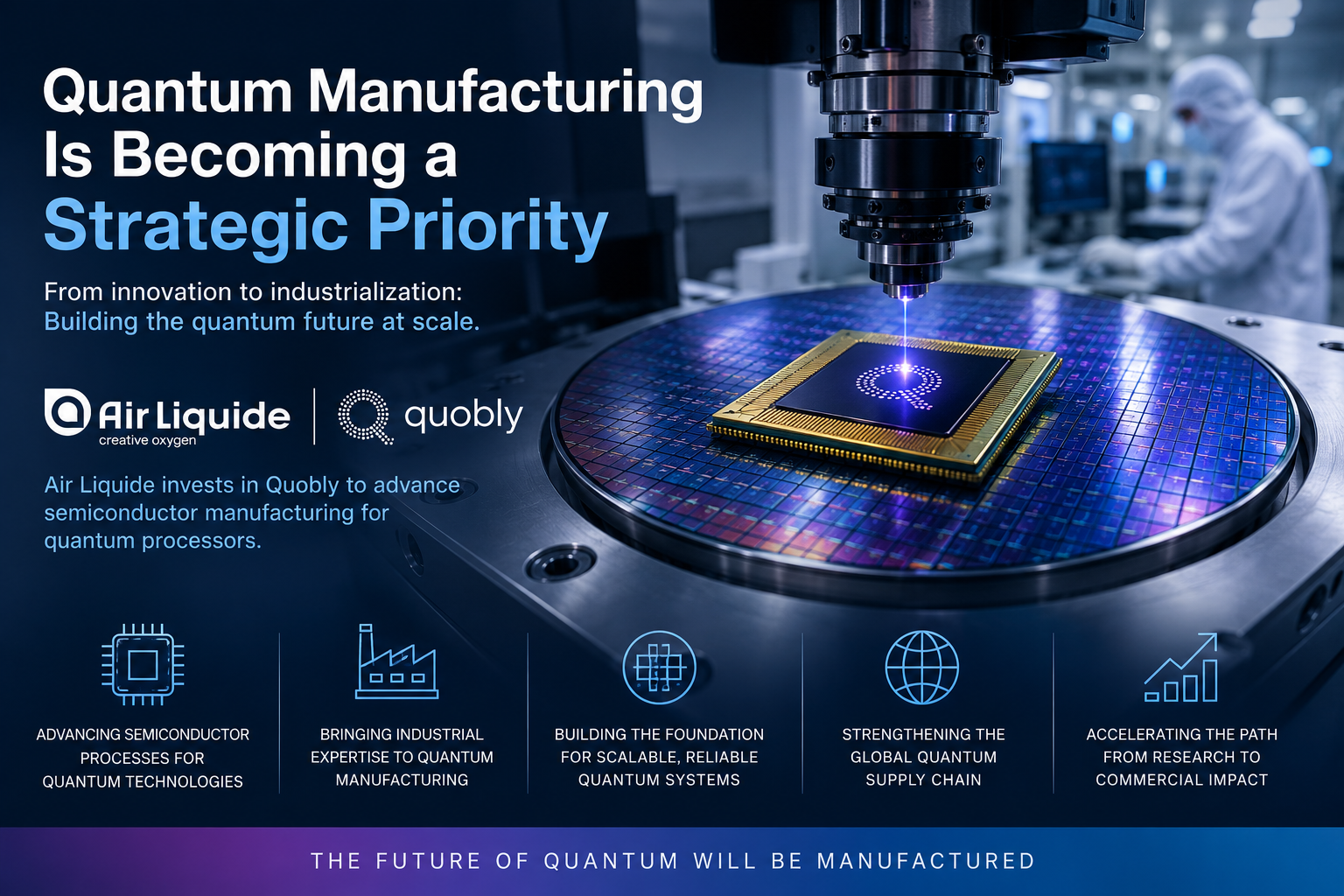
Silicon Spin: Quobly
Grenoble-based Quobly is leveraging France’s semiconductor legacy.
In 2026, it opened a subsidiary in Canada, creating a bridge between European research and North American manufacturing.
Its mission: industrialize quantum chips using standard CMOS processes.
In other words, make quantum compatible with existing chip factories.
That’s how scale happens.
3. The Quantum Cloud Goes Mainstream
By 2026, access was no longer the bottleneck.
Integration was.
Through France’s Hybrid Quantum Initiative, researchers and startups gained seamless access to systems that combined classical supercomputers with quantum accelerators.
OVHcloud became the primary platform for this democratization.
By partnering with Quandela and Alice & Bob, it began offering true “Quantum-as-a-Service.”
With tools like MerLin, launched in late 2025, data scientists could experiment with quantum machine learning without needing a physics doctorate.
This matters.
Because ecosystems grow when barriers fall.
4. Security First: Post-Quantum Is Now a Business Issue
As quantum capability grows, so does risk.
By 2025, “Harvest Now, Decrypt Later” had moved from technical whitepapers to boardroom agendas.
France responded early.
Its cybersecurity authority, ANSSI, led national migration toward post-quantum cryptography.
Companies followed.
- SEALSQ developed quantum-ready chips
- Orange expanded QKD networks
By early 2026, France unveiled the “Quantum Highway”: an integrated trust platform securing everything from silicon to cloud.
That’s not future-proofing.
That’s present-proofing.
5. Paris as a Global Quantum Magnet
By 2025, Paris had become a serious destination for quantum talent.
Conferences, venture capital, research collaborations, and startup accelerators converged.
The Franco-German partnership deepened in 2026 with joint doctoral programs and shared talent platforms.
Europe stopped competing internally.
And started competing globally.
6. The Numbers Tell the Story
| Metric | 2024 | 2026 |
|---|---|---|
| Active Startups | ~60 | 100+ |
| Investment | €1.8B | >€2.5B |
| Fault-Tolerant Qubits | Experimental | Early Prototypes |
| Cloud Integration | Pilot | Fully Operational |
This is what momentum looks like.
From “If” to “How Fast”
The 2025–2026 period will be remembered as the moment France proved that quantum is not just a research discipline.
It is an industry.
A security asset.
An economic platform.
By aligning academic excellence, industrial scaling, cloud infrastructure, and national policy, France built something rare in deep tech:
A coherent system.
As we move toward 2030, the conversation is changing.
Not:
“Will quantum work?”
But:
“How fast can it help us solve climate, health, and energy challenges?”
And right now, France is setting the pace.