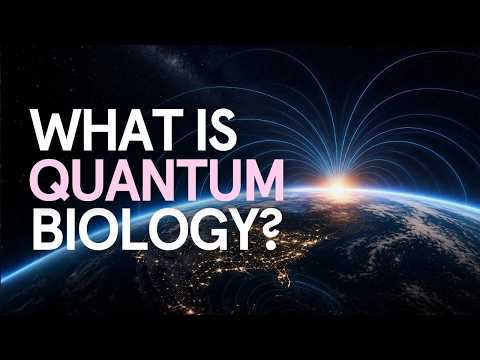
Could life be operating on deeper principles than we once understood? For generations, biology has explained living systems through the lens of chemistry: DNA, proteins, and cellular machinery tirelessly orchestrating the dance of life. Yet, an emerging field suggests there might be a far subtler script at work, whispering beneath the surface of our traditional models. What if some of life’s most essential processes also depend on quantum phenomena? This question lies at the heart of quantum biology, a field that proposes that quantum effects could play significant roles inside living organisms, potentially reframing everything we know about health, aging, and cellular behavior.
Based on content from Quantum Biology DAO
To delve into quantum biology, it’s helpful to consider its constituent parts. On one side, biology: the study of life, exploring how organisms grow, survive, heal, reproduce, and evolve, and ask fundamentally, how does life work? On the other hand, physics—particularly quantum physics- concerns itself with the behavior of matter and energy at the smallest scales, including the bizarre behavior of particles that exist in multiple states or pass through seemingly insurmountable barriers. In marriage, these fields breed questions that challenge the limits of our understanding.
Imagine a busy city full of traffic. In classical systems, vehicles obediently follow predictable routes and traffic signals. In quantum systems, however, particles might take elusive shortcuts, back roads, or tunnels, bypassing conventional paths to reach destinations faster or more efficiently than classical predictions allow. Quantum biology asks whether similar quantum effects might occur naturally inside living organisms. Not in sterile labs or hypersensitive machinery, but within the very essence of life—inside animals, plants, perhaps even within us.
Traditional biology, taught in classrooms around the globe, treats life much like a sophisticated machine where parts fit methodically, cause and effect are observable phenomena. While undeniably potent, this mechanistic view doesn’t negate the curiosity of quantum biology: Is there a deeper layer of organization at the atomic and subatomic levels that also defines life’s functions?
Consider the elegance of photosynthesis, the uncanny navigation of migratory birds, or the intricate dance of smell. Each serves as a tantalizing hint of quantum processes at play. Birds’ ability to navigate Earth’s magnetic field might be informed by quantum mechanisms within proteins in their eyes. Meanwhile, the perception of smell might involve ‘inelastic tunneling’—where molecular vibrations are distinctly sensed—thereby adding scent as another suspect in quantum influence. These ideas, though novel, are pillars of serious study, far from the margins of science fiction.
Among the most intriguing pursuits within quantum biology is the exploration of weak magnetic fields on biological systems. Life didn’t evolve in a magnetic void; Earth’s magnetic environment has been a constant companion. Might life be optimized around this silent force? If so, it suggests that our current understanding of biology and medicine might be missing a crucial variable: the nuanced quantum-level sensitivity to magnetic fields.
This matters because the implications could be profound—and timely. If life meaningfully uses quantum effects, our understanding of health, disease, aging, and healing is incomplete. Not flat out incorrect, but lacking. As such, quantum biology could yield transformative insights in the medical sciences, unlock new treatments, and enrich our approach to thelife sciences. What if the quantum lens offers explanations for cellular behaviors, presenting solutions previously hidden in plain sight?
Though quantum biology has yet to wholesale redefine biology, the field is gathering momentum thanks to technological and methodological advancements. Precision tools, from quantum sensing to advanced microscopy, now allow researchers to probe this hidden realm as never before. Furthermore, the intersectionality of quantum biology—rooted in physics, chemistry, biology, and computation—fuels its collaborative potential.
The Quantum Biology DAO stands at the forefront, championing open research in this space. By supporting unconventional paths not easily realized through traditional funding mechanisms, this community-driven organization is building the infrastructure for tomorrow’s scientific frontier. For scientists, builders, funders, or simply the curious, there is a place in this emerging field.
Quantum biology, therefore, is not presented as an inevitability—a revolution in waiting. Yet, as the pieces fall into place, its promise invites us to ponder: What whispers linger at the quantum fringes of life? What mysteries lay just out of reach, waiting for us to notice?
If any of these ideas resonate or kindle a spark of curiosity within, consider joining the dialogue at the Quantum Biology Community Discord. Engage with open science where the future of biology aligns with the promise of quantum discovery, and explore further insights at platforms like quantumbiology.xyz.
—