Sometimes, it’s in the unsettling dance between the known and the unknown that breakthroughs happen. Imagine a room at the cusp of spring, April light slicing through half-drawn shades, casting long shadows that speak of the morning’s promises not yet whispered. In this room, the inaugural Quantum Biology Forum unfolded, hosted by Northwell Health, bringing together a tapestry of minds—scientists, healthcare pioneers, and innovators, each uniquely crafted from varied disciplines yet united by an inquiry into the minutiae of quantum phenomena. It was here that a dialogue began, one that hints at the very essence of life itself being underwritten not just by molecules and reactions, but by the peculiarities of quantum mechanics.
Based on content from Northwell Health
Delving into the vastness of human capability, the forum threaded through realms of biology traditionally held as sacrosanct. Quantum biology, at first blush, seems an enigma, even fanciful—a bridge between the mysticism of the subatomic world and the structured universe of living organisms. But it’s this very bridge that promises to reshape medicine, weaving quantum oddities into the fabric of biological understanding, suggesting a new paradigm where the absurd isn’t merely possible, but transformative.
At the heart of the conversation was Dr. Guy, a figure at once unassuming and charismatic, whose narrative is an entwined tale of pharmaceutical triumphs and postulations dismissed. With a career steeped in challenges akin to navigating between determinism and chaos, he shared anecdotes that pit the absurd against the inevitably true. Under the warm forgiving light of professional achievement and a dose of irreverent charm, he pondered the unspoken possibilities of diseases treated with light and magnetism rather than traditional chemicals. His recounting of the journey—an ebb and flow of societal skepticism and scientific vindication—was palpable; a lesson in persistence and the reevaluation of what is deemed “absurd.”
From the realm of the fantastic came stories of creatures whose seemingly trivial existences conceal profound biological enigmas. Take, for example, the tardigrades, those microscopic titans able to endure space’s void, or the jellyfish known scientifically as Turritopsis dohrnii, reverting endlessly to its youthful state. Each entity is a reminder: perhaps the limits we perceive in biology are but scratches on a much broader canvas, ones which quantum biology might one day illuminate fully.
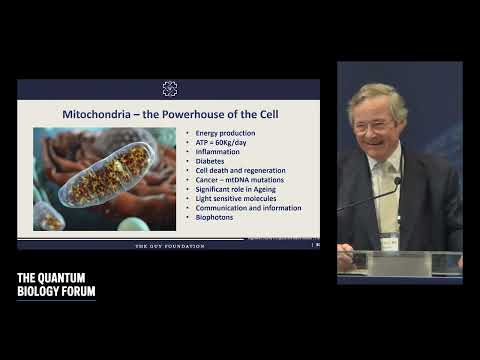
No less intriguing was the reflection on aging and its attendant mysteries—a bridge not just of time but of energy mismanagement within our cells, intricately tied to mitochondria, the once merely dubbed “powerhouse” now recognized as command central for cellular vitality and communication. Could the answer to reversing cellular demise lie within the embrace of quantum effects, subtly nudging cells back to a time of vigor and renewal?
But within the ether of possibility lies the often-cold reality of adaptation to modernity; humanity’s escape from natural rhythm to the spectrums fabricated by its own hand. In our quest for efficiency—embodied by the clinical hue of LED lighting—we may have estranged our biology, leaving it yearning for the infrared warmth lost within layers of progress. It’s a stark reminder of unintended consequences, a modern scurvy of sorts, that science must address.
The forum wasn’t solely about building castles in the air; it also grounded itself in evidence and potential applications. There were discussions of anti-cancer therapies employing magnetism, of mitochondria responding to specific light frequencies—a vivid illustration of what quantum biology could actualize. Each finding is a pebble cast into the pond of scientific discourse, rippling outwards with the potential to redefine what is possible, even what is inevitable.
As the conference drew to a close, the minds gathered there left with more questions than answers, a hallmark of any pursuit worth its salt. Yet, it left a resonating thought echoing in the mind—a nod to the interconnectedness of our universe where perhaps, like particles in superposition, we hold dualities too, being both bound by our limits and liberated by our possibilities.
In the coming years, as the curtains rise on this new act of science and medicine, we are prompted to consider: What other “absurd” ideas could change the world? And are we ready to see our universe not merely as a series of isolated islands of knowledge, but as a vibrant archipelago of interconnected phenomena—one that quantum biology may help us to fully explore?
—