For decades, quantum computing was a field defined by “if” and “when.” It was a laboratory science, a beautiful mathematical theory that struggled against the harsh reality of physical noise and decoherence. But as we move into the mid-2020s, the narrative is shifting. We are no longer just asking if a quantum computer can work; we are witnessing the birth of the Quantum Engineering Era.
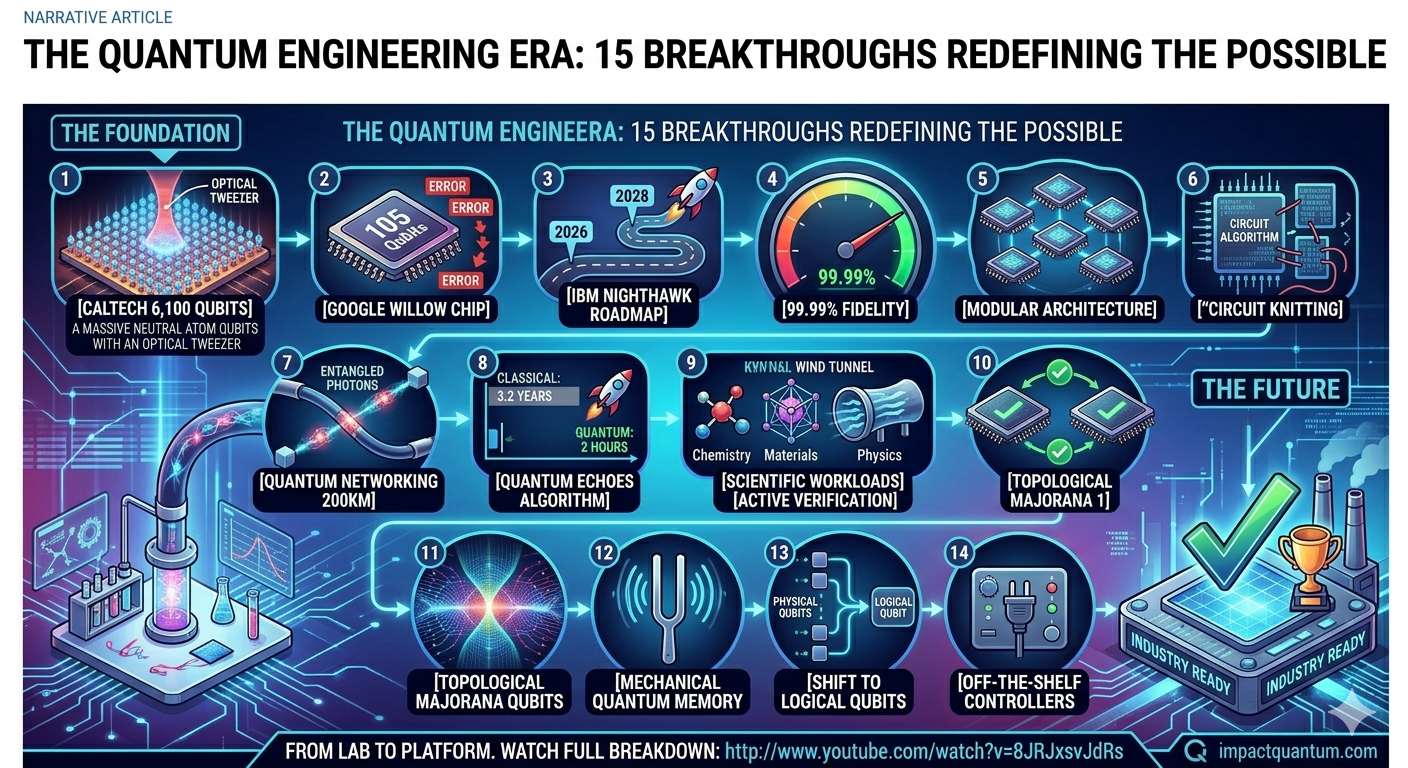
Recent breakthroughs across the industry—from Google and IBM to startups like Quantinuum and Rigetti—suggest that the road to fault-tolerant, useful quantum computation is being paved faster than many anticipated. Here is an in-depth look at 15 major milestones that are moving quantum computing from abstract spectacle to industrial platform.
1. The Scaling Leap: 6,100 Qubits and Beyond
For years, the industry operated under a grim trade-off: as you added more qubits, you added more noise. Caltech physicists recently shattered this assumption by assembling a neutral atom quantum processor with 6,100 qubits [00:21]. By using 12,000 optical tweezers, they held these atoms in superposition for 13 seconds—ten times longer than previous records [00:31]. Most importantly, they proved that qubits could be physically moved across the array without losing their quantum state [00:50]. This suggests that scaling is no longer a fundamental physics problem but an engineering one.
2. Crossing the Error Correction Threshold
Theory met reality with Google’s Willow chip. Containing 105 qubits, the chip demonstrated exponential error reduction as the grid size increased [01:10]. This is the “below threshold” regime: the holy grail where adding more qubits actually makes the system more reliable rather than less [01:29]. Willow also completed a sampling task in under five minutes that would take a classical supercomputer roughly 10 septillion years [01:48].
3. The Public Advantage Roadmap
IBM has moved away from vague promises toward a concrete, measurable timeline. Their Nighthawk processor boasts 20% more connectivity than its predecessors, enabling 30% more circuit complexity [02:18]. IBM has publicly stated they expect community-verified quantum advantage by the end of 2026, with their “Starling” system aiming for 100 million gates on 200 logical qubits shortly thereafter [02:50].
4. The “Four Nines” of Fidelity
IonQ recently announced two-qubit gate fidelities exceeding 99.99% [03:10]. Moving from 99.9% to 99.99% (the “four nines” level) can reduce logical error rates by thousands of times [03:21]. Furthermore, IonQ achieved this without ground-state cooling, which greatly simplifies the operational infrastructure for high-performance quantum tasks [03:41].
5. Modular Quantum Architectures
Instead of cramming everything onto a single massive chip, researchers are embracing modularity. Rigetti announced a 36-qubit multi-chip system, proving that connecting smaller chips can maintain fault tolerance even if the links between them are noisy [04:12]. This “systems engineering” approach mirrors how classical computers scaled from single processors to massive server farms.
6. “Circuit Knitting” for Small Machines
Until we have massive machines, we are using clever software to make small machines act like big ones. A method called CIF fold has reduced quantum resource overhead by nearly 800% [05:02]. By cutting large programs into segments, executing them separately, and recombining them in a classical manner, engineers are bridging the gap between today’s NISQ (Noisy Intermediate-Scale Quantum) devices and the fault-tolerant future [05:14].
7. Integrated Quantum Networking
Scaling isn’t just about what happens inside a processor; it’s about how processors talk to each other. Researchers recently demonstrated a quantum signature network connecting users over 200 kilometers [05:48]. New photonic chips are also being developed that control laser frequencies using 80 times less power than traditional systems, making quantum communication look more like deployable infrastructure and less like a fragile lab experiment [06:05].
8. Real-World Speedups: The Quantum Echoes Algorithm
Google’s Quantum Echoes algorithm completed a structured physics simulation 13,000 times faster than Frontier, the world’s fastest supercomputer [06:36]. While the gains weren’t universal, they were measurable: a task that would take 3.2 years on a classical system was finished in just over two hours [06:47].
9. Narrowing the Advantage to Scientific Workloads
The hype of “quantum changes everything” is being replaced by a more credible narrative: “quantum solves this class of problems.” Experts now expect the first real-world advantages to appear in chemistry, material science, and physics [07:15]. A study suggested that quantum systems could begin tackling Department of Energy scientific workloads within the next 5 to 10 years [07:36].
10. The Rise of Verification
As supremacy claims become more common, the focus is shifting to verification. Google’s Quantum Echoes was designed to be “quantum-verifiable,” meaning its results can be cross-checked by another quantum device [07:59]. Meanwhile, Microsoft and Quantinuum ran over 14,000 circuits without a single error, using active syndrome extraction to correct logical qubits in real time [08:10].
11. Topological Qubits and Majorana 1
Microsoft and UC Santa Barbara have unveiled Majorana 1, an 8-qubit topological processor [08:47]. Topological qubits encode information in a way that is naturally protected from noise [09:07]. If this architecture scales, it could drastically simplify the overhead required for error correction, fundamentally changing the hardware map of the industry.
12. Superior Quantum Memory
Speed is useless without memory. Caltech researchers have developed a mechanical oscillator that translates quantum information into sound, extending memory lifetimes by 30 times compared to standard superconducting systems [09:30]. Longer coherence times mean algorithms can run deeper and handle more complex calculations before the quantum state collapses [09:51].
13. The Shift to Logical Qubits
The industry is moving away from counting “physical qubits” and focusing on “logical qubits.” Microsoft and Quantinuum recently created four logical qubits using a 32-qubit processor, achieving error rates 800 times lower than the physical hardware beneath them [10:42]. Reliable, corrected qubits are the true currency of the quantum future.
14. Off-the-Shelf Quantum Control
We have officially entered the year of “Quantum Readiness.” Off-the-shelf quantum controllers are now available, allowing researchers to stop building hardware from scratch and start focusing on algorithms [11:03]. As Rigetti targets 100-qubit systems with 99.5% fidelity, quantum progress is beginning to look less like a series of miracles and more like iterative industrial progress [11:44].
15. The 2026 Horizon: Verified Quantum Advantage
All these threads converge on a single goal: Verified Quantum Advantage. IBM is on track to demonstrate this by the end of 2026 [11:56]. If 2026 delivers community-confirmed advantage in a real-world workload, quantum computing will cease to be a “promise” and will officially become a “platform” [12:32].
The “Quantum Winter” never arrived. Instead, we found ourselves in a “Quantum Spring,” where the transition from laboratory physics to systems engineering is happening in real-time. For industries ranging from pharmaceuticals to materials science, the clock to 2026 is officially ticking.
Watch the full breakdown: Top 15 New Quantum Computing Breakthroughs That Will Change Everything