There’s something quietly poetic about capital when it finally gets specific.
For years, quantum funding has felt like a polite dinner guest, curious, cautious, and dabbling at the edge of the table. But this week, Britain pulled up a chair and said, “We’re not dabbling anymore.”
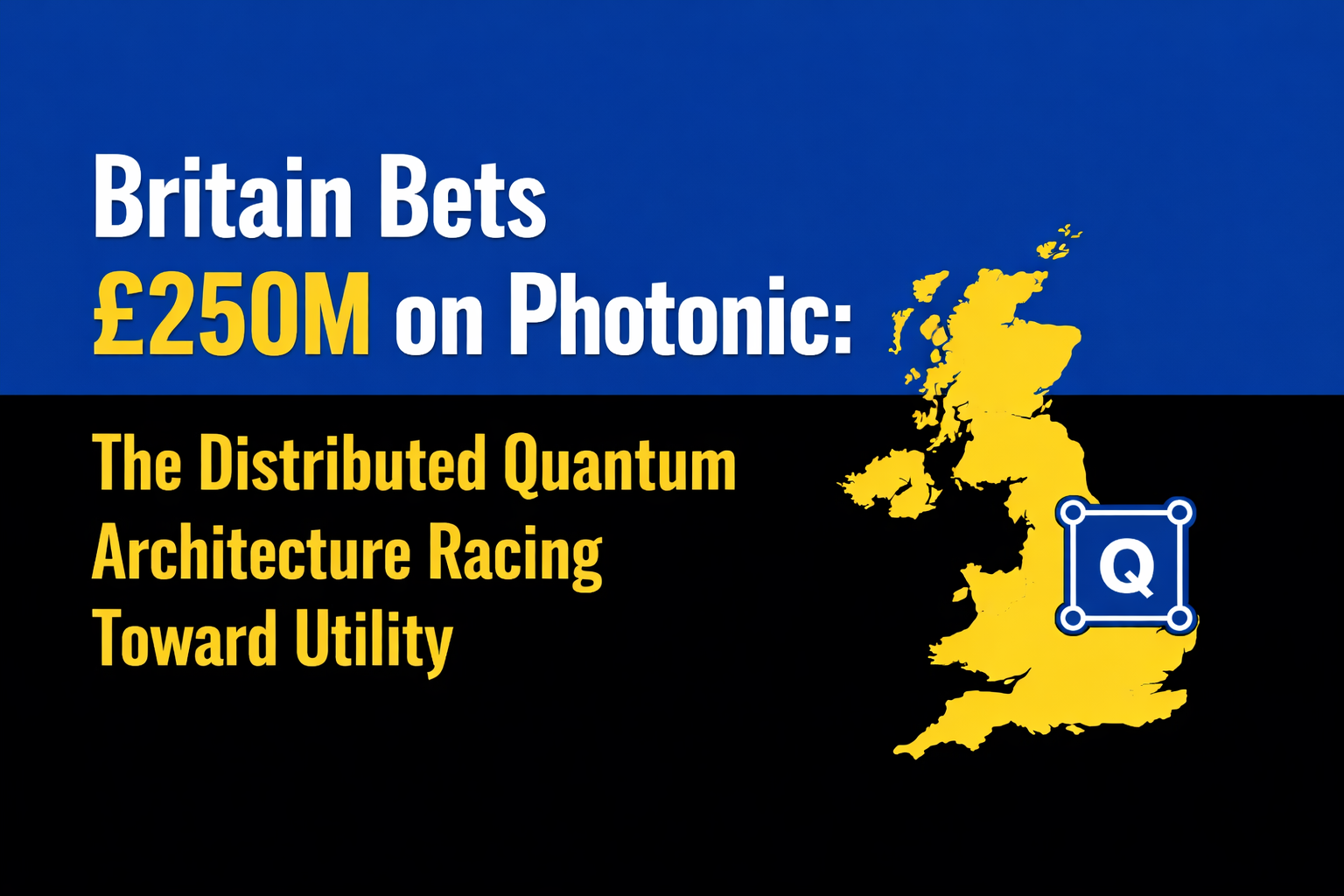
A new £250 million specialist quantum fund, roughly $315 million USD, has made its debut with a decisive investment in Photonic Inc., the Vancouver-based company building distributed, fault-tolerant quantum systems. The news, first reported by The Quantum Insider on February 13, 2026, signals something larger than a single deal.
It signals that the Quantum Utility Era is no longer theoretical.
And for Photonic, this isn’t just money. It’s architectural validation.
The Age of Specialist Capital
Quantum has matured past its “science fair” phase.
For the last two years, generalist deep-tech funds have circled the space, intrigued but wary. Quantum physics is not SaaS. The timelines stretch. The engineering is merciless. The returns require patience bordering on monkhood.
This £250 million British vehicle, backed by institutional investors, pension funds, and sovereign capital, is designed for exactly that level of patience. Its mandate is clear: bridge the valley between lab prototypes and industrial-scale processors.
Choosing Photonic as a flagship investment is a statement. The market is shifting from isolated hardware experiments to networked, fault-tolerant systems capable of delivering real-world value.
That word matters now: useful.
Photonic’s Architecture: Entanglement Before Ego
Stephanie Simmons founded Photonic with a different instinct than the superconducting giants like IBM or Google.
Instead of cramming qubits onto a single monolithic chip, Photonic builds modular systems connected via telecom-grade fiber.
At the heart of their platform is the Silicon Colour Centre a beautifully pragmatic hybrid that combines:
- The long-lived memory of silicon spin qubits
- The speed and connectivity of photons
And here’s the strategic elegance: it’s built on silicon. The same silicon that powers the trillion-dollar semiconductor ecosystem. This means compatibility with existing fabrication infrastructure, no need to reinvent manufacturing from scratch.
Their Entanglement First™ Architecture links smaller processors into one distributed quantum system. It’s less “giant machine in a lab” and more “quantum network stitched across space.”
If traditional quantum machines are trying to grow taller, Photonic is growing outward.
That shift feels architectural, and architectural thinking always scales better.
The UK Bridge: Quantum as Infrastructure
The timing isn’t accidental.
In mid-2025, Photonic announced a £25 million R&D facility in London, backed in part by the UK’s National Security Strategic Investment Fund and aligned with the National Quantum Strategy.
The UK has deep roots in quantum theory and optics. This new fund strengthens what’s quietly becoming a transatlantic quantum bridge between Canada and Britain.
And there’s something else humming beneath this: the Quantum Internet.
Not marketing fluff but the real idea that quantum processors will one day communicate across global fiber networks. Securely. Instantly. Without classical vulnerabilities.
Photonic sits right at that intersection of photonics, telecommunications, and distributed computing.
That’s not an accident. It’s positioning.
$375 Million and Counting
With this investment, Photonic’s total raised climbs to roughly $375 million CAD.
Earlier this year, their Series C brought in participation from Microsoft, Royal Bank of Canada, and Telus.
Microsoft’s involvement is particularly revealing. Photonic’s technology is being integrated into Azure Quantum Elements, providing enterprises with a cloud-based entry point to this distributed architecture.
That tells you something important: this isn’t a moonshot sitting on a lab bench. It’s being wired into enterprise workflows.
And here’s the quiet strategic advantage: Photonic’s reliance on telecom-standard components suggests a faster, more economically realistic path to fault tolerance, the moment when a quantum machine can correct its own errors and sustain long, meaningful computations.
Fault tolerance is the advancement of quantum computing.
And adulthood requires funding like this.
Why Photonic. Why Now.
The 2026 narrative has shifted.
We’re no longer obsessing over “quantum supremacy” demos that win headlines but solve nothing. The focus is now utility. Manufacturability. Network effects.
Photonic checks three very specific boxes:
Manufacturability
Silicon leverages decades of semiconductor supply chains and process maturity.
Connectivity
Fiber-linked modules sidestep the spatial bottleneck of cramming qubits onto a single chip.
National Security
As encryption standards age under quantum pressure, sovereign quantum capability becomes strategic infrastructure. Not optional. Foundational.
That last point matters more than most headlines will admit.
The Ecosystem Effect
The £250 million fund is larger than a single company. It’s a signal flare.
Britain wants to be a quantum superpower, not in branding, but in late-stage scaling capital. That kind of targeted funding attracts founders, researchers, and operators who want more than grant cycles. It creates gravitational pull.
Photonic’s London expansion is expected to create over 100 highly skilled roles focused on networking, error correction, and software integration.
Talent attracts talent. Capital follows clarity.
This is how ecosystems mature.
A Quantum Spring
There was quiet anxiety a few years ago about a “quantum winter” — that funding would dry up before the technology caught up.
What we’re seeing instead feels more like spring.
Specialist capital. Modular architectures. Distributed systems. Cloud integration. National strategy aligning with enterprise demand.
Under the leadership of Stephanie Simmons and CEO Paul Terry, Photonic is positioning itself not just as a hardware company but as the infrastructure for a future in which quantum systems communicate as naturally as classical servers do today.
And maybe that’s the deeper shift.
Quantum is no longer trying to impress us with physics.
It’s trying to become boringly essential.
When that happens, when infrastructure becomes quiet and reliable, you know it’s real.
And £250 million says Britain believes it’s real now.