In 1981, physicist Richard Feynman issued a challenge that still echoes through the computing world:
“Nature isn’t classical… and if you want to make a simulation of nature, you’d better make it quantum mechanical.”
For decades, that idea lived mostly in theory. Quantum computers existed, but they were isolated machines—extraordinary scientific instruments, yet difficult to integrate into the broader computing ecosystem.
Now that picture is starting to change.
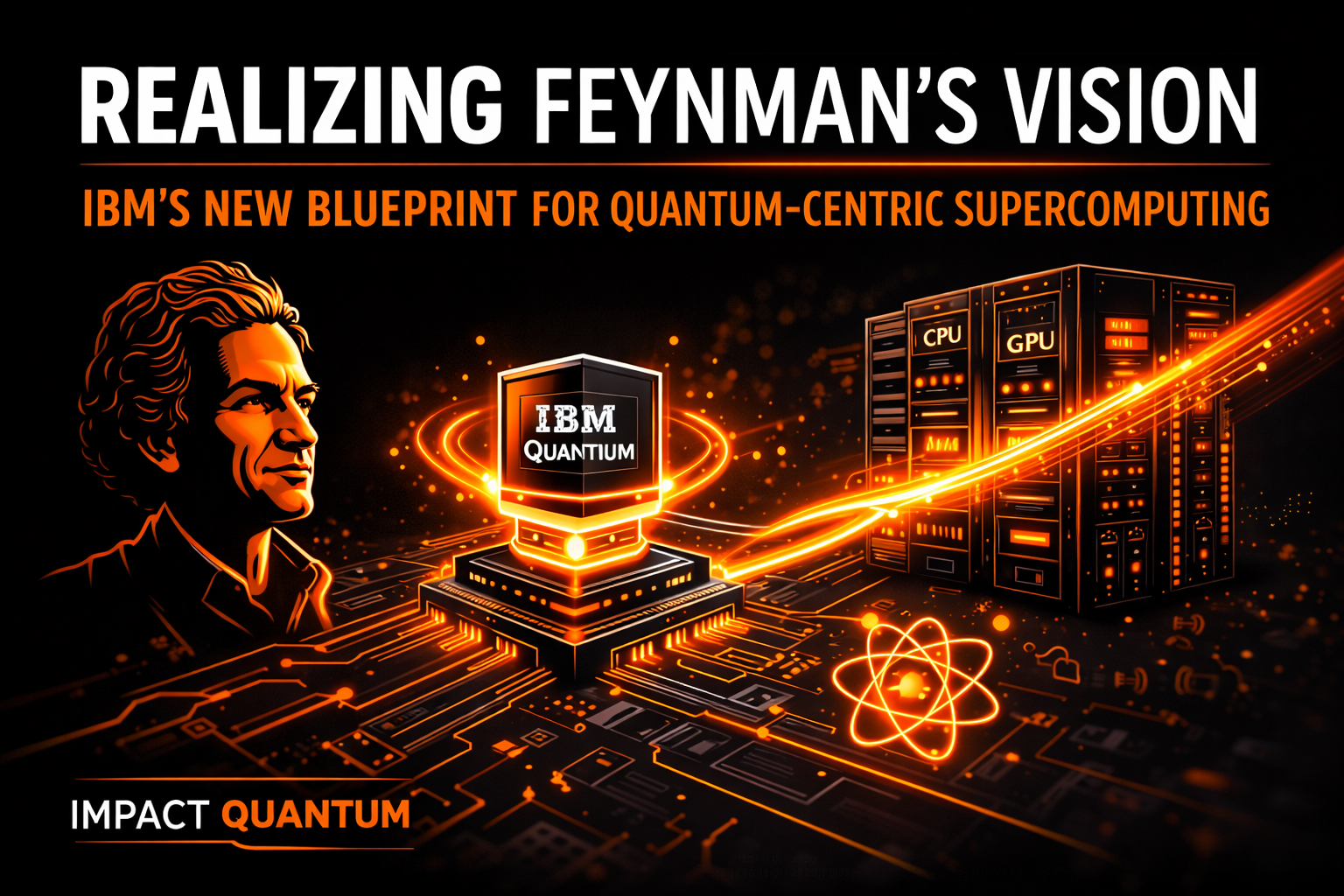
On March 12, 2026, IBM released the industry’s first Quantum-Centric Supercomputing (QCSC) Reference Architecture. It might sound like a technical white paper, but it represents something much bigger.
It’s a blueprint for how quantum computers will actually work in the real world.
Not alone.
But as part of hybrid computing systems designed to tackle problems classical machines simply can’t solve.
From Exotic Machines to Team Players
For most of the past decade, quantum computers were treated as standalone devices.
You’d send a job to the quantum processor.
Wait for the circuit to run.
Then analyze the results on a classical computer.
It worked—but it was inefficient.
IBM’s new architecture flips that model entirely.
Instead of treating the quantum processor (QPU) as a distant resource, a quantum-centric supercomputer embeds it directly inside a larger computing system, working alongside CPUs and GPUs.
Think of it this way:
Just as GPUs accelerated graphics and AI workloads, QPUs are now being designed to accelerate specific scientific calculations.
Each processor type does what it does best.
Classical machines handle large-scale data processing.
Quantum processors handle the pieces of the problem where quantum mechanics gives an advantage.
The result is a new type of computing architecture where quantum becomes part of the infrastructure.
The Four Layers of the Quantum Future
One of the most important aspects of IBM’s reference architecture is that it makes this system understandable.
Instead of presenting quantum computing as mysterious or inaccessible, the framework breaks everything down into four logical layers, similar to how classical supercomputing systems are organized today.
Hardware Infrastructure
At the lowest layer sits the hardware itself.
The QPU connects directly to high-performance classical computing resources through ultra-fast links. These connections allow classical and quantum processors to exchange information in near real time.
This tight feedback loop is essential. Many quantum algorithms require classical computers to analyze intermediate results and send updated instructions back to the QPU.
Without extremely fast communication between the two, hybrid quantum workflows simply wouldn’t function.
System Orchestration
Next comes orchestration—the system responsible for managing computing resources.
IBM’s architecture integrates tools like the Quantum Resource Management Interface (QRMI) with traditional supercomputing schedulers.
For many researchers, this means quantum jobs can eventually be managed alongside classical workloads using familiar tools like Slurm.
That might sound like a small detail.
But it’s actually a huge step toward making quantum computing usable at scale.
Application Middleware
Above the orchestration layer sits the middleware, the software that translates scientific goals into something the quantum hardware can understand.
This is where Qiskit, IBM’s open-source quantum development framework, plays a major role.
Researchers describe their problem at a high level of chemistry, optimization, materials science, and the middleware converts that goal into quantum circuits and classical-quantum workflows.
In other words, the middleware acts as a translator between science and hardware.
The Application Layer
Finally, at the top of the stack are the real discoveries.
This is the layer where scientists explore questions about the following:
• molecular chemistry
• new materials
• complex optimization problems
• biological systems
• energy technologies
These applications are exactly the kinds of problems Feynman was talking about decades ago—simulations where classical computing struggles because nature itself behaves quantum mechanically.
Real Results, Not Just Theory
What makes this announcement especially interesting is that IBM didn’t just publish a conceptual framework.
They also shared early scientific results that demonstrate the architecture in action.
One example involved simulating a 303-atom protein, one of the largest molecular systems studied using a quantum-integrated computing approach. Researchers at the Cleveland Clinic used hybrid workflows to tackle a problem that would be extremely challenging for classical systems alone.
Another project focused on creating a half-Möbius molecule, a structure with a unique electronic twist that had never been experimentally verified.
And in Japan, researchers at RIKEN connected an IBM Quantum Heron processor to the Fugaku supercomputer, linking quantum hardware with all 152,064 nodes of one of the most powerful classical systems on Earth.
That kind of closed-loop integration between quantum and classical computing is exactly the kind of hybrid architecture Feynman envisioned.
Why This Matters Beyond Physics
If you’re new to quantum computing, announcements like this might feel highly technical.
But what’s really happening here is something much broader.
The industry is shifting from building quantum devices to building quantum infrastructure.
That distinction matters.
Because once quantum computers become part of larger computing systems, the field expands dramatically.
It’s no longer just physicists designing qubits.
It’s also:
• system architects
• cloud engineers
• workflow orchestrators
• software developers
• data scientists
• operations teams running hybrid computing environments
Quantum computing is becoming part of the modern computing stack.
And that opens the door for far more people to participate.
The Architecture of Discovery
Feynman believed that to truly understand nature, we would need machines capable of speaking nature’s language.
For decades, we tried to build those machines one qubit at a time.
Now the industry is beginning to assemble systems that enable those qubits to work with classical computing at scale.
That shift—from isolated devices to integrated infrastructure—may turn out to be one of the most important milestones in the evolution of quantum computing.
Because breakthroughs rarely happen in isolation.
They happen when the right tools, systems, and people come together.
And with quantum-centric supercomputing, it looks like we’re finally building those tools.