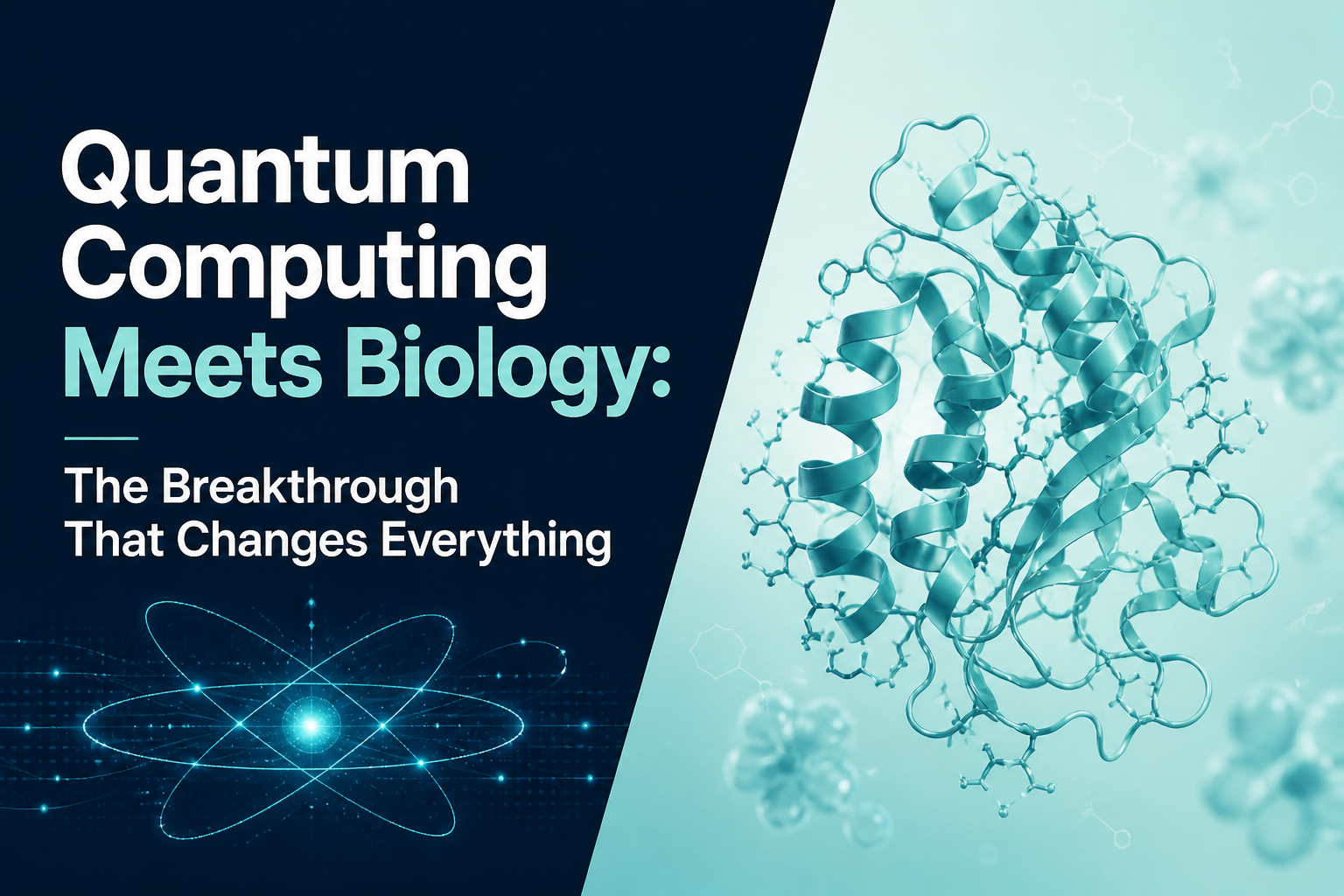
Researchers from IBM and their collaborators simulated a protein—trypsin—with more than 12,000 atoms using a hybrid quantum–classical system. On paper, it reads like a milestone: the largest biological molecule ever modeled with quantum computing. A technical achievement. A scaling story.
But if you sit with it a little longer, something else begins to surface.
It’s not just that the system worked.
It’s what it chose to work on.
For years, quantum computing has lived mostly in the language of physics—qubits, coherence times, error rates. The conversations felt inward-facing, like a field proving itself to itself. Even the breakthroughs, as meaningful as they were, often stayed contained within that world.
This feels different.
Because biology doesn’t behave like physics problems, we can simplify. It resists neat boundaries. It’s messy, layered, and constantly shifting. A protein like trypsin isn’t just a structure—it folds, it interacts, it responds. It exists in motion, in context.
And now, quantum systems are beginning to meet it there.
What made this possible is the architecture—a hybrid approach that blends quantum processors with classical supercomputing systems like Fugaku.
There’s something quietly revealing in that choice.
Not a replacement. Not a takeover.
A collaboration.
The quantum processor handles the parts of the problem that are fundamentally quantum—the interactions that become impossibly complex for classical systems to track accurately. The classical supercomputer stabilizes the process, fills in the gaps, and manages scale.
It’s less like a handoff and more like a conversation between two different ways of thinking.
And maybe that’s what this stage of quantum really is—not a sudden leap, but a gradual weaving into the systems we already trust.
If you zoom out, the significance isn’t just computational.
It’s directional.
For decades, drug discovery and molecular modeling have relied on approximations—good ones, refined over time, but still approximations. Simulating how molecules behave in real environments is one of those problems that grows exponentially harder as systems become more realistic.
You add atoms, interactions, environmental variables… and suddenly the problem becomes too large to hold.
So we simplify. We isolate. We guess.
And those guesses carry consequences—long development cycles, failed trials, treatments that almost work but don’t quite.
Quantum computing has always been positioned as a way to break through that ceiling. But until recently, that promise felt… distant. The gap between theoretical advantage and practical application was still wide enough to keep things safely hypothetical.
This experiment narrows that gap.
Not completely. Not yet.
But enough to feel the shift.
There’s also something more subtle happening here—something harder to measure, but maybe just as important.
A change in where attention is going.
When a field starts applying itself to biology, it’s no longer just optimizing performance. It’s beginning to intersect with human outcomes—health, medicine, longevity, quality of life.
And that changes the emotional weight of the work.
Quantum computing stops being an abstract frontier and starts becoming… more immediately relevant. Not because it’s fully ready, but because it’s moving closer to questions people already care about.
What causes disease?
Why do some treatments work for some people and not others?
What are we still missing when we look at the body as a system?
These are not physics questions. But they are deeply computational ones.
And now, they’re beginning to sit within quantum’s reach.
At the same time, it’s important not to overstate what this means.
This isn’t a cure for anything.
It doesn’t suddenly unlock drug discovery overnight.
There’s still a long path between simulating a protein and fully understanding how it behaves in a living organism. Biology doesn’t yield that easily. It layers complexity on top of complexity, each answer revealing new unknowns.
But progress in fields like this rarely arrives as a single defining breakthrough.
It arrives as a capability.
The ability to model something slightly larger.
To capture interactions with slightly more fidelity.
To reduce uncertainty just enough that new kinds of questions can be asked.
And that’s what this represents.
A widening of what can be explored.
There’s a feeling that comes with watching something like this unfold. It’s not excitement in the loud sense. It’s quieter than that.
More like standing at the edge of a threshold you didn’t fully realize you were approaching.
Because once a system can model a protein of this scale, the next question is inevitable:
What comes after?
More complex proteins.
Molecular interactions.
Entire pathways.
And eventually, systems that start to resemble the complexity of life itself—not perfectly, not completely, but enough to offer insight where before there was only approximation.
What lingers isn’t just the technical achievement.
It’s the sense that quantum computing is beginning to turn outward.
To move from proving that it works… to exploring what it’s for.
And in doing so, it’s stepping into one of the most intricate, least understood systems we know.
Not to simplify it.
Not to reduce it.
But to meet it with a different kind of lens—one that might finally be capable of holding its complexity without collapsing it.
There’s still distance to travel.
But something about this moment feels like a line has been crossed—quietly, without announcement.
Quantum isn’t just describing the world anymore.
It’s beginning to participate in understanding life within it.