There’s a quiet kind of tension running underneath this video—like something steady you’ve relied on your whole life is slowly loosening its grip, and no one is quite saying it out loud yet.
https://youtube.com/watch?v=wD3nItBq5i8%3Frel%3D0%26playsinline%3D1%26origin%3Dhttps%253A%252F%252Fchatgpt.com%26enablejsapi%3D1%26widgetid%3D1%26forigin%3Dhttps%253A%252F%252Fchatgpt.com%252Fc%252F69d90145-6edc-832c-9508-a7a59f6a9f58%26aoriginsup%3D1%26vf%3D1
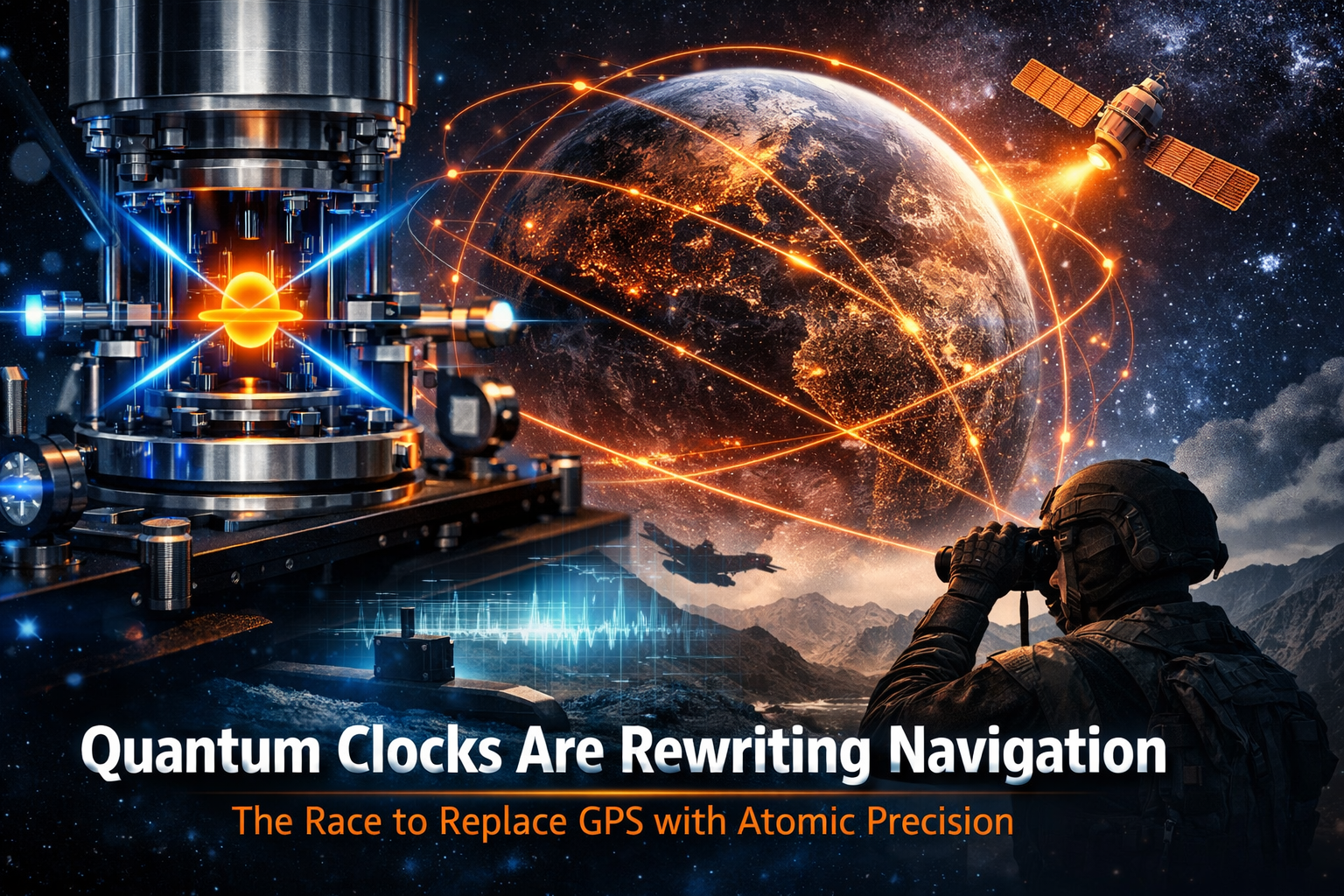
At first glance, it’s about navigation. About what happens when GPS—this invisible lattice we move through without thinking—stops being reliable. The video centers on quantum clocks, developed by companies like Infleqtion, and their ability to measure time with such precision that location can be inferred without satellites. Not guessed. Not approximated. Known.
But underneath that, something else is happening.
You start to realize how much of modern life is quietly synchronized. Planes, financial systems, supply chains—they all depend on timing so exact it almost feels like choreography. GPS isn’t just “where you are.” It’s when you are down to fractions of a second. And when that timing drifts, even slightly, the whole system begins to feel… uncertain.
Quantum clocks step into that uncertainty almost gently.
They don’t rely on signals from above. No satellites. No external reference. Instead, they sit with the atoms themselves—watching their oscillations, their rhythms, the way matter keeps time when left alone. There’s something strangely grounding about that. As if, when the external world becomes unreliable, the answer is not to reach further out… but to look inward, to something more fundamental.
The video walks through how these clocks could enable navigation in environments where GPS fails—underwater, underground, or in contested spaces where signals are jammed or denied. It sounds technical, but it lands differently if you sit with it.
It’s about independence.
About systems that don’t panic when the signal disappears.
And maybe that’s why it lingers.
Because there’s a familiar pattern here, especially if your mind already moves in nonlinear ways, if you’ve ever felt the friction of relying on structures that don’t quite hold when you need them to. There’s something deeply recognizable in the idea of building your own internal reference. Of trusting a different kind of precision.
Not louder. Just… closer.
The technology itself is still emerging. These quantum clocks aren’t yet small, cheap, or everywhere. They’re being tested, refined, and sent into space in careful increments. There’s patience in that process. A kind of restraint. No sweeping declarations—just incremental steps toward something that could quietly reshape how we move through the world.
And maybe that’s the most interesting part.
This isn’t a breakthrough that announces itself with spectacle. It doesn’t feel like a moment. It feels like a shift you only notice after it’s already begun.
Like realizing, mid-step, that you’re no longer following a path someone else mapped out for you.
You’re navigating by something else now.
Something more precise.
Something that was there all along.