There’s a quiet but thrilling shift happening in quantum computing right now, something like the moment when an orchestra tunes up before the conductor lifts their baton. For years, the field has been dominated by a single refrain: more qubits, more power. But the melody is changing. The new theme: quality over quantity.
At the center of this shift is Nord Quantique, a rising quantum startup based in Sherbrooke, Quebec. The company has just been invited to join Stage A of the U.S. Defense Advanced Research Projects Agency’s (DARPA) Quantum Benchmarking Initiative (QBI), a prestigious and highly competitive program designed to measure what really matters in quantum computing.
This isn’t just another partnership or a polite nod from the global quantum community. It’s a validation, a signal that Nord Quantique’s bold approach to error correction is being taken seriously by one of the world’s most demanding and rigorous tech programs.
Measuring What Matters
DARPA’s Quantum Benchmarking Initiative may sound like something lifted from a sci-fi plot, but its mission is efficient: create standardized, meaningful metrics that distinguish genuine progress from marketing hype.
We’re still living in the NISQ era, short for Noisy Intermediate-Scale Quantum. Machines today can handle dozens or even hundreds of qubits, but they’re error-prone, unstable, and ultimately not reliable enough to solve real-world problems. A stray vibration, a cosmic ray, or even the act of measuring a qubit can cause its fragile quantum state to collapse, like a soap bubble in a stiff breeze.
DARPA is now asking the hard questions: Which architectures can help us move beyond that fragility? What will it take to build Fault-Tolerant Quantum Computers (FTQC) that can perform complex computations without unraveling mid-task?
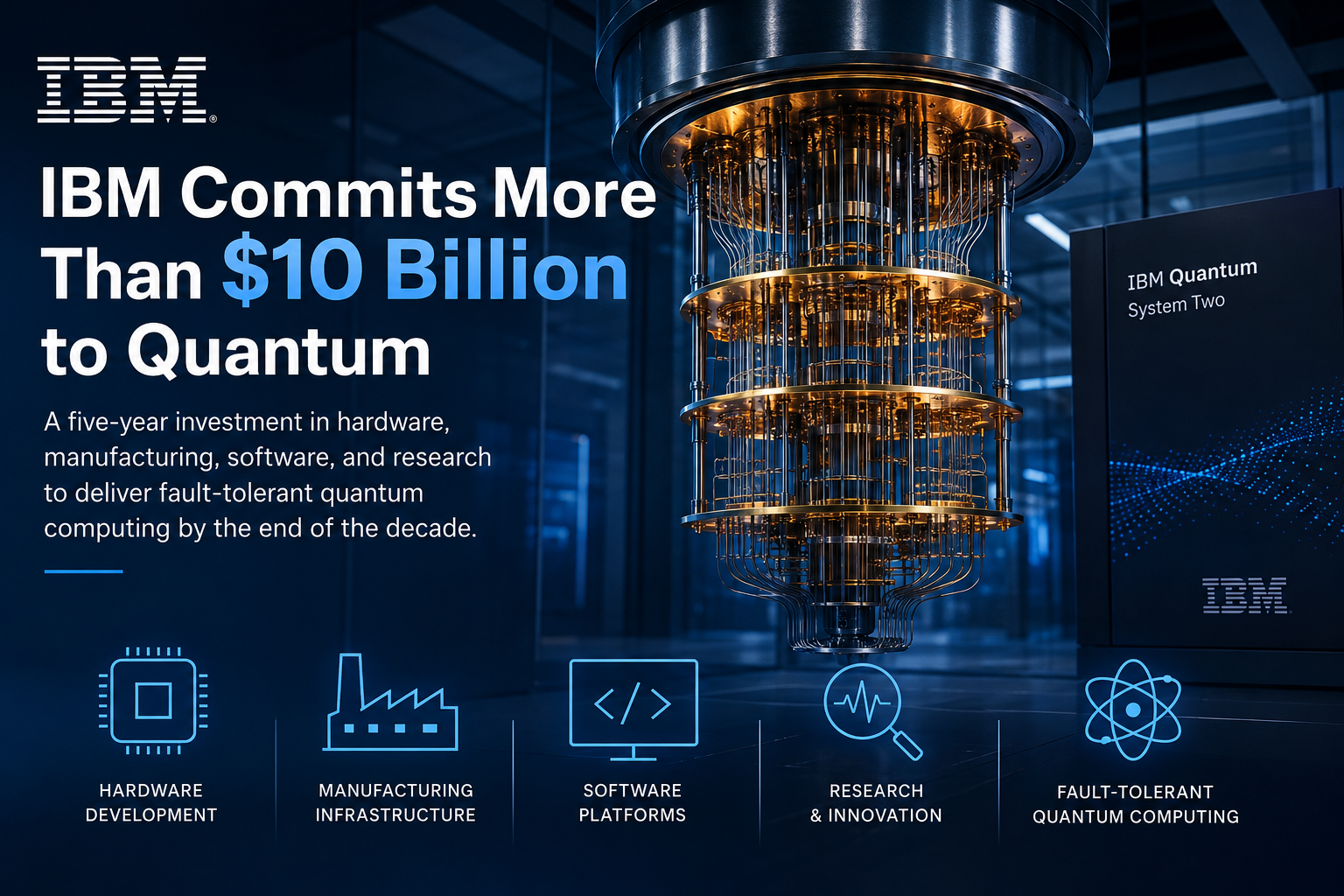
In Stage A, selected participants, including Nord Quantique, IBM, Quantinuum, and Canada’s own Xanadu must present detailed roadmaps toward “utility-scale” quantum computing. Later stages (B and C) will test working prototypes, with up to $300 million USD in funding available for those who deliver.
It’s a high-stakes challenge and an enormous opportunity for a company from Sherbrooke that refuses to play small.
Error Correction by Design
Most quantum companies begin by scaling up qubit counts, hoping to address noise and errors after the fact. Nord Quantique flipped that model on its head.
Their approach starts with a deceptively simple but radical idea: error correction shouldn’t be an afterthought; it should be built into the system from the ground up.
At the heart of their architecture are superconducting bosonic qubits, encoded in harmonic oscillators—systems that naturally restore balance, like a pendulum returning to center. These qubits are designed to resist certain classes of errors independently. Imagine writing a message on water, but with ripples that know how to realign themselves before the words are lost.
This intrinsic resilience enables Nord Quantique to significantly reduce the typical overhead required for error correction. In most systems, it takes thousands of physical qubits to produce a single reliable logical qubit. Nord Quantique claims to approach a 1:1 ratio—a breakthrough that could reshape how we think about scalability in quantum computing.
Their stack is deliberately co-designed across three levels:
- Physical Layer: Robust, low-noise superconducting qubits
- Control Layer: High-precision microwave electronics for fast, accurate gate operations
- Logical Layer: Real-time error detection and feedback mechanisms
By aligning these layers from the start, they’re not just building a machine; they’re building coherence into the architecture itself.
Beyond the NISQ Horizon
The core challenge in quantum isn’t getting qubits to dance, it’s keeping them in sync. Every pulse, every stray photon, every tiny environmental disturbance threatens to throw the system out of tune. In this metaphor, error correction is the metronome, the quiet but essential rhythm that holds the music together.
That’s why Nord Quantique’s inclusion in DARPA’s benchmarking initiative is so significant. It marks a shift in focus across the industry: from brute-force scaling to the art of coherence.
If Nord’s architecture holds up under DARPA’s scrutiny, it could bring useful logical qubits into reach sooner than expected. That opens the door to game-changing applications in drug discovery, materials science, cryptography, and global logistics, domains that have long stood just beyond our computational capabilities.
Canada’s Quantum Moment
For Canada, this moment is more than a milestone; it’s a spotlight.
With Xanadu in Toronto pioneering photonic quantum systems and Photonic Inc. in Vancouver advancing quantum networking, Nord Quantique’s entry into the U.S.-led benchmarking initiative affirms Canada’s position as a multi-modality quantum powerhouse.
It’s also a payoff for years of national investment through the Canadian National Quantum Strategy, which emphasized deep research, education, and commercialization. Rather than placing all its chips on a single approach, Canada is enabling a diverse quantum ecosystem—superconducting, photonic, and beyond—where multiple paradigms evolve in parallel.
If Nord Quantique advances through the QBI program, the benefits won’t stop at their lab door. The ripple effects could galvanize Canadian universities, startups, and STEM programs, igniting new research collaborations and career pipelines.
The Dawn of the Quality Era
If the last decade in quantum computing was about chasing qubit counts, the next will be about earning trust—in performance, in stability, and in the algorithms we dare to run.
Nord Quantique’s story is a signal that this new Quality Era is already underway. It’s a reminder that real progress often doesn’t come from simply doing more; it comes from doing better, from designing machines that not only compute but also endure.
And maybe, just maybe, we’ll stop asking, “How many qubits?” and start asking, “How well can they sing together?”
Because when the music of quantum coherence finally plays, we’ll remember who helped tune the first notes.