
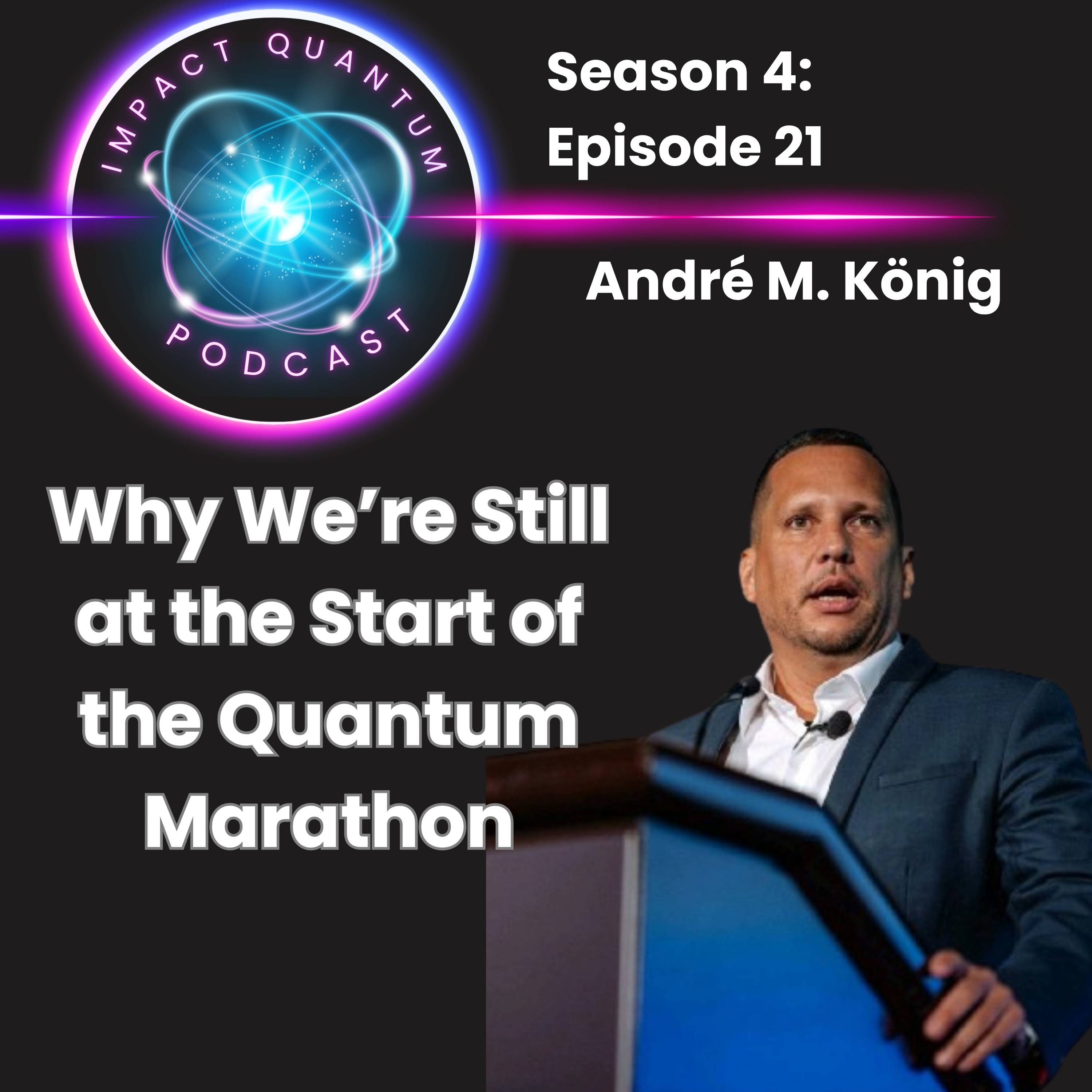
In this episode, we’re joined by Andre Koenig, a strategic consultant whose work helps governments, investors, and companies worldwide navigate the rapidly evolving quantum landscape. Together, we peel back the layers of hype and misconception around quantum technologies, exploring what it really takes to drive innovation, the intersection of quantum and AI, and why the true transformative power of quantum may still be decades away. Whether you’re a scientist, entrepreneur, or simply quantum curious, this conversation offers invaluable insights into the present and future of one of technology’s final frontiers.
Links
- André on LinkedIn – https://www.linkedin.com/in/estrapadus/
- Watch on YouTube – https://youtu.be/Uozkyn4JKYk
Time Stamps
00:00 Scaling responsibly within the industry
04:55 Challenges in Implementing Weather Tech
07:45 Understanding Amara’s Law in Tech
12:22 AI for quantum computing
14:03 Early adoption of quantum technology
20:34 Cloud services and enterprise technology
21:53 Discussing misconceptions in quantum tech
27:08 Discussing evolution in technology
28:38 Career opportunities in Quantum technology
31:22 Challenges in global collaboration
35:50 Impact of prompt engineering
Transcript
I think to be able to scale unresponsibly, you would need to
Speaker:be part of one of these big handful of
Speaker:folks in the leader pack that is starting to fall away.
Speaker:I don't think you have the capability to do anything
Speaker:irresponsible if you're not at this point part of
Speaker:this call a team that will consist of government entities,
Speaker:some of these large combat research labs and some so forth. So
Speaker:again, I think you need to distinguish that you're inside that punting curtain or
Speaker:outside that pump and curtain outside that pumping curtain. You're not going to do
Speaker:much harm. Maybe you'll have a scam investment
Speaker:portfolio and the saving of some people.
Speaker:Right. Welcome to Impact Quantum
Speaker:Hello and welcome back to Impact Quantum, the podcast where we explore the emerging
Speaker:field of quantum computers, where you don't necessarily need to be a
Speaker:physicist, you just need to be curious. And with me today, as always,
Speaker:is the most quantum curious person I know, Candace Kahuly.
Speaker:How's it going, Candice? It's going great, Frank. Thank you so much. I'm really
Speaker:excited because today we're going to be talking to Andre
Speaker:Koenig and he, he's very exciting. He
Speaker:is a strategic consulting company in Quantum
Speaker:and he's helping industry leaders and countries and media
Speaker:and just about everybody understand the fantastic world of
Speaker:Quantum. Hi Andre. Love Quantum. I love
Speaker:Impact. I love the Quantum Curious. Good to be back with both of
Speaker:you and your audience. It's a spooky world and overused and abused
Speaker:term in Quantum. But it's the true technology
Speaker:that is still early but it is unsurpassing its excitement
Speaker:to how it might transform our future. And it comes with many different
Speaker:expressions and flavors. Feeling back the layers of the onion
Speaker:is what we do at the global company Intelligence we've been around for 10 years.
Speaker:We are a decision intelligence company. So data analytics,
Speaker:data mining on the supply chains of quantum
Speaker:geopolitical aspects, investments in quantum,
Speaker:anything that a government or strategic investor in
Speaker:Quantum might need to hopefully make the best possible decision on
Speaker:this crazy spooky. Very
Speaker:cool. Welcome back to the show. You were on a previous episode
Speaker:and great to have you back. Discussion.
Speaker:Let's feel back that onion and see what we find.
Speaker:Professor Ashalang, the head of the quantum computing
Speaker:lab at the University of Chicago, a very famous researcher. So
Speaker:it took a lot of persistence. Long story short, that
Speaker:kind of experience was recurring for three, four years
Speaker:until people started to recognize that maybe it takes more than just
Speaker:physics to actually build a company, a technology product,
Speaker:high services. Well, especially in
Speaker:the startup space, right? At least with my experience, when I'm
Speaker:working with people who are in the startup space, it's normally the engineer
Speaker:that's come up with the idea that decides that. I've come up with
Speaker:the idea, so I really understand it and I want to run the company. And
Speaker:they don't necessarily have the right skill set. Running a
Speaker:company with a business mind is very different from coming from
Speaker:it, strictly from the scientific engineering side.
Speaker:And that's why it takes all kinds of people to run the world, right? Like
Speaker:we all have skills that are needed in this. That's a problem with
Speaker:quantum technologies a lot. We have a solution looking for
Speaker:a problem, which is a typical startup problem, obviously in any
Speaker:industry. But all these amazing researchers that I
Speaker:admire so much came up with a lot of solutions, right? Oh,
Speaker:here's quantum entanglement. Now we can use this quantum entanglement
Speaker:to exchange information and make it secure.
Speaker:Sure, there's a problem. We need secure information exchange, right? We need
Speaker:secure communication. But it comes out of a solution.
Speaker:We discovered a new solution. It seems to fit many different
Speaker:problems, but when the rubber hits the road, it's a lot
Speaker:more nuanced than that. So
Speaker:there's so many problems out there, right? So you look at, for example,
Speaker:what quantum computing could do for precision medicine,
Speaker:right? Or what quantum computing could do for
Speaker:weather forecasting, right? So that, for example, we wouldn't have
Speaker:the kind of terrible disasters that we're having nowadays.
Speaker:You know, what do you think is really one of the
Speaker:biggest problems in need of our, in need of a
Speaker:quantum solution out there that would be achievable in
Speaker:the next, let's say, five, five, 10 years. I think people have done
Speaker:exactly wrong because we don't know if it can really help us
Speaker:predict the weather better. Yes, on paper it can. But
Speaker:do we have enough algorithmic speed up on a specific problem to actually
Speaker:do it? What is the cost of it in terms of computational
Speaker:time, power consumption? And then how do we implement
Speaker:it? How does it work with classical data? How do we connect it to existing
Speaker:weather workflows and weather data silos and
Speaker:so forth? And that's what I mean. When the rubber hits the road, as soon
Speaker:as you start to look into these use cases and we track over
Speaker:200 of them across eight industries, it gets
Speaker:very difficult to see the enterprise end user
Speaker:benefit of it. So the way that I look at it benefit of
Speaker:hindsight. Here is the way that the people should have looked at the Internet.
Speaker:Right? Internet is something new. Nobody knew that the
Speaker:first and most successful application of it would be payments and
Speaker:payments for a certain type of entertainment. Right. You couldn't imagine
Speaker:that. You couldn't come up with that. That's not a use case that anybody had
Speaker:in a spreadsheet that was tracking the digital
Speaker:networking space. So the problem
Speaker:that can benefit from Quantum as a solution
Speaker:hasn't been invented yet, but it comes out of the realm of
Speaker:what Feynman said. Don't think so then classically,
Speaker:if you want to understand nature, and that's the powerful aspect
Speaker:of quantum really simulating natural, natural
Speaker:dynamics, we do adopt this T pocket.
Speaker:So are you willing to, for example, hazard a guess as
Speaker:to which industry you feel Quantum will be able to
Speaker:impact first? I have a client paying me
Speaker:$400,000 right now to answer that question for them. And we
Speaker:argue every week over it. And I give them exactly that
Speaker:answer, which really doesn't satisfy them, especially considering
Speaker:what they pay us. We have to play the game and do break it down
Speaker:by industries and applications, use cases. And yes,
Speaker:there are ways to prioritize it and frame the risk in
Speaker:terms of the timeline and roi. And of course, things
Speaker:like quantum chemistry, especially from a materials point
Speaker:of view, seem to be closest to the globe in terms of
Speaker:timeline and potential roi. But again, means a
Speaker:lot more than just a quantum computer and quantum algorithm deliver. And I
Speaker:think if you bet on an individual use case, on individual
Speaker:industry, you're going to be hot water. Okay,
Speaker:so if you could cut through all the hype, what do you feel
Speaker:is one misconception about
Speaker:quantum technology that you wish
Speaker:every executive understood? It's
Speaker:what is called Amara's Law. We
Speaker:overestimate the impact of Quantum the short term and
Speaker:underestimate its impact on the long term. True for so many
Speaker:technologies out there. Right. And, and when you read the news,
Speaker:especially if you're a CEO that might not be as active
Speaker:in Quantum as, as folks at JP Morgan, Al some of those
Speaker:early adopters, you, you could say to yourself every week,
Speaker:record fundraise, new breakthrough announcement, new
Speaker:quantum advantage experiment. These are the first
Speaker:steps in a marathon. We've been saying that for many years. But a marathon
Speaker:is long. We're still in the first steps of a marathon. We're
Speaker:starting to see a runner marathon. I know where the pack
Speaker:in a marathon starts to form, at what mile. But we're that mile where you
Speaker:have a small pack of 20 people or probably a handful of
Speaker:companies in quantum computing that are pulling a tiny little
Speaker:bit away from the rest, but nothing more. It is very
Speaker:early. You need to understand. It's like going to the gym. You're
Speaker:training a muscle again. And if you want to go to the gym, you're not
Speaker:saying, oh, I'm only going to do art unless you're an armrest. But
Speaker:even if you're an armrest, you do other muscles as
Speaker:well. Quantum is a methodology, it's a philosophy. It's
Speaker:not about a specific industry or specific use case. That's the biggest
Speaker:misconception. Do you want to play in a field that will
Speaker:dominate the future of.
Speaker:That's a really. Honestly, that's the first time I've ever heard
Speaker:that as the answer for the biggest misconception.
Speaker:But you're not living in the hype. You really
Speaker:are being surgical and strategic
Speaker:about the information that, that you see that's out there and what,
Speaker:what can be done with it. As an investor,
Speaker:how do you distinguish between startups that have real staying
Speaker:power and those that are just more hype than substance?
Speaker:You don't. Again, an answer that
Speaker:is really difficult for an Investor. We've done $2.5 billion
Speaker:in deals with angel to PC
Speaker:and stack. Let me get back to the previous question for a second.
Speaker:Quantum is not an invention, it's a discovery.
Speaker:We Einstein. I'll just introduce him to everybody, right?
Speaker:Einstein and his colleagues, Max Plane before they discovered
Speaker:new laws of how the world worked at
Speaker:the particle and subpartical level. And now for
Speaker:the last 20, 25 years, we're trying to build technology and products on top
Speaker:of that. It's not an invention. The Internet is an
Speaker:invention. Bitcoin is an invention. SaaS platforms
Speaker:isn't invention. Salesforce is a convention. These are smart people
Speaker:inventing a product or service or technology
Speaker:to fix a problem that they saw. Quantum is not an invention, it's
Speaker:a discovery. And we're now trying to figure out what we can do with it,
Speaker:what we can build on top of it. And that's what you have to understand,
Speaker:no matter if you're a CEO of a Fortune 500 company, an angel
Speaker:investor or VC. As an economist, I will tell you,
Speaker:build a portfolio and compose constituencies,
Speaker:right? As a user, build a portfolio of usage,
Speaker:not just of use cases, if you're an aerospace, but also
Speaker:how you're going to use it. Can you use it for workforce development? Can you
Speaker:use it for strategic decision making? Can you use it for
Speaker:machine learning? Of course. Build A portfolio of
Speaker:usage. Same for the domestic. Build a portfolio of companies,
Speaker:bet on a couple products, bet on a couple teams, Horse
Speaker:versus jockey. Build on a couple of. Bet on a couple of different
Speaker:applications. Don't make this fun. We're way, way too
Speaker:early. Okay, so there's a lot of
Speaker:time we're talking about with our guests,
Speaker:quantum and AI
Speaker:and how they really can be interesting if
Speaker:they're going to work together. And I wanted to
Speaker:know from your perspective, what excites you the most about the
Speaker:intersection of quantum and AI? Our ability
Speaker:to use AI to make quantum better. We
Speaker:call it. We have. We write way too many reports.
Speaker:And one of our reports, we had a couple of weeks of internal
Speaker:argument what we call it, because it's about the quantum and AI. But do we
Speaker:call it quantum and AI? We call it quantum AI. We call it quantum for
Speaker:AI. Do we call it AI for Quantum? Actually, I don't even remember what we
Speaker:ended up calling it. But in it on the first page, you will see that
Speaker:there is quantum for AI, there is AI for Quantum, and
Speaker:then there is quantum and AI. What we're most excited about
Speaker:is AI for quantum because that's the only thing that's
Speaker:tangible. Everything else is in the realm
Speaker:of possibilities and nice. Today we can use
Speaker:AI for quantum and error correction. Of course,
Speaker:many companies we can use it. Microsoft has the
Speaker:copilot whirly and strangers higher platform around
Speaker:it in terms of how can we use AI to frame
Speaker:your quantum problem set and then build those jade
Speaker:models on circuits and then many other AI methodologies
Speaker:that will probably inform how we speed up the
Speaker:development from a scientific point of view all the way to here.
Speaker:Okay. Okay. So do you think that right now we
Speaker:are actually at the inflection point that everyone keeps saying
Speaker:we're we're there, or do you still think that we're still
Speaker:a little bit off from it? I don't understand that question.
Speaker:What is there? Where is there? Show me there on the map. Yes, we're there.
Speaker:Inflection. The company announced a $1.8 billion back
Speaker:this week. We're there. I'm an economist. You ask me an economist, and
Speaker:we're there. Yeah. Company just raised 1.8 billion. I'd like to have
Speaker:1.8 billion. Yeah, we're there. So what does there mean?
Speaker:I'm on my way to Washington D.C. after this podcast
Speaker:for some meetings on the Hill. Quantum is there. It's
Speaker:at that level, at the political geopolitical
Speaker:consideration game, as real as AI and biotech. If not
Speaker:more. But again, is it there for the
Speaker:airline CEO that needs to optimize cargo loading,
Speaker:plane planing and so forth? No, and
Speaker:it's not going to be for many years. Let's stop fueling those
Speaker:claims that in:Speaker:2028, all these industries will see revolutions in the,
Speaker:in their Monte Carlo traveling salesmen and logistics problems. That's just
Speaker:not the case. Right. But Quantum is there today. And even if
Speaker:you're an airline CEO or a bank CEO or
Speaker:a pharma CEO, Quantum is there today because you
Speaker:need to get ahead of that learning curve. You need to build your partnerships,
Speaker:you need to build your teams, and you need to think about that usage
Speaker:model for you beyond the use cases. That's a good point. But
Speaker:no, I think you're right in terms of
Speaker:it's a question only Quantum industry seems to have. Is it there yet?
Speaker:Right. And I always wonder why that is because to your point, in
Speaker:some places it's there. And what is there? Right. If there
Speaker:is raising large sums of capital, clearly it's there.
Speaker:If it's there. And no matter how much of a bump,
Speaker:there's always an expectation if you're raising capital
Speaker:that there's going to be return on some investment there. Right. So there's
Speaker:obviously there's something there. And I think you're right. Clearly there's a big national
Speaker:security impact in this space. But you're right, it's not going to
Speaker:be the point where airline CEOs are going to care about it. Right?
Speaker:ght. Maybe. Definitely not by:Speaker:for lucky:Speaker:And this, it's always this kind of this weird dynamic in this.
Speaker:e Jensen Huang say earlier in:Speaker:that'll be 20, 30 years before we get a quantum practical. Quantum computer. What
Speaker:constitutes practical. Right. You know, that's a very
Speaker:loaded question. And I think that to your point,
Speaker:it's already here. But you could argue that the computer
Speaker:age started with the mainframe. Right. But then a lot of kids
Speaker:these days will say that the computer age started in the 90s
Speaker:with AOL and Windows 95, which is laughable.
Speaker:It's hard to say that without laughing. Yep. And good to see
Speaker:you weren't sure if you'd make it. Yeah. Thanks for your patience. But
Speaker:that's. And you asked me earlier, Candace, I think this is the
Speaker:second big misconception we are all sitting here. And I blame the
Speaker:vendors, many of which are my clients and my friends so apologies, but we're
Speaker:all sitting here with a hammer and trying to hammer this Quantum thing
Speaker:into a square box when it is some wild, crazy
Speaker:round galaxy, whatever it might look like. We
Speaker:gotta stop attaching the success of Quantum
Speaker:to industries, to enterprise, use cases, to roi.
Speaker:That is not what Quantum is. That is what Quantum along the
Speaker:way at some point will do. And it will be huge
Speaker:transformative for many industries. That's not what Quantum is.
Speaker:Quantum is many other things. It is a way for some very smart
Speaker:people to make some really good money. And Quantum is there for
Speaker:that. It is a top three, top five national security
Speaker:priority. We are aware of 33 national quantum
Speaker:missions. Quantum is there more than any other technology.
Speaker:And it is a way to understand nature and the future.
Speaker:And there are barely any other topics on which there is more research
Speaker:being published than Quantum. When you look at physics,
Speaker:nature, natural sciences and so forth, Quantum is there
Speaker:in a big way. It's not going anywhere. There's no but just this box
Speaker:that we're trying to hammer it in the use cases in roi. It's just
Speaker:one smaller Quantum, one small part of Quantum, one small aspect of
Speaker:Quantum. It's going to come at some point, but we're attaching to
Speaker:what weight to it, which again, vendors who put on investors
Speaker:and board of directors, they are forced to play that game,
Speaker:tell that storyline, it is the way it is and we'll
Speaker:deliver on. But that's not the main driver. What
Speaker:advice would you give students or professionals who want to pivot
Speaker:into Quantum but don't have a physics background?
Speaker:Absolutely, go for it. It is fascinating. I don't think we need to
Speaker:argue over the fact we're in America here. Right. I'm not the
Speaker:same as in Europe, where my roots are. Technology will rule the
Speaker:world in a large way. Quantum is going
Speaker:to be one of those main technologies. Yes, there will be others. API is
Speaker:not going anywhere, but there'll be others as well. But Quantum
Speaker:is the most transformative, the most impactful. It's
Speaker:also the one that is still the earliest on the curve. So you have the
Speaker:biggest. And good luck getting into AI, Right? Sure.
Speaker:Say AI there. Yeah. If you want to slap together a pitch deck and say
Speaker:you have a new LLM that's energy efficient and whatever, you can probably
Speaker:raise 50mil and disappear onto my Caribbean island,
Speaker:never be seen again. But good luck getting into AI today. Right.
Speaker:Blockchain will say, please come into blockchain, do crypto. But that that
Speaker:space is dominated by something Quantum
Speaker:isn't. So I Think, don't be afraid of it. At the same time,
Speaker:take it serious. It is not an invention, as I said earlier,
Speaker:that you can easily apprehend and understand. Go to a couple
Speaker:conferences, watch a couple of YouTube videos. You really have to be willing to dig
Speaker:in and take a bet on it and stick to it. You're willing
Speaker:to do that. It doesn't matter. If you have a physics background, you will pick
Speaker:up those details. And we need diverse talents. We need
Speaker:other people that quantum physicists in the field. So
Speaker:don't be afraid, but be ready to make the commitment and be
Speaker:ready to understand that this is a much deeper than current.
Speaker:Very cool. That having been said,
Speaker:what do you think that the future looks like for people who
Speaker:are adjacent to the science aspect of it? Right. The marketers. Right. Because
Speaker:that's one of the things that Candice and I had a discussion earlier this year
Speaker:is actually partly brought on by the controversial
Speaker:statements at CES that Jensen Huang made. Right. Was
Speaker:obviously you're going to need a core set of technologists, physicists.
Speaker:Right. That's without a question. But beyond that, you're going to need
Speaker:people that to do the, go to marketing aspects of it. Right.
Speaker:The, the marketing aspects, the sales. Right. And the customer
Speaker:success. The previous show we had was, and we touched upon it with a
Speaker:few previous guests too, where you buy a quantum solution. And in
Speaker:this case it was an on prem solution. It was like, oh, someone has to
Speaker:rack and stack machines. Right. If you're dealing with a cloud
Speaker:service, it's not really as much of an issue the vendor or the cloud provider
Speaker:would take on that, that, that risk. But at some point
Speaker:these have to be practical enterprise
Speaker:technologies. Right. Who can you, even if you don't want to be a physicist
Speaker:and you don't want to do that, do you think there's a future for kind
Speaker:of people who are adjacent to the core technology and they
Speaker:could specialize in kind of the special
Speaker:concerns that come up in this space and maybe not traditional it.
Speaker:I feel like I'm at the dentist now because you're having a little bit of
Speaker:a nerve here. Again, many, many people in
Speaker:quantum are my clients and friends also on the marketing and PR
Speaker:side. And yes, these people are needed. But when you look at
Speaker:what's happening in marketing and PR and I can tell you one of
Speaker:the biggest shifts over the last couple of years was the a couple of years
Speaker:ago CEOs would email me with their latest update and
Speaker:explain it in a very kind of constructive, factual technology,
Speaker:product market way. Today, every day I get half a
Speaker:dozen emails from some PR firm. Oh, company XYZ
Speaker:Quantum. Did you know, by the way, did you know? Yeah, I do. I've been
Speaker:in fungi for 10 years and you don't know that. But did you know the
Speaker:company XYZ published a breakthrough yesterday that
Speaker:will transform blah, blah, blah. And it's can you use language
Speaker:on your podcast? It's like these people that really don't
Speaker:know what they're talking about. And they are partly to blame
Speaker:for what some people might call a quantum winter, at least
Speaker:on this commercial side that's attached to RI and
Speaker:use cases. There is so much just wrong,
Speaker:fundamentally wrong, narrative
Speaker:storytelling and positioning of fundamental technologies and
Speaker:products that it is harming the industry. But there is such
Speaker:a demand and such a need for people that are
Speaker:adjacent to the quantum science and engineering profession,
Speaker:even legal. I'm going to Quantum Legal Workshop in a few days,
Speaker:two weeks in Washington. We need all those
Speaker:functions, hr and there's a small handful of head hunters in Quantum.
Speaker:But even they don't really understand how
Speaker:educational credentials align with technical requirements,
Speaker:market realities. And that's why I said earlier, that is the
Speaker:opportunity. So if you are not a quantum scientist and you want to get
Speaker:into content, absolutely. It is a huge opportunity. The price
Speaker:of that opportunity is to be serious about content, really
Speaker:understand it. And that's a commitment. That's a learning curve. If and
Speaker:when you do that, you will have a huge impact in marketing and
Speaker:pr, in legal and product management and
Speaker:operations in HR and all these adjacent professions.
Speaker:But we're desperate for talent. I need a marketer.
Speaker:I can't find one. I've tried agencies, I've tried freelancers.
Speaker:I can't afford to pay a quantum scientist to my
Speaker:LinkedIn posts. But it needs to be technically accurate, yet have a
Speaker:marketing voice. Extremely difficult to do. That's
Speaker:interesting. That's interesting because you want to think about how companies are
Speaker:supposed to build teams that
Speaker:can address all of these different issues between
Speaker:the interplanet, the interdisciplinary teams that bridge the gap between the
Speaker:scientists, the engineers and the business strategists. How can
Speaker:companies work on that, that difficulty?
Speaker:It's difficult. I'd argue my company, gqi
Speaker:is one puzzle piece there. Right. We give you that decision, intelligence, the
Speaker:baseline, the references, the data, the frameworks to
Speaker:build those functions, from marketing to strategy,
Speaker:finance and so forth. So that's what we're hoping to contribute there.
Speaker:But then I think it's just be humble. Don't
Speaker:assume it is like AI or SAS or we see so
Speaker:many HPC people in Quantum. Oh, Quantum is just like hpc. Both
Speaker:the same systems, same pricing models and go to market models.
Speaker:And that's just not the case. Right. You have to be smart, but you have
Speaker:to be willing to humble and be humble. And I think you have to be
Speaker:a real entrepreneur. That's what it comes down to here. It's a discovery,
Speaker:not an invention. You're discovering the business models and then
Speaker:the marketing narratives at the same time that we're discovering how to
Speaker:build the best possible and scale. And so I don't have a good
Speaker:answer to that candidate. But I think being a
Speaker:dedicated, committed entrepreneur, this is one of the biggest.
Speaker:Yeah. And I see this potentially
Speaker:as big as the transistor. Potentially
Speaker:over the long haul. Right. I don't want to add to the hype wave. Right.
Speaker:There's plenty of energy in that hypo. Not in the next two years,
Speaker:but I think over the long haul. And I think also too,
Speaker:just like the transistor, I can't imagine somebody at Bell labs in the 60s
Speaker:imagining tick tock. Right. Would be a thing. Right. Or the iPhone
Speaker:or pick any type of thing. Right. Like it.
Speaker:You're nodding for those that don't. So it seems like you generally agree
Speaker:with that. I think the question is how much is when.
Speaker:The timeframe, I think is really the, the one of the great unknown
Speaker:variables here. Right. It's probably going to be measured in decades. But
Speaker:again, if you're making billions of dollars, and at least as of we're recording this,
Speaker:billions of dollars is still a lot of money. And I say that in jest
Speaker:because I was just listening to an autobiography of. Not an autobiography,
Speaker:but a biography on William Randolph Hearst. And when he
Speaker:inherited his wealth, it was not. The numbers because of inflation
Speaker:were very different. Right. So you kind of have to do the mental math in
Speaker:terms of that billions as we're recording, this is still a lot of money.
Speaker:We're trying to make billions. I am pretty old, but I'm not old enough to
Speaker:remember the transistor days. But I'm wondering if people were
Speaker:worried about timelines and ROI during the transistor
Speaker:days, which took a couple of decades. Right. I think they were. I'm not old
Speaker:enough to remember that either, but I remember watching a documentary on
Speaker:the history of computing and there was this. This was the days of
Speaker:vacuum tubes. Right. So like when the computer broke, you went in, you unscrewed the
Speaker:vacuum tube and you replaced it and you turn it back on. Right. So one
Speaker:of the journalists was asking the inventor of the transistor, like, these things are
Speaker:microscopic. What are you gonna have, like, somebody with tweezers and, like a thing and
Speaker:a little soldering gun will fix it? He goes, no, no, it'll be
Speaker:so cheap. If one of the things blows on the chip, you can just get
Speaker:a new chip. And like, their eyes lit up. And I think. I don't know,
Speaker:like that. I think those are like we.
Speaker:Whenever there's an. Whenever there's a big paradigm shift, and I hate using that word
Speaker:because it's been so overused, but whenever there's a big paradigm shift, a lot of
Speaker:the baggage from the previous era tends to come along in the first
Speaker:generation or two. One of the most fascinating things I heard was when
Speaker:factories started to get electrify, right? So
Speaker:prior to that, they would basically have a water wheel attached to a river that
Speaker:would turn a crank, and all the machinery had to be, like,
Speaker:aligned with the crank. So electricity, you don't really need that.
Speaker:But the first few generations of factories that were built,
Speaker:they had the crankshaft mindset. And I'm trying to remember where I heard this,
Speaker:but it was an interesting concept of, so all the machines were lined up in
Speaker:a particular way, and then somebody a couple of years into it was like, wait
Speaker:a minute, we could just run a wire anywhere, right? As long as we have
Speaker:the electricity kind of working. And then that led to a whole radical
Speaker:shift in how factories were designed. And I think that
Speaker:maybe it's going to be the same thing with Quantum, right? Where we have certain
Speaker:assumptions about compute and compute costs today. And.
Speaker:hype, this isn't going to be:Speaker:is going to be 15, 20 years down the line, right? Where we'll rethink a
Speaker:lot of things. Because of Quantum, we're
Speaker:in a paradigm shift from making billions to trillion. Yes,
Speaker:I like that. I could use a trillion or two myself.
Speaker:I think you just gave the perfect answer, right? And that's how people need to
Speaker:think about it. This is what you do in engineering. You iterate. And I
Speaker:mentioned earlier, portfolio. Why is everybody looking for the
Speaker:answer again? Quantum. The dare is here today. And
Speaker:now you can have a career in Quantum today.
Speaker:And now you can build an application in Quantum today,
Speaker:and now you can build a business today and now is that going to be
Speaker:the same career, the same application, the same business today
Speaker:that it will be in five years or in 20 years? Hopefully
Speaker:not, because Quantum will be such A paradigm shift and
Speaker:we start making trillions instead of billions but just
Speaker:iterate rather than looking for the optimal answer. If you're not
Speaker:willing to do that, then stick with AI and Bitcoin.
Speaker:I am old enough to remember the dot com crash and I do
Speaker:worry about or is the AI field setting themselves up for
Speaker:an equal crash. But also too crypto did have a crash, but
Speaker:crypto's not completely DOA the same way that the technology tech industry
Speaker:felt in the early:Speaker:predict because it hasn't happened yet. So.
Speaker:But the CYs are good, crashes are good. That means more talent
Speaker:and more resources for fun. And I'll be egoistic
Speaker:happy about that. But yeah, let's reframe the
Speaker:conversation. Don't think that's the biggest takeaway from our conversation today.
Speaker:Just understand what year and today means you can have
Speaker:use cases, success careers. No matter who you are,
Speaker:what you are today, that will be different from tomorrow.
Speaker:Stop trying to understand the timeline, just enjoy the ride
Speaker:and maximize your impact that you're learning. And that's how you'll be
Speaker:more successful every day, every week.
Speaker:Interesting. So let me ask you this. How
Speaker:do you see the recent G7 Quantum Accord
Speaker:Shaping Collaboration versus Competition
Speaker:in Quantum now the dentist is growing fast in order
Speaker:to do the play. I'm a
Speaker:pessimist on that question, you tell me. But I do think that
Speaker:we live in a bipolar world. I think the press will
Speaker:cycle, the shakeout will leave us with a bipolar
Speaker:technology world in certain
Speaker:universe. I think especially on our side, the US side
Speaker:that does come with a dust cloud. What the dust
Speaker:cloud Looks like G7 Aquas,
Speaker:NATO. Something else was impossible to
Speaker:predict. Quantum is also abused the term
Speaker:of other projects happy project. But this is something
Speaker:that requires resources, talent,
Speaker:supply chains that go beyond even our capacity
Speaker:capabilities. So do need those good reliable partners.
Speaker:What exactly that looks like I think also depends on the
Speaker:geopolitical situation outside
Speaker:that will drive our relationships will be
Speaker:shaped in the next few years. That's why Quantum again is just a way
Speaker:to assimilate nature so we'll never chase out the
Speaker:wider world is what you'll see in but we need
Speaker:friends to do it. But I think it is going to be not
Speaker:unlike nuclear. Some people talk about the pumping curtain.
Speaker:There will be a curtain and you're either the inside or the outside
Speaker:of the pumping curtain. That's going to be an iron curtain.
Speaker:I don't know how many watts of energy get flowing through it.
Speaker:So I think it's Going to be very protective, at least at the large scale
Speaker:level. Very exclusive. No, that's a good way to put it. Because
Speaker:you have to wonder if there is a true
Speaker:breakthrough in Quantum, that there's going to be people
Speaker:that would want to keep that quiet, particularly when it comes to
Speaker:RSA encryption. Right. For as long as they possibly can.
Speaker:So I often wonder like where is the true cutting edge right now? Right.
Speaker:How much of it is above board? Right. It doesn't matter what country. Right.
Speaker:Any country that we would do that would be. Just look to your history books.
Speaker:Right. Anyone who can break encryption, they tend to keep it quiet for as long
Speaker:as they can. Right. And it just, I don't know, like
Speaker:I am both fearful and optimistic about the future. That's
Speaker:exactly the question. If you have a function computer of a certain size
Speaker:error plot, would you want to tell the world about
Speaker:it? Yes or no? Would you want to run your Monte
Speaker:Carlo optimization of Wall street with it? Yes or no? Or
Speaker:you'd rather miss out on those billions or potentially trillions at that
Speaker:point and maintain that kind of weapon, defensive
Speaker:offensive capability and surprise them. And it's an
Speaker:inappropriate comparison. But it is more powerful than a
Speaker:nuclear effect. I think people don't understand the
Speaker:consequence of a full encryption. It would be civil
Speaker:war. People would starve to death. They will not have
Speaker:access to any communication any else. How
Speaker:finance power would be out. Right. It's a little bit of a
Speaker:slower death, few of burn wounds, but absolutely
Speaker:fatal and tragic. That's why I think there will be a Quantum curtain. That's why
Speaker:I think it will be a small clock on the inside of the Quantum curtain.
Speaker:Faced with one adversary that might have a couple allies as well.
Speaker:And then you'll have different versions of Quantum that will run on
Speaker:Wall street, that will run and so forth.
Speaker:It'll come from all over the place and we'll see some use cases of roi,
Speaker:which is fantastic and potentially transformative. But the real power
Speaker:of Quantum will be very, very elusive. Exclusive.
Speaker:What lessons can Quantum entrepreneurs learn from the
Speaker:evolution of AI or biotech industries in terms of
Speaker:scaling responsibly? I think to be able to
Speaker:scale unresponsibly, it would need to be part of of
Speaker:one of these big handful of folks in the leader
Speaker:pack that is starting to pull away. I don't think
Speaker:you have the capability to do anything irresponsible
Speaker:if you're not at this point part of what is called a team
Speaker:that will consist of government entities, some of these large combat
Speaker:research labs and so forth. So again, I think we need to distinguish
Speaker:if you're inside that Quantum curtain or outside that funding Curtain. Curtain.
Speaker:Outside the funding curtain, you're not going to do much harm.
Speaker:Maybe you'll have a scam investment portfolio and
Speaker:the saving of people. Right. Which is
Speaker:terrible be recommended. But you're not
Speaker:going to have future if you are on the inside of that iron
Speaker:curtain. You just need to think about the future you want for yourself in the
Speaker:next generation. Like every, every one of these cycles.
Speaker:Yeah, you keep on talking about that there's this divide. There's going to be those
Speaker:like the haves and the have nots or the those that are working
Speaker:and using Quantum technology as opposed
Speaker:to those that are just not accepting it or not working
Speaker:with it. And I'm sure that divide must worry you a little bit.
Speaker:I think you see that every day in the world. Right back to AI. And
Speaker:I am by no means a prompt expert, but
Speaker:the difference in results that you can get when you know
Speaker:how to engineer and write a proper prompt for chat,
Speaker:GPT or Gemini or Proc versus just
Speaker:hey, please give me every company in Quantum and your
Speaker:investments. It's a tremendous difference with a huge impact.
Speaker:And even amongst my educated smart tech friends,
Speaker:I'm shocked how many people even take time to learn
Speaker:about prompt engineering and probably use these new AI tools.
Speaker:Right. So we already live in a world of haps or have not
Speaker:that world has penetrated our elites and problem
Speaker:is just a lot more complex and inaccessible than
Speaker:any other technology. Yes, it was a definite concern.
Speaker:So if people are interested in finding out more about you
Speaker:and what you do, where would you suggest they go to find that information?
Speaker:I'm hard to avoid just the pain of all my distractors but just
Speaker:Google Andre and Quantum. I have a website under chemic
Speaker:k o n I g.com Lots of beautiful
Speaker:pictures, videos, features, links to all my companies.
Speaker:So yeah, I can chat with anyone. Whether you want to get started and
Speaker:help solve the PR marketing dilemma in Quantum or you know,
Speaker:Quantum scientists that thinks it's hard to do cube it up the future.
Speaker:Very cool. Thanks for joining us. Thanks for coming back on the show and we'll
Speaker:let our AI finish the show.
Speaker:The multiverse is skanking Skanking in time Black holes are
Speaker:wailing in a horn line so fine From Planck scales to planets they're
Speaker:connecting the dots Candace and Frank, they're the cosmic
Speaker:hot star.
Speaker:Quantum podcast turn it up fast Canis and Frank
Speaker:blow in my mind at last Quantum podcast they're breaking
Speaker:the mold. Science has got beats. It's bold
Speaker:and it's gold.






Leave a Reply