
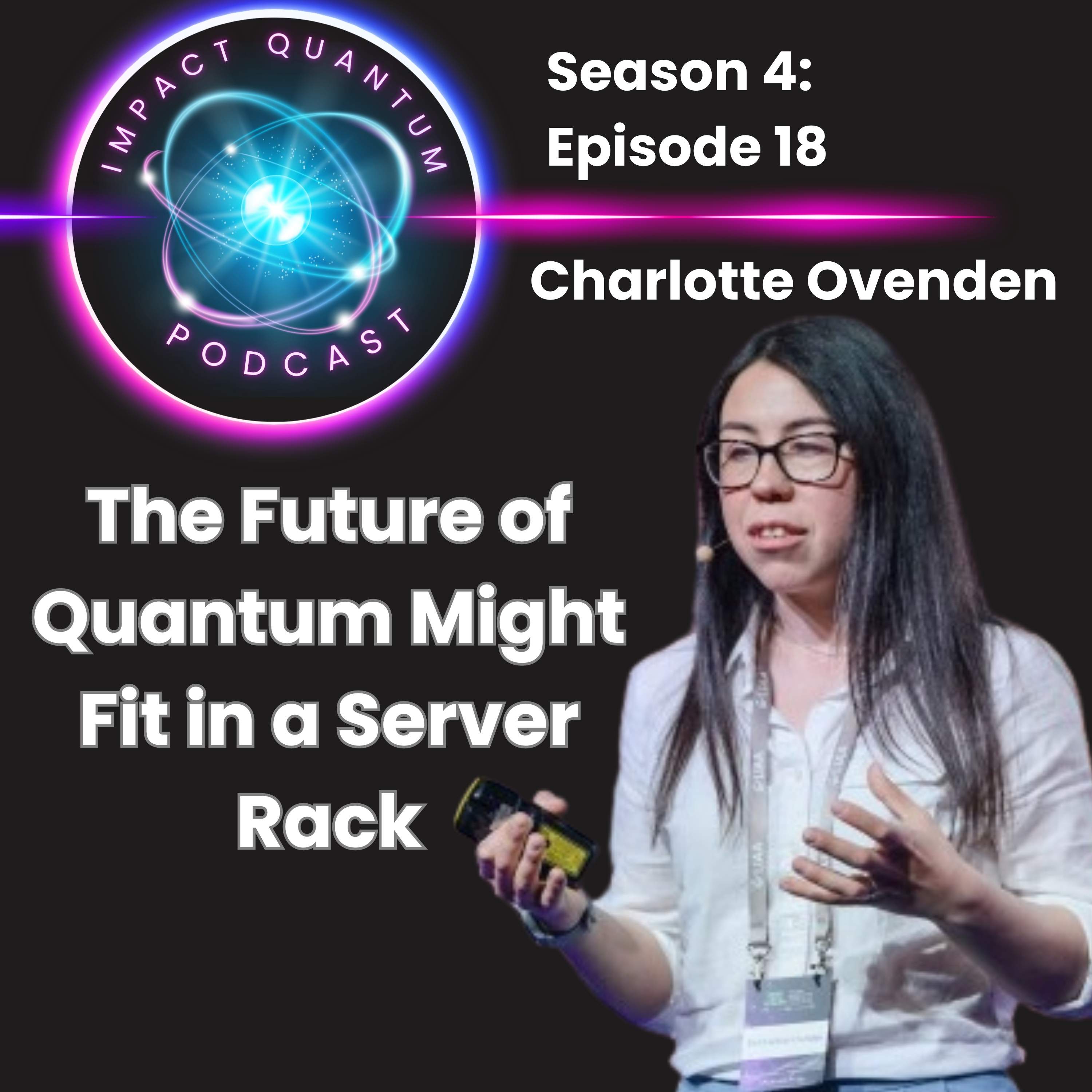
Candace and Frank sit down with Charlotte Ovenden, Delivery Lead at Aegiq and a passionate advocate for interdisciplinary collaboration in quantum technology.
With a unique background spanning chemistry, physics, and electrical engineering, Charlotte Ovenden shares her journey from academic research to leading groundbreaking projects in quantum photonics.
Together, they unpack myths about quantum computing, discuss its future alongside classical computing and AI, and explore the practical challenges—and excitement—of scaling photonic quantum systems. Whether you’re a quantum enthusiast, a curious technologist, or just keen to understand what skills will matter in the next era of computing, this conversation offers candid, accessible insights into the rapidly evolving quantum ecosystem.
Links
- Charlotte on LinkedIn – https://www.linkedin.com/in/charlotte-ovenden-38b00052/
- Watch this Episode on YouTube – https://youtu.be/xH2yiUOdE-g
Time Stamps
00:00 Discovering passion for quantum dots
04:38 Importance of diverse technical skills
06:54 Working as a delivery lead at Age Corp
10:12 Explaining quantum dot behavior
14:30 Developing scalable quantum architecture
18:08 Exciting future of quantum networking
20:58 Ease of quantum computer deployment
25:56 Scalability challenges and solutions
27:37 Balancing team skills for success
30:51 Opening the quantum industry
35:33 Creating entangled states with quantum dots
38:24 Language barriers in quantum computing
40:08 Expanding tech possibilities
46:07 Talking about internet evolution
49:21 Importance of communication skills
51:11 Electric motor’s potential explained
54:16 Discussing the quantum podcast
Transcript
I think the. The hype of quantum computing is going to take
Speaker:over the world. The first one that I hear,
Speaker:you know, if I, you know, talk to people, oh, what do you work on?
Speaker:And they're like, oh, is that going to be the next. You know, it takes
Speaker:over everything. I think quantum computing is going to sit alongside
Speaker:what we're doing with HPC classical AI at the moment,
Speaker:rather, rather than being, like, wiping everything else out. It's not going to
Speaker:replace anything. It works really well with those
Speaker:technologies in parallel. Welcome to Impact
Speaker:Quantum Podcast.
Speaker:Turn it up fast.
Speaker:Quantum Podcast. They're breaking the mold. Science and
Speaker:hello, and welcome to Impact Quantum Podcast. We explore the
Speaker:emerging industry of quantum computing where we don't need to
Speaker:be a PhD, although probably helps. We'll talk about that.
Speaker:But you just need to be a little bit curious because this is an entire
Speaker:ecosystem that's being built out right before our eyes, and you just
Speaker:need to be a little bit curious. And with me is the most quantum curious
Speaker:person I know, Candace Kahuly. How's it going, Candice? It's great.
Speaker:Thank you so much. I'm really excited about today.
Speaker:We're going to be speaking to Charlotte Ovenden, who
Speaker:is the delivery lead at ajic,
Speaker:and in the green room, we already started talking about what
Speaker:she does and we had to stop ourselves to get back to the show. So,
Speaker:Charlotte, thank you so much for joining us today. Oh, thank you so much.
Speaker:It's great to be here. I'm very excited to talk to you.
Speaker:Awesome. So we were talking in the green room, so that's why I said the
Speaker:bit about the PhD. So according to your LinkedIn, you have a
Speaker:master's in chemistry and then you got your PhD in
Speaker:electrical engineering. Yes. That alone is an
Speaker:so. So for fun fact for those listening and for you, Charlotte, who may
Speaker:not know, I started my college career with designs on being a
Speaker:chemical engineer. So chemistry is, I wouldn't say close to
Speaker:my heart, but in the same neighborhood as my heart.
Speaker:Yeah. So that's an interesting
Speaker:leap right there from chemistry to electrical engineering. Yeah,
Speaker:a quantum leap, so to speak. But I was, you know, I was going to
Speaker:let that go, but. So how did you go from chemistry to
Speaker:electrical engine? Yeah, so, well, I think
Speaker:I firstly, absolutely love doing my chemistry masters. I
Speaker:think what I really learned there was curiosity, which
Speaker:fits well with this podcast. But I was
Speaker:looking all at graphene and computational chemistry, actually.
Speaker:And graphene is this very interesting 2D material
Speaker:that was discovered in Manchester in the UK, actually, which I'm Based
Speaker:in Sheffield, so just across the, just across the peak district,
Speaker:but really in that master's studying graphene,
Speaker:it was kind of similar to semiconductor materials
Speaker:and physics. And I was always kind of interested in that
Speaker:intersection between chemistry, physics and
Speaker:engineering, really. And so when I thought, actually I'd love to
Speaker:continue to do a PhD, I, I love learning. It's just
Speaker:the most fantastic thing to me. Then I thought, what do I want to, to
Speaker:do? And a PhD came up that was all about these things
Speaker:called quantum dots in the electron
Speaker:electrical and electronic engineering department. And
Speaker:this was actually perfect because it was kind of an intersection of material
Speaker:science, chemistry, physics and engineering.
Speaker:And so although my PhD was hosted in that department, actually it was funded by
Speaker:the physics department as well. So it was kind of perfect because it was really
Speaker:interdisciplinary. And so although it was
Speaker:a jump and I loved my colleagues would do stuff that was
Speaker:a bit more engineering in nature and so I could learn
Speaker:those off them. It was really this kind of interdisciplinary play
Speaker:that, that really I wanted to be part of
Speaker:and so I could bring the chemistry in, learn some physics, learn some engineering,
Speaker:and that was perfect. And I think, I think
Speaker:you being in the quantum industry makes a lot of sense
Speaker:because there is a significant overlap between chemistry,
Speaker:electrical engine engineering and quantum. Right, yeah.
Speaker:And I think you said the magic word of the day, which is
Speaker:interdisciplinary. Right. This is, you know, one
Speaker:of. One of our earliest guests had said that there's already enough
Speaker:PhDs. No, particle physicists, PhDs
Speaker:in the quantum industry. Yeah. And I thought that
Speaker:was interesting because that's not what I would have expected
Speaker:anyone to say. And the gist of it was,
Speaker:you know, we need people with different disciplines to,
Speaker:you know, solve these problems, lay out these problems, and
Speaker:even as I like to say, you know, rack them and stack them, right?
Speaker:Somebody's gotta plug these machines in. Somebody's gotta,
Speaker:I guess in extreme cases deal with the H Vac issues, the super
Speaker:cold stuff. But I mean, at some point,
Speaker:you know, these are going to be production systems and
Speaker:enterprise ready production systems have a lot of,
Speaker:they're kind of high maintenance, Right. Let's be real, right? Like if
Speaker:you want to get to, you know, five nines of reliability,
Speaker:which may or may not apply to quantum computers immediately.
Speaker:Although I guess tell that to tell that to a financial trader in London,
Speaker:you're gonna need a lot of different people, right? From
Speaker:H Vac techs to electricians to,
Speaker:you know, good old fashioned, you know, hardware people.
Speaker:Yeah, definitely. Yeah, I completely agree. And
Speaker:I think we have a really Interdisciplinary team here.
Speaker:And that's great because actually there's even different language within
Speaker:each of those sorts of subsections. And so having people that
Speaker:understand the language, how do communicate with this set of
Speaker:people, this set of people to. Before you even start trying to solve the
Speaker:problems, that's really, really useful, I think. And
Speaker:you know, the problems that then once you've built your quantum computer that you're trying
Speaker:to solve, they might be spread across quite a few areas
Speaker:as well. Catalysis, aerospace,
Speaker:battery, chemistry. And again, if you have interdisciplinary
Speaker:teams, it's great to be able to go out and talk
Speaker:to those people and understand exactly what is their problem, what do they need
Speaker:to solve and do you do that and how do you work with them?
Speaker:So let me ask you. So we called you a delivery lead.
Speaker:So what is a delivery lead? What is it that you
Speaker:tell us a little bit about? What is it that you do? Yeah, well, it's
Speaker:a good question. So I mean, we're still a relatively small team at
Speaker:startup, so it's a very diverse role. And actually I started
Speaker:as a quantum photonics engineer and then a senior engineer and then
Speaker:moved into delivery. But what it's really about is we have,
Speaker:well, I mentioned these kind of quantum dots that I studied in my
Speaker:PhD and they're the technological backbone of what
Speaker:I look, I look at in my role. So they are what
Speaker:is known as a single photon source and they able to
Speaker:produce the photons or the state
Speaker:that we need for our photonic quantum computers. That's kind of what we do at
Speaker:Age Corp, one of the things we build. And so as a delivery lead,
Speaker:I run projects and
Speaker:product delivery and work with partners all around the development
Speaker:of those single photon sources based on quantum
Speaker:dots, which they're basically deterministic.
Speaker:Deterministic sources of entanglement. And so yeah, my role
Speaker:is all about working with lots of people, working with
Speaker:technical teams to make sure that we can deliver those
Speaker:sources so then they can be used in photonic quantum
Speaker:computers. That's kind of a slightly different
Speaker:set of work that we look at. So
Speaker:I have a couple questions about that one. Okay,
Speaker:I want to unpack some of that. There's a lot. I mean, it's all good.
Speaker:And I think that, you know, I think you're underselling it. Right. Delivery leads tend
Speaker:to bear the brunt of actual implementation. Right.
Speaker:Most of that work is on your shoulders. Right. Like so,
Speaker:like it's one of those things where like, if you want to talk to somebody
Speaker:smart, the delivery lead is probably the person that knows what's
Speaker:going on. That, that's kind of what I've seen. And I'm not just saying that
Speaker:to compliment you, but, you know, but, but I mean, it's true. Like, you know,
Speaker:I've met a lot of, you know, I see a lot
Speaker:of parallels between operationalizing AI and what
Speaker:we're, what we're starting to see with operationalizing quantum. Right. There's
Speaker:a lot of parallels. Right. Because these are, you know, you're bringing really
Speaker:niche abstract mathematical concepts to regular
Speaker:software engineers. Regular, you know, regular people that are not
Speaker:necessarily in that discipline. Right. It is inherently, as you said,
Speaker:multidisciplinary. So what the heck is a quantum dot
Speaker:again? Because you said it was. No, no, no. But you
Speaker:said something that really, that really like, made me like stop and think.
Speaker:And it was like, they're deterministic. Yes. It's
Speaker:not a term you hear a lot. Deterministic entanglement,
Speaker:I think you said. Right, yeah. What is that?
Speaker:Yeah. And then not only what is that, but how does. Because this is not
Speaker:a non deterministic field generally. So.
Speaker:Yeah, yeah, I should. That's a lot. Explain all of that. That's a lot unpack.
Speaker:So let's start. Yes. Yeah. So I'll kind of define the language a little bit.
Speaker:So, well, the quantum dots, I'll explain what they are. I'll
Speaker:go through. So a quantum dot, kind of physically, what that is,
Speaker:is around, give or take 10,000
Speaker:atoms. In our case, they're in semiconductors.
Speaker:So 10,000 atoms of a semiconductor
Speaker:embedded in another semiconductor. And the reason that we do
Speaker:this is because they have different band gaps, those two
Speaker:material types. And that means that we can confine
Speaker:electronically confined charges. Basically within the
Speaker:quantum dot, you get some sort of confinement. And that means
Speaker:that basically if you hit it with a laser, one of the
Speaker:electrons in one of those atoms will be excited. After some
Speaker:time, it will decay and then a photon will be produced.
Speaker:This is kind of the deterministic aspect of it. So
Speaker:whenever you hit that quantum dot with a
Speaker:laser, a photon is produced deterministically. So
Speaker:and that happens every time. And the energy of the photon,
Speaker:it's the same in each case because it's based on this band gap.
Speaker:So conduction to valence band in the quantum dot. This is kind of like
Speaker:an. An atom. So it's an artificial atom. You can think of it
Speaker:as. So basically you're deterministically on demand
Speaker:getting photon out. And each photon is the same energy
Speaker:as the next one. Oh, okay,
Speaker:that, that makes sense. As opposed to normal, nor normally, like, who
Speaker:knows what you get. So as we're recording this, the entire,
Speaker:maybe not the entire US but like a third of the US is under this
Speaker:massive snowstorm thing. I don't know if it's made international news, but the forecast
Speaker:we're Getting in Baltimore D.C. is well,
Speaker:up until today it was. Well, it could be two inches or it could be
Speaker:two feet. Right. So I mean,
Speaker:weather forecasting is kind of a good example of non
Speaker:determinism. Right? Yeah. You're not right all the time.
Speaker:Yeah, yeah. I mean, the only thing that we, in this example I think is
Speaker:kind of, you could say that there's both. Right. It's going to snow.
Speaker:Yeah. But as I told my kid today, who is very excited about the possibility
Speaker:of being out of school for more than one day, you know, I'm
Speaker:like, I'm like, look, it's going to snow. The question is, is this going to
Speaker:be the type of snowstorm you'll tell your kids about or is this going to
Speaker:be just another snow day? Yeah, I don't know. Right.
Speaker:Yeah, exactly. So we, we know that a photon will
Speaker:be produced each time. So the on demand
Speaker:entanglement bit, that's a. I'll kind of go towards that.
Speaker:But yeah, so that's my kind of building block is my quantum
Speaker:dot producing these photons that are all the same to each as each other,
Speaker:so indistinguishable. And the beauty of
Speaker:indistinguishable, indistinguishable photons is you can entangle them.
Speaker:And of course, well, entanglement is very useful for quantum
Speaker:computing. It allows us to do lots of very interesting things.
Speaker:And because we have this determinism, it means that we have on
Speaker:demand, essentially entanglement. And we can build
Speaker:up many of these photons that we produce from a quantum dot
Speaker:or many quantum dots to produce the kind of input state
Speaker:for the photonic quantum computer. So I should say, because we're in photonics,
Speaker:we're basically in all optical domain. So we just. Everything
Speaker:is done with photons. There are qubits, basically,
Speaker:there are, there are building blocks. So the, the quantum dot in the
Speaker:sense is the engine behind the quantum computer.
Speaker:Hopefully that answers the, that does kind of. I mean, many more
Speaker:questions, but can you
Speaker:share anything a bit about the most exciting
Speaker:project you're working on right now with quantum photonics?
Speaker:Yeah, definitely. Yeah. So we've moved
Speaker:into the telecom C band. So
Speaker:this is basically the wavelength the quantum dots emit at or what the energy
Speaker:of the photons is. And previously we
Speaker:spun out the University of sheffield in the UK and
Speaker:they had over 20 years of experience of developing these
Speaker:quantum dots at another wavelength so
Speaker:around 900 nanometers. And so we want to do
Speaker:this at:Speaker:This is important for a number of kind of technical
Speaker:reasons, but actually there's a few sort
Speaker:of changes you need to make to your system. You need a new material,
Speaker:you need to operate in slightly different ways.
Speaker:And so I've been working on projects developing that
Speaker:and that's going really well actually getting some really
Speaker:nice results really interesting out of that. And
Speaker:that's kind of being applied across a few
Speaker:projects. And then what we've done recently as well. Although
Speaker:from more the theory team side is released our
Speaker:architecture. So we've called this qgate and this is
Speaker:all about this on demand entanglement. Using
Speaker:this determinism from these quantum dots to have a really
Speaker:scalable architecture of your photonic quantum computer.
Speaker:That means that you have fewer component requirements
Speaker:and some of those engineering challenges
Speaker:associated with probabilistic sources you can kind of reduce a bit.
Speaker:So it's, it's really exciting to take this
Speaker:quantum dot technology that I kind of studied in my PhD and see
Speaker:okay, we can build a photonic quantum computer using
Speaker:these deterministic properties. That very exciting
Speaker:basically. So yeah, that's been really great to work on.
Speaker:Is there any particular problem domain that your solution
Speaker:excels at? I know you mentioned battery storage and chemistry.
Speaker:Give given your background in chemistry and electrical engineering, that does seem like a
Speaker:natural fit for your skills. But is that something that your company
Speaker:focuses on? Yeah, so I think well with
Speaker:our computer and kind of with quantum computers in general, what they
Speaker:do very well. What what we'd like to do and are aiming to do
Speaker:and working with people to is. Is
Speaker:very. Is. Is describe the physical world which
Speaker:is quantum in nature. When you take that kind of quantum chemistry like you
Speaker:said, catalysis, battery chemistry, molecular interactions,
Speaker:quantum natively describes that very well
Speaker:because those systems are. Are quantum in nature. So
Speaker:I think our technology lends itself very well to
Speaker:describing those sorts of problems that often actually
Speaker:what I remember myself from my masters, I did computational
Speaker:chemistry. So of course it's very different to being an industry. But
Speaker:I do remember the frustrations of oh I've got this idea but
Speaker:it will take so long to simulate it that you know,
Speaker:I can't do it and being like okay, let's scale down the problem or
Speaker:and you know I'm sure in industry you'll take something
Speaker:that might take a very long time to develop in the lab,
Speaker:but actually if you could simulate cuts your lab time
Speaker:quite significantly. And so yeah, I think that's what our,
Speaker:our technology, what we're looking at, what we're interested in
Speaker:is those quantum by nature problems that the
Speaker:quantum computer is kind of ideal for.
Speaker:Interesting. Okay,
Speaker:what trends in quantum communications and photonics are you the
Speaker:most optimistic about right now? Yeah,
Speaker:so. Well, I think photonics in general is
Speaker:a great modality to work in.
Speaker:It's, it's all optical already when we, when we really talk about
Speaker:computing. So kind of, well, in terms
Speaker:of trends, I think, well, we'll see what, what happens in terms
Speaker:of the modalities of quantum computing. But photonics kind of underpins
Speaker:all of, all of those sorts of quantum computing modalities.
Speaker:It's important and so I'll be excited to see how everything
Speaker:progresses. Photonics is kind of going to, I think, be an important
Speaker:part of all of that. That's very interesting.
Speaker:And then in terms of communications, I think
Speaker:networking, loads of great steps are
Speaker:being made there. It's, it's, we're seeing, you know,
Speaker:continuous improvement in what people can do. And
Speaker:to me it's going to be very exciting when, when we do get to a
Speaker:stage where you have kind of networks, no,
Speaker:you know, quantum nodes, all of those things and it all starts to come together.
Speaker:It's a. And I think that will really sit in parallel and
Speaker:be very useful as well. It will sit with HPC and AI
Speaker:and all of these things and they'll, they'll all work well together. And so
Speaker:I'm looking forward to quant developing or kind of all of those
Speaker:things coming together and seeing where we get to
Speaker:do, do photonic systems in general, I've heard,
Speaker:generally don't require being super cooled. Is that. Yes,
Speaker:true. Okay. Yeah, that's right. Yeah. So the
Speaker:cooling in our system, the quantum dots, currently they do have to be
Speaker:cool to around well under 10 Kelvin. But it's
Speaker:not this kind of big chandelier that you see with the millikelvin
Speaker:cooling. And that means actually. Yeah, so it's actually quite
Speaker:different in terms of your requirements. So we deployed,
Speaker:it's a kind of test bed photonic quantum computer, quite small one in the
Speaker:National Quantum Computing center in the UK and it's actually
Speaker:just a 19 inch rack system and
Speaker:the cooling is just integrated into the rack,
Speaker:basically. Wow. Yeah, so it's just, yeah,
Speaker:it just looks like what you would see in a data center basically.
Speaker:And so you just press a button and that calls the system to, you know,
Speaker:10 Kelvin or a bit under. And that's, you know, quite
Speaker:quickly and it has really high uptime and actually then it's
Speaker:pretty stable system actually it works well over a long time
Speaker:period. And that, that does make, you know, your life a bit easier.
Speaker:I've not worked with the chandelier systems or
Speaker:millikelvin cooling, but my understanding is it's a bit more
Speaker:finicky and a bit more difficult and has a bit more
Speaker:overhead. So I'm not an H vac tech
Speaker:by any stretch or cryogenic tech, but
Speaker:so 10 Kelvin would be about negative 260ish,
Speaker:263C, which is seems like, would be an,
Speaker:oddly enough an order of magnitude easier to maintain that than like a
Speaker:millikelvin. Right? Yeah, for sure. And in fact, if
Speaker:it fit, like, people will laugh at me. But like, you know, like
Speaker:the fact that it would fit in a regular server rack with reasonable
Speaker:accommodation, if any, is a huge deal. Right. Just in terms of
Speaker:just basic boring infrastructure and logistics,
Speaker:people forget how important that is until it breaks down
Speaker:then for sure. Yeah. I mean this is something we're
Speaker:really interested in as well is deployability. So
Speaker:if someone already has a data center, whatever, can you just
Speaker:deploy into that really easily and making the customer
Speaker:experience as simple as possible. Because
Speaker:in the end, you know, when we go down the line, these quantum
Speaker:computers, I imagine they're not going to be run by people
Speaker:who, you know, have decades of experience in optics
Speaker:or in cryogenics. They're going to be people that are
Speaker:interested in doing their experiments
Speaker:or you know, might access by the cloud as well. And it's, you know,
Speaker:maintained by someone that isn't an expert. But in the
Speaker:end, you know, you want to get to answering the interesting questions. You
Speaker:don't want to spend all your time maintaining your quantum
Speaker:computer. So yeah, that's something we're really interested in is
Speaker:that deployability being robust, being easy to use
Speaker:and having the benefit of the determinism from the
Speaker:quantum dot that doesn't need to be called so low. It's kind of
Speaker:a, you know, an added benefit. Yeah, that's
Speaker:interesting. You also mentioned C band. Now I remember reading about C
Speaker:band when I was bored one day
Speaker:reading about satellite, how DirecTV works and like.
Speaker:So that is a satellite band communications, right? That's correct, yeah.
Speaker:Okay. Yeah. So we do operate in fiber, so it's
Speaker:also a low loss wavelength in fiber. So
Speaker:one thing you do want to do is once you produce these in
Speaker:photons and have this on demand entanglement, you don't want
Speaker:them to go anywhere. You want to keep them basically. And, and
Speaker:that's what we describe as loss. And any loss will introduce some error
Speaker:and again you don't want error. So the telecom C band, one of the
Speaker:advantages is in fiber and in other materials
Speaker:like silicon photonics, you lose fewer
Speaker:photons if you operate at this wavelength range. So it's an
Speaker:advantage. So and that's why we were interested in
Speaker:developing this quantum dot technology in that wavelength. And
Speaker:you can also all of that silicon photonics manufacturing
Speaker:capability that of course has been developed over a long time period,
Speaker:you can then kind of adapt that to what you need to do and
Speaker:take advantage of all those very smart people that have
Speaker:developed many things over many years. Plus all the infrastructure for
Speaker:C band frequency is already in orbit. It's already
Speaker:like the, the, the, the shape of the dishes are optimized
Speaker:for those frequencies. It seems like it seems like the right choice
Speaker:for a number of reasons. Yeah, for sure. And actually even just simply
Speaker:from a more engineering standpoint by
Speaker:buying components off the shelf. There's, there's so much at
Speaker:C band and 900 is a bit of a, you know, it's
Speaker:still a very interesting wavelength. You can still do lots there and you know we
Speaker:have a lot of know how around that. But you do sometimes have to pay
Speaker:a lot more for your components because it's slightly odd wavelength
Speaker:range. So there's also other advantages like that. That is more
Speaker:the engineering brain of oh, I can just look how much choice I
Speaker:have. You can piggyback on existing
Speaker:systems which. Yeah, that is, that is a very practical engineering concern.
Speaker:Yeah, right. Because you could probably go off. I knew a guy who was really
Speaker:into satellite stuff like and picking up satellite systems
Speaker:legally. I'm sure I don't ask too many questions
Speaker:but you know, he was telling me all about all the stuff you can find
Speaker:on ebay, like just discarded stuff. Yeah.
Speaker:So he had a setup that was just
Speaker:ridiculous, like absurd. But I could admire it, you know,
Speaker:but it was, but you know, he said, you know, he can get parts for
Speaker:pennies on the dollar, so to speak. They're used for sure. Yeah,
Speaker:yeah. And it makes a big difference particularly when you're a small
Speaker:startup that maybe you don't have quite as much
Speaker:cash as other people. You know, it does make a difference and
Speaker:it helps with scaling as well. If you can compete keep that component Cost
Speaker:down. And of course scaling is the name of the game with quantum. We,
Speaker:you know, we all want to scale our computer size to be able to
Speaker:solve these interesting problems.
Speaker:Yeah, that's. Oh, sorry, go ahead. So further to the scaling question,
Speaker:what part of the system is the
Speaker:most underestimated?
Speaker:So as in kind of. Oh, sorry,
Speaker:sorry. What do you mean sorry? Well, I was thinking about the. When
Speaker:you think about how you get to scale quantum photonics, I'm
Speaker:wondering like we were talking about error correction, we're talking about temperature.
Speaker:So I'm wondering which is the one that people might not
Speaker:people are underestimating as it's a difficult part to scaling.
Speaker:I mean. Yeah, it's a great question. So I think
Speaker:in terms of scalability, the difficult parts
Speaker:actually have been a lot of the probabilistic nature
Speaker:of the systems. And so this is kind of what we're
Speaker:trying to solve with our determinism. Of course that isn't to
Speaker:say, you know, the people working probabilistic sources, they have
Speaker:absolutely fantastic engineering means of dealing with that, but it does
Speaker:mean you have these very large footprints and does make scalability
Speaker:more difficult. That, that's a big part I would say as
Speaker:well. So to kind of look at that
Speaker:determinism definitely helps. But also things
Speaker:that aren't quite connected to the technology, you need enough
Speaker:skilled people or you know, people interested
Speaker:in doing these things. You need support, financial support
Speaker:and we need kind of people to get together and make sure
Speaker:that these, you can have support for these technologies. There's the skilled
Speaker:people within companies able to, to work on them,
Speaker:to develop because there's lots of
Speaker:still kind of interesting engineering problems to solve and you need the
Speaker:people to do that to be able to scale.
Speaker:Interesting. I
Speaker:forgot my question. Go ahead, Candy. Okay, no problem. So it's
Speaker:difficult, I mean everything that you're working on. So and this is like long
Speaker:term projects. So how do you keep long
Speaker:term scientific rigor intact while
Speaker:still pushing for these real world milestones?
Speaker:Yeah, I think it's, it's a great question because
Speaker:everything has to be done really rigorously and you
Speaker:have your, your goals, you have your kind of projects, your products
Speaker:that you want to get to. But you do have to be so
Speaker:detailed along the way because actually if you small
Speaker:issues could turn into something larger. So yeah, I
Speaker:mean there's, there's stuff in kind of companies about as a startup, this is something
Speaker:we've looked at you, you have to develop your processes and have
Speaker:the right people to do that. And a Lot of the time, you know, if
Speaker:you have a small company that comes from maybe
Speaker:people with great understanding of the academics,
Speaker:the technology, but haven't necessarily done a lot of that process
Speaker:control and rigor, you have to make sure that you have the right balance
Speaker:in your team to say, okay, we've got the
Speaker:people that can blue skies thinking, the technology, people that are really
Speaker:good at looking at the details, the processes and making sure
Speaker:that every step is rigorously completed and just a
Speaker:balance of those things. And I think, you know, having a
Speaker:team where each person cares and is
Speaker:diligent and looks at the details
Speaker:of those things while keeping in mind bigger picture is important. So
Speaker:I think it comes down to the balance of your team. I think we're very
Speaker:lucky. We've got a fantastic team that I love to work with
Speaker:that kind of. We're all really excited by what we do
Speaker:and really care that it's done very, very well.
Speaker:There's, I think, a wider question about stuff like
Speaker:standardization. So
Speaker:who looks at, I know there's NIST in the US and
Speaker:we have bodies in the UK as well that look at
Speaker:standards and then basically controlling against
Speaker:those standards. And can you have an external body come and check
Speaker:and measure what you've done as well and define the language
Speaker:about what are you actually doing as well? If
Speaker:I say I have a photon indistinguishability of X,
Speaker:what does that mean? How have you measured it? What does it do? So
Speaker:there's a kind of on the small scale of the team and then moving on
Speaker:to kind of, you know, maybe countrywide,
Speaker:defining your standards, etc, and then a kind of global.
Speaker:Okay, how, how do we then make sure that's all standardized as well?
Speaker:So I'd say there's lots of like little details along the way and
Speaker:different ways of looking at it, but I think that that also proves out
Speaker:kind of, you know, a thesis for our show is the idea that you
Speaker:don't need like somebody who has an experience building an assembly
Speaker:line. Right. Whether it's for, you know,
Speaker:computer chips or, you know, anything really.
Speaker:Like, how do you, how do you make an industrial product line?
Speaker:Yeah. So to speak, for sure. Printed circuits, boards, whatever,
Speaker:can have a very satisfying and rewarding career in quantum. Because
Speaker:that is something that quantum companies are
Speaker:going to need. Right. Like it does. You don't have to, you know, obviously a
Speaker:little bit of understanding goes a long way, but you just have to be curious.
Speaker:Yeah, a hundred percent, definitely. Yeah. Curiosity
Speaker:and care for what you're doing are so important. I Think
Speaker:as we see the quantum industry grow, you know, when it started,
Speaker:maybe it's a bunch of people with quite similar backgrounds talking to each other,
Speaker:but that doesn't build an industry. You, you have to
Speaker:have all sorts of people. And so yeah,
Speaker:that, that's so important and, and opening it up. I
Speaker:think something I, I was, I remember doing my masters and
Speaker:moving into kind of engineering, then moving more, you know, into a photonic
Speaker:startup and kind of feeling that nervousness with each
Speaker:jump, like, oh, is this the place for me? Like, this is scary.
Speaker:And so making sure that kind of there is space for
Speaker:all of those people that we really need to say yes,
Speaker:quantum is for me is incredibly important. I'd say
Speaker:yeah. And you know, and you know, I'm sure you have a failed sales team
Speaker:and things like that that'll go and say, like, you know, have you. Somebody
Speaker:has to do the go to market strategy, right. Like if everything from
Speaker:soup to nuts, as we say, has to be considered if you're going
Speaker:to be a serious company. Right. So,
Speaker:you know, maybe. And you're right, like at one point everybody was standing around a
Speaker:whiteboard arguing about formula and you know
Speaker:what that is? That is perfectly fine because today's wacky,
Speaker:wacky markings on a whiteboard are like,
Speaker:you know, the next decades, like industry. Right. So
Speaker:that's important too. But like, as this becomes more and more of a commercially
Speaker:viable solution, obviously you're going to
Speaker:need everybody that can help make it commercially viable.
Speaker:And you know, that includes, you know, the charismatic CEO
Speaker:like Steve Jobs. Right. You know, all the way down
Speaker:towards, you know, your marketing genius, like, like Candace.
Speaker:Yeah, he's so good to me. So.
Speaker:Yeah, yeah, no, I completely agree. And each
Speaker:of those people, you know, I'm sure they're so important,
Speaker:they're so needed and I'm sure gets, you know, in your
Speaker:niche, you get so much satisfaction out of doing a good job as well.
Speaker:So making sure that supported is really important.
Speaker:So I have a nerdy technical question about
Speaker:entanglement over fiber. We had a previous
Speaker:guest saying that right now satellite is the most effective way because
Speaker:all you need is a unit up and a unit there
Speaker:and then whatever the receiver. Because
Speaker:fiber, entanglement over fiber only lasts. What was the number,
Speaker:Candace? 30,000, 40,000 kilometers? Something
Speaker:like that. Yeah. Not. Yeah, and you might need
Speaker:repeaters and then repeaters introduce. It's not like old
Speaker:fashioned fiber repeaters where you don't have to think about entanglement.
Speaker:These repeaters are very expensive and I would imagine
Speaker:Putting my paranoid hat on that
Speaker:you have to collapse the state and then all of that
Speaker:secureness you get over, you know,
Speaker:being invulnerable to eavesdropping.
Speaker:If you have to collapse it and then remake it, that seems like it would
Speaker:be a nice little point of failure. Yeah, I
Speaker:could be wrong, but that's just kind of my, my thinking
Speaker:because my wife actually works at NIST doing cyber security.
Speaker:Oh. So like, so, so yeah, we're two engineer family. So.
Speaker:So when, when I tell my wife about some kind of new tech that,
Speaker:you know, supposedly she's like, well, she always will
Speaker:try to find a point where it's a point of failure. And one of the
Speaker:things out was well, if you have a repeater, is that
Speaker:not a point of failure? And if it's at the bottom of the ocean, that's
Speaker:one level of difficulty. Right. Or you know, in a
Speaker:surface closet somewhere. Right. That's one level that's probably
Speaker:difficulty. Zero. Bottom of the ocean raises the stakes. But
Speaker:in orbit is probably be the hardest one to intercept. Not
Speaker:impossible, but hardest. That having been
Speaker:said, like what are the limitations of doing this over fiber?
Speaker:Yeah. So I think our kind of fiber stuff is a
Speaker:little bit different. So when. Well my, I don't really
Speaker:work in the communication space, but yes. What. And you
Speaker:know, I'm familiar with the kind of repeaters and yes, you have this thing
Speaker:kind of entanglement swapping and stuff like that.
Speaker:But our entanglement and our fibers are a bit different.
Speaker:So because it's kind of locally within the quantum computer
Speaker:we generate things. So it's much shorter distances.
Speaker:Yeah. So we're generating the entanglement. So we have these quantum
Speaker:dots that can produce these things known as cluster states, which are kind
Speaker:of entangled photon states, basically
Speaker:many photons. And then you have a silicon or
Speaker:whatever material want to use based
Speaker:interferometer or kind of chip
Speaker:photonic integrated circuit of sorts that you can do stuff known as
Speaker:fusion operations between qubits. So kind of
Speaker:glue those, those states together basically and then
Speaker:you produce this kind of this big fused
Speaker:state that, that's your resource state into your photonic
Speaker:for your photonic quantum computing. And then you're in
Speaker:fiber, but they're very short distances and
Speaker:so it's a little bit different. So it sounds like it's a problem you, your
Speaker:company doesn't have to deal with. Yeah, basically you're not sending stuff
Speaker:into orbit or you're not sending entangled photons from New York to
Speaker:London or. Exactly. You're probably doing it within the same
Speaker:data center, if not the same rack. Exactly. Yeah. So
Speaker:it's a kind of, in terms of that, it's kind of easier problem
Speaker:to deal with, really. And yeah, I mean, you still have to
Speaker:consider kind of photon losses, but more if you have,
Speaker:say, your etching of your material isn't very good and you
Speaker:had a rough surface, some photon would pew off somewhere else and
Speaker:you'd lose it. So there's still considerations of
Speaker:errors, photon losses, but it's a little bit of a different,
Speaker:you know, different technology. I mean, I'm sure someone that knows a lot about
Speaker:comms and all of that might, might tell me I'm missing something, but.
Speaker:Yeah, but at your scale of like meters, you're not worried
Speaker:about, this is not a problem that'll show up within
Speaker:the distances you're talking about. Okay, yeah, that makes sense. That makes a lot of
Speaker:sense. Yeah. Well, we always ask
Speaker:everybody this and the answer is always very
Speaker:interesting. So what do you think is the biggest
Speaker:misconception out there right now about quantum
Speaker:computing that you think could use a little bit of reframing?
Speaker:Yeah, I think that's a great question. So, I mean, I'd probably
Speaker:start maybe with a couple of things. I think the, the
Speaker:hype of quantum computing is going to take over the world.
Speaker:The first one that I hear, you know, if I, you know, talk to people
Speaker:like, oh, what do you work on? And they're like, oh, is that going to
Speaker:be the next, you know, it takes over everything. I think quantum computing is going
Speaker:to sit alongside what we're doing with hpc, classical
Speaker:AI at the moment, rather than being like, wiping
Speaker:everything else out. It's not going replace anything. It works really
Speaker:well with those technologies in parallel. That would kind of be
Speaker:my, my big thing. And I think more on a personal level
Speaker:that quantum computing isn't for. Or
Speaker:quantum in general isn't for everyone. I know that when I kind of
Speaker:moved into this space, the language was very different to what I was used
Speaker:to. And so it was kind of getting
Speaker:over that barrier of. Of course, language is important because it allows people
Speaker:to, you know, a word you might need to learn about,
Speaker:you know, the background of something for five years and you can describe it in
Speaker:one word, and that's very useful when talking to your
Speaker:colleagues or whatever. But it shouldn't be a barrier to someone
Speaker:who's got some fantastic ideas, but doesn't quite
Speaker:have the same language in their, in
Speaker:their space, not coming in and contributing.
Speaker:And so I think inclusivity of language is so important,
Speaker:making sure that people are welcomed. And so any
Speaker:misconception if you think quantum isn't for you. Well, it is,
Speaker:it is, definitely, it's. I found it to be a really welcoming
Speaker:space. And yeah, if
Speaker:anyone's kind of scared by it, as I know I was,
Speaker:welcome to quantum, basically. Well,
Speaker:paraphrase Richard Feynman, if you're not scared, you're not paying
Speaker:attention. Right. Like I. There's a lot
Speaker:of crazy things and. But that's the fascinating thing. When I, when I first heard
Speaker:about it, I was like, wait a minute,
Speaker:you know, this can't be real. And like, oh my God, it is real.
Speaker:And then like you kind of start pulling out that thread where it's like, well,
Speaker:if, you know, because of the different nature of it,
Speaker:you need different fundamental logic gates at the hardware level.
Speaker:Like, my God, what does that open up? That opens up like a whole new
Speaker:world of possibility. Right. And that was me
Speaker:like an old school, like computer science grad or like, you know, it was like,
Speaker:you know, there was the, I don't know, however many gates there were and
Speaker:variations of them. Less than two dozen for sure. But
Speaker:now you can add what are there about five or six of them
Speaker:now, say. But if
Speaker:you throw that in combination with the existing ones, then you've
Speaker:increased the complexity and what you can build orders of
Speaker:magnitude. It really opens up. That plus the non deterministic
Speaker:nature of it also opens up some really amazing
Speaker:doors too. Right. So the combination of it all was that
Speaker:aha moment for me.
Speaker:Yeah. And I think you're right. We do need
Speaker:inclusive. In the spirit of inclusive language, you've said HPC a number of
Speaker:times. Oh, I did, yeah. No, that's fine. We love
Speaker:acronyms. But I'm assuming you mean high performance computing.
Speaker:I do, yes, exactly. And how would you define high performance
Speaker:computing? Because everyone has a slightly, everyone will have a slightly different thing. But if
Speaker:you were like at a cocktail party and you said hpc, you
Speaker:know, what would you say to like a normal, like a normie?
Speaker:I would probably say think of
Speaker:loads of your computers glued together so that you
Speaker:can kind of answer very large
Speaker:problems is how I'd think about it classically.
Speaker:But some problems, you know, you, they are solved classically very
Speaker:well. So you just need lots of computers glued together.
Speaker:That's a, that's a great way to put it. Right. I don't think I could
Speaker:improve on that. The.
Speaker:No, I think it's interesting to kind of see,
Speaker:you know, high performance computing was generally just an academic thing for the
Speaker:longest time. Then industry, certain industries, I think pharma was
Speaker:probably the one that pops to mind, really kind of latched
Speaker:onto it. Now you're seeing more and more whether it's engineering.
Speaker:Once upon a time, you know, when I worked at
Speaker:Microsoft, one of the. I never worked on
Speaker:it, but, like, I knew people that worked on for one of the big auto
Speaker:manufacturers out of Detroit, they had an HPC to
Speaker:simulate, you know, all sorts of things.
Speaker:Yeah. And NDA would probably prevent me from saying anything other than all
Speaker:sorts of things, but a lot of things that you wouldn't necessarily think about, like.
Speaker:Oh, yeah, you know, and obviously, you know, there's the canonical example of root
Speaker:optimization, which although quantum does a much better job at.
Speaker:Yeah. But I mean, some things, hpc, you know, we've got some fantastic
Speaker:results out of. For sure. Yeah. So this, this
Speaker:is why I think it's important to not say Quantum's going to come in
Speaker:and take everything for sure. Although
Speaker:I can easily see like you're gonna have. I wonder
Speaker:if in not the distant future, but the
Speaker:reasonably soon future, Quantum will just
Speaker:be considered another type of hpc. Yeah, yeah, for sure.
Speaker:And the budgets are about the same. Yeah, definitely.
Speaker:Yeah. And I think the kind of differences that you
Speaker:make might not be shouted about. They'll be, you know, you have your
Speaker:electric vehicle, it charges in two minutes. Why is
Speaker:that? Because the battery was simulated on a
Speaker:quantum computer that's been solved. No one's, you know, that's
Speaker:not in the news. Quantum computer makes a fantastic battery. What's in
Speaker:the news is, oh, whichever company has, you know, a
Speaker:fantastic battery. So to me, it's,
Speaker:yes, another form of HPC that allows us. Those developments that we've
Speaker:been making, maybe a step change in what we're able to do.
Speaker:But those will be the kind of taglines in the news rather
Speaker:than the concept. It will get to the point, at least that it's just
Speaker:HPC and people. Maybe there's not quantum this
Speaker:and quantum that. It's battery this, pharmaceutical that, or
Speaker:just. Yeah, conventional things get better. Like, one example I like to give is Star
Speaker:Trek. Right. If you ever watch Star Trek, how often do they have trouble with
Speaker:their communicators? Yeah, very rarely. Right. They're like
Speaker:300km under a rock and they can still talk to the ship. Like,
Speaker:I can't go. I can't go to the petrol station without
Speaker:hitting at least two dead spots. Right. Like, and I'm on the
Speaker:surface of the planet. Right. Like, you know, and it's just kind of funny. Right.
Speaker:So entanglement could, you know,
Speaker:could address that, I would say. Yeah,
Speaker:definitely. Those little niggles that will
Speaker:solve and someone will be like, oh, I'm really happy
Speaker:that that doesn't impact me or things. That
Speaker:drug development already over the decades has been incredible.
Speaker:If we could have a step change in
Speaker:solving and being able to cure more diseases, that sort of thing, that would be
Speaker:fantastic. And that would be the kind of
Speaker:headlines I would want to see as well, you know, you know,
Speaker:cancer is cured or so I don't, I don't know if I don't. But I
Speaker:mean, nothing about that at all really. But, you know, I mean, at the end
Speaker:of the day, even cancer is some biological
Speaker:malfunction of a chemical process which, because it's
Speaker:a chemical process, it's inherent there. There is a quantum aspect to it.
Speaker:Yeah, yeah. Oh, no.
Speaker:So, yeah, I won't pretend to know anything about biology.
Speaker:Right. Yeah, yeah, yeah. So you'll enjoy, you'll enjoy
Speaker:this. This is an anecdote from the other day. So I had my 10 year
Speaker:old and my 16 year old in the car and apparently we went through one
Speaker:of those dead spots and his Internet like clipped out so he
Speaker:couldn't play his game, glitched out or something like that. And he
Speaker:was upset that, that, yeah, you know, happen. Why can't they
Speaker:make cell phones faster or more reliable? Yeah. And then
Speaker:my teenager turned to his younger brother and said, hey,
Speaker:you know, well, when I was your age, you know, we had
Speaker:to pay, we had to pay extra to get like more than a certain amount
Speaker:of bandwidth. So, you know, I couldn't always use
Speaker:the, you know, the device in the car. And then, and I said,
Speaker:well, when I was, when I was, you know, when
Speaker:I was your age, you know, slightly older, I had to give a
Speaker:presentation about what would be possible, like getting higher,
Speaker:you know, really high bandwidth speeds through what was
Speaker:G in:Speaker:remember I had a bunch of people at a research group that
Speaker:I was giving the presentation for told me that was never going to happen.
Speaker:And, you know, there were too many barriers. And that was
Speaker:1999. Right. And here we are now with 5G and
Speaker:you know, somebody is working on 6G. Right. So, yeah, I'm
Speaker:always very mindful when I say something's impossible, you
Speaker:know. Yeah, but you're right. Like, you know, and then they'll
Speaker:be telling their kids or possibly their youngest sibling, like, you know,
Speaker:I Remember whenever we drove past this spot, we'd lose Internet, you know.
Speaker:Yeah, for sure. Yeah. And then they'll be like a hologram sitting next to one
Speaker:of the kids, like with them, you know. Right, right, right, right, right.
Speaker:Yeah, for sure. It's. And the, the next generation, what they'll
Speaker:just take for granted. It kind of blows my mind. It's, it's
Speaker:really fantastic. And it feels like we're
Speaker:developing so much at the moment. Like technology is moving
Speaker:so fast. It's very exciting. Yeah. It used to be like one
Speaker:generation to the next. Now it's even within the same generation. Right. Like, so when
Speaker:I was a kid, I would complain that my grandmother had a
Speaker:rotary phone and didn't have a color tv. Yeah.
Speaker:In her generation, you know, radio was the
Speaker:top of the line. And we have older members of the family that remembered
Speaker:there was no electricity, like. Yeah. You know, so it kind of became
Speaker:like this, this running joke of, you know, well, you know, and then now
Speaker:with my kids, it's kind of like, well, I remember before you could, you
Speaker:know, I remember, I still remember the first time it was on, I think it
Speaker:was on a Zoom or something like that. Like I was able to download
Speaker:a song in my car, like, and play it
Speaker:like real time stream. Not like, yeah, I don't know how
Speaker:old you are, but I remember like having to get like the big binder of
Speaker:CDs for a long car trip. Oh, for sure. Yeah. My car still
Speaker:has CDs actually. That's funny. That's funny.
Speaker:And then, then it became like, well, before I go on a road trip, I'm
Speaker:going to sink my, you know, my ipod or whatever. And then now it's like
Speaker:just, you know, and even now on planes, some of
Speaker:the plane services now they include Internet, you know, so like
Speaker:it used to be, oh, before I get on this, you know, cross country flight,
Speaker:you know, I gotta, you know, download everything locally. Nope,
Speaker:not anymore. So not
Speaker:necessarily. It's not widespread, but yeah. To that point.
Speaker:What skills do you think are going to matter most for
Speaker:this next generation? Entering quantum and
Speaker:photonics? Yeah, I think.
Speaker:Well understand you've got all your kind of
Speaker:standard, I guess, technological skills or.
Speaker:Yeah. In, in whatever area you want to go into. But I think actually
Speaker:a kind of really key skill is going to be able to go out and
Speaker:talk to other people and understand where
Speaker:they're coming from, what their problems are. So I think a lot of it's
Speaker:going to come down to communication. And of course,
Speaker:AI, you know, is fantastic it has loads of uses,
Speaker:but I think that human to human interaction is going to remain
Speaker:incredibly important and going to be able to talk to people
Speaker:firsthand, build those relationships while having, you know, whatever
Speaker:understanding of whatever area in the field that you need.
Speaker:That's going to be a key skill. So, you know, I,
Speaker:I work with loads of fantastic partners. I really enjoy working with
Speaker:them, and it makes a big difference, I
Speaker:think, building those relationships, enjoying working with people.
Speaker:You. Well, personally, I learn a lot from other people, from talking to
Speaker:them, and I feel like that's a good skill to kind of
Speaker:take through as we move away from just purely
Speaker:being like physicists at the blackboard, which is important as well. You know, keep
Speaker:that definitely, because that's the next. That's
Speaker:the next 30 years. Like, I don't. I can't read what's on your blackboard and
Speaker:your whiteboard. But, but I mean, if you, you know, and it. That's probably more
Speaker:practical given you're a delivery lead. Right? But like, if you were at a
Speaker:university, I mean, one of my favorite stories, I forget what book
Speaker:it was in, but it was basically, Robert Maxwell, I suppose,
Speaker:was doing some crazy electronic electrical experiments in the
Speaker:1850s or something like that. And as the story
Speaker:goes, could be. Could be a real thing, could be not. You know, he was
Speaker:like, you know, he built like this little electric motor, and then he showed it
Speaker:to some member of Parliament. And the member of Parliament was kind of like,
Speaker:big deal. It spins, right? And he goes, no, no, no, no,
Speaker:no. One day you'll be able. It'll be able to do all this stuff.
Speaker:It'll be able to, like, you know, make factories anywhere and things like that. And
Speaker:he goes, oh, and you'll be able to tax it and everything it creates.
Speaker:And then as the story goes, the member of Parliament, his eyes
Speaker:lit up like, tell me more.
Speaker:You know, but you're right. I mean, but. But that's a communication thing right there,
Speaker:right? Like, you know, and, and as someone who has, in a past role,
Speaker:had to present to members of congress and, you know,
Speaker:visiting dignitaries and, you know, what excites a
Speaker:developer does not excite them. Right? Yeah. Like, so you kind of have to change
Speaker:your message. And that's also important too, like, for anyone that's. That's listening
Speaker:to this for career development. I don't know what the statistic is, but it's
Speaker:something like 90% of the people are more afraid to speak in front of public,
Speaker:in public than they are jumping out of a plane.
Speaker:Oh, wow. Something ridiculous. I mean, but it's kind of
Speaker:like. Well, and that's us. I told my kids this. I told anyone,
Speaker:anyone that'll listen. You know,
Speaker:honestly, if you just get comfortable public speaking, you already in the top
Speaker:10th percentile, top 10 percentile of
Speaker:just people. Right. Just that alone. If you're comfortable with it and
Speaker:God help you if you get good, then, then it gets even better from there.
Speaker:But like, just be comfortable with it and you're already like
Speaker:night. You're already in the top 10%. Yeah. Right. Yeah.
Speaker:And that, that's a good point. Yeah.
Speaker:So where can folks find out more about your company, you and kind of
Speaker:what you all are up to? Yeah. So. Well, we just launched our
Speaker:new website actually, conveniently. Oh, cool.
Speaker:Yeah, all on our website, which. Well, we have. I know it's
Speaker:a slightly strange company name. So it's about
Speaker:aegiq, so feel
Speaker:free to come to Ajic or Egypt. We all pronounce it differently as
Speaker:well.com and check us
Speaker:out. And then I'm on LinkedIn. I, I
Speaker:always love answering. You know, I get questions sometimes from
Speaker:different people, sometimes who are interested in careers. I, I always love
Speaker:answering questions and, and talking about what we do. So always
Speaker:if anyone wants to come ask me a question on LinkedIn, always very
Speaker:happy to answer that. It's. Yeah,
Speaker:so, yeah, just. We'll include those links in the show notes. Just, just. Oh, amazing.
Speaker:And anything else you want us to. To put there, that'll be fine. Just let's
Speaker:let Candace know and with that we can play the
Speaker:outro music.
Speaker:The multiverse is skanking Skanking in time Black holes are
Speaker:wailing in a horn line so fine From Planck scales to planets they're
Speaker:connecting the dots Candace and Frank they're the cosmic
Speaker:hot shot.
Speaker:Quantum podcast turn it up fast Candace and Frank
Speaker:blowing my mind at last Quantum podcast They're breaking
Speaker:the mix mold Science has got beats it's bold
Speaker:and it's gold.






Leave a Reply