
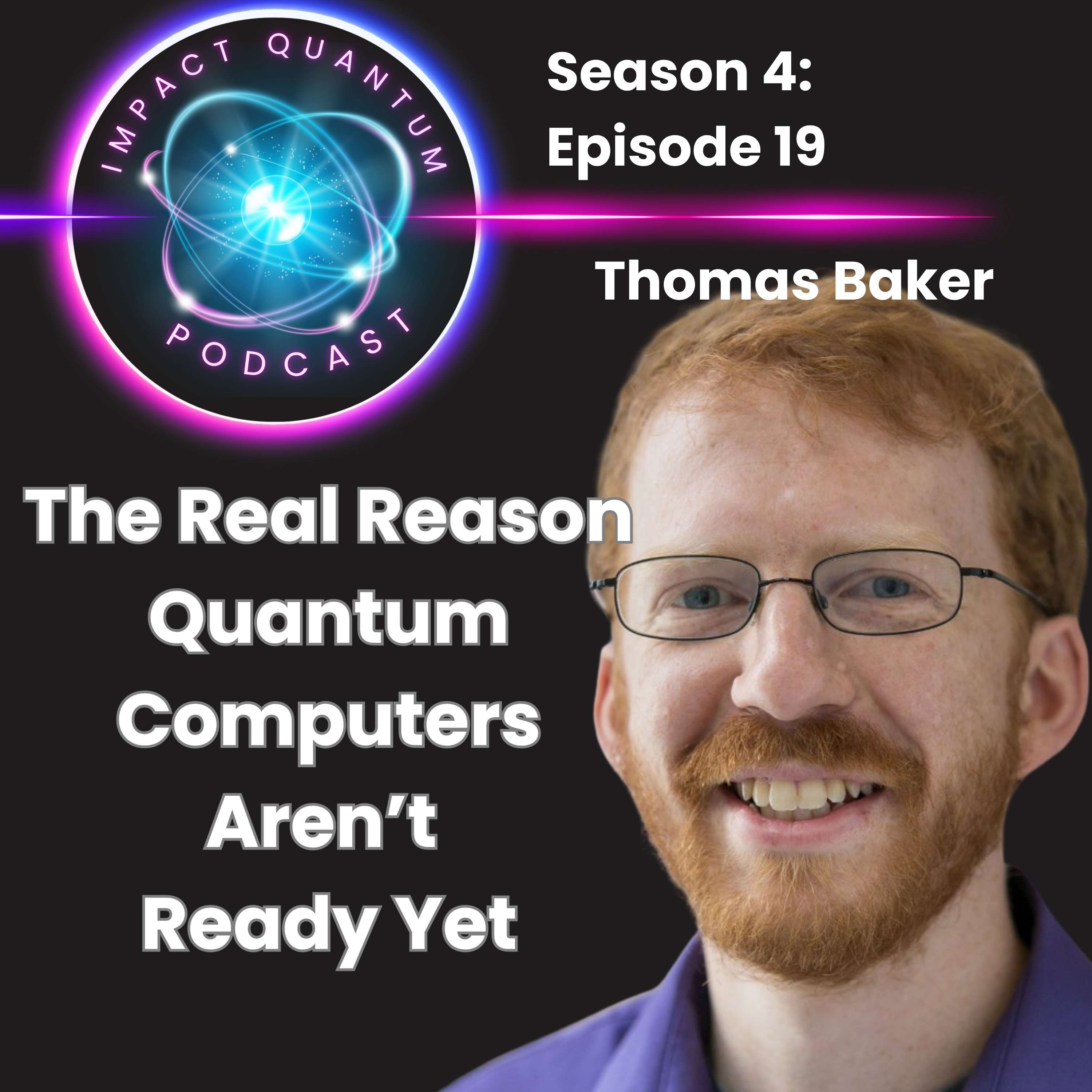
In this episode, we sit down with Dr. Thomas Baker, Canada Research Chair in Quantum Computing for Modeling of Molecules and Materials at the University of Victoria.
Together, we dive into the fundamental differences that set quantum computers apart, the interdisciplinary challenges and breakthroughs in the field, and the real-world hurdles facing quantum’s transition from theory to practicality. Dr. Baker shares how creativity, flexible thinking, and collaboration across physics, chemistry, and engineering are vital to progress in quantum information science—and why learning skills like programming and public speaking still give students an edge. Whether you’re a quantum enthusiast or simply curious about the future of technology, this episode offers accessible insights, advice for newcomers, and candid reflections on where this exciting discipline is headed.
Links
- Thomas Baker on LinkedIn – https://www.linkedin.com/in/drbakerte/
- Watch on YouTube – https://youtu.be/hH8L6zKOn0c
Time Stamps
00:00 Explaining Quantum Computing Basics
03:19 Getting into quantum computing
08:19 Quantum vs Classical Algorithm Testing
11:46 Quantum error correction challenges
13:54 Discussing quantum computing and error correction
20:23 Challenges in interdisciplinary quantum fields
24:05 Comparing qubit types to fuel sources
25:34 Discussing quantum computing concepts
30:57 Challenges of Quantum Information PR
32:05 Adapting talks to different audiences
38:11 Science Meets Parliament experience
38:59 Importance of Funding Quantum Science
45:29 Using Julia for student projects
47:09 Using Julia for easy programming
50:22 Importance of typing and coding skills
53:19 Discussing the Quantum Podcast
Transcript
Have kind of contact with mathematics when they're in school. And so if
Speaker:you say that you, like, do math, and they're like, oh, yeah, I add numbers
Speaker:together, too. I know what's going on there. When you say that you're in physics,
Speaker:though, that's already a huge barrier. And then when you say that you're in quantum
Speaker:information or quantum computing, that's already. You've pretty much lost
Speaker:everybody by the time you get there. Welcome
Speaker:to Impact Quantum
Speaker:Podcast. Turn it up fast. Candace and Frank, blowing my
Speaker:mind at last. Quantum Podcast. They're breaking the.
Speaker:Hello, and welcome back to Impact Quantum. The podcast. We
Speaker:explore the emerging field of quantum computing and what that
Speaker:means for the job market at large. You know, you don't need to have
Speaker:a PhD, don't need to be a researcher. You just need to be a little
Speaker:bit curious. And with me is the most quantum curious person I
Speaker:know, Candice Kahouli. How's it going, Candace? It's
Speaker:great. I want to say Happy New Year to you because you still get to
Speaker:say it, I think. That's right. We're still in the first week of January.
Speaker:You still get to say it. Exactly. So I'm really excited because
Speaker:today we have Thomas Baker, and he is
Speaker:Canada Research Chair in Quantum
Speaker:Computing for modeling of molecules and
Speaker:materials from the University of
Speaker:Victoria. So how are you,
Speaker:Thomas? I'm doing well. Happy New Year to you guys, too. And, yeah,
Speaker:thank you. I'm glad to be here. Awesome.
Speaker:So that is quite a mouthful. So
Speaker:it's a tough roster. Well, yeah.
Speaker:Like, you know, when presumably you were at cocktail parties or holiday
Speaker:parties, like, what do you tell people you do? Oh,
Speaker:first of all, I try and allay their fears. I think a lot of people
Speaker:have kind of contact with mathematics when they're in school. And so
Speaker:if you say that you, like, do math and they're like, oh, yeah, I had
Speaker:numbers together, too. I know what. I know what's going on there. When you say
Speaker:that you're in physics, though, that's already a huge barrier. And then when you say
Speaker:that you're in quantum information or quantum computing, that's already. You've pretty
Speaker:much lost everybody by the time you get there.
Speaker:Really what I do is I'm trying to figure out how to use and how
Speaker:to make quantum computers, which is a fundamentally new type of
Speaker:computer. So everybody watching this is
Speaker:probably using some sort of computer either in their cell phone or in their
Speaker:laptop. And quantum computers are able to do
Speaker:computations with fundamental laws of physics. And the idea or the
Speaker:hope is that we can derive different results that are more efficient than what
Speaker:you can get with classical computers. Oh, I like
Speaker:that. That was really straightforward. I was really
Speaker:fantastic. I wish you would have been with me when my son was
Speaker:here over Christmas, and I could have given that answer, you
Speaker:know, And I'm talking about the infinite possibilities
Speaker:between 0 and 1, and I'm like, no, no, no, I've totally lost
Speaker:him. I've totally lost him. You know, spooky action at a
Speaker:distance, but that was really, really interesting. So let me
Speaker:ask you this. Okay. So what
Speaker:first drew you to quantum computing?
Speaker:Was there a specific moment, a problem, a
Speaker:curiosity? Yeah, great, great question.
Speaker:So I was floating around in another field of
Speaker:physics, condensed matter, before jumping into quantum
Speaker:computing. And with a little bit of quantum chemistry, it turns out that everything that
Speaker:I was working on falls under to what I do now. So right now my
Speaker:position is this big synthesis of everything I've done in my life.
Speaker:But the.
Speaker:Point that I really got into quantum computing was actually through one
Speaker:guy at the University of Sherbrooke, where I did a postdoctoral
Speaker:position for three years, and his name was David Ploulon.
Speaker:Unfortunately, he passed away right at the beginning of the pandemic.
Speaker:But before that, even before I'd met him, he put up this paper basically saying
Speaker:that the current way that we were thinking to generate the
Speaker:initial state on the quantum computer was not all that efficient.
Speaker:And this had just made. It had ricocheted through the community. So I actually heard
Speaker:someone talk to me about this paper. And then they said, okay, quantum computers might
Speaker:not be that good. And then when I went there and I realized that it
Speaker:was him and that they were offering me this incredible position
Speaker:to go work with these incredible people, I just had to say yes. And
Speaker:so I wound up going. And I remember he. He kidnapped me
Speaker:into his office in the first day that I was there and held me for
Speaker:three hours while he explained everything that he knew about quantum computing. And I
Speaker:picked up maybe just a little bit of it, but it was enough to get
Speaker:me thinking, like, okay, let's try and do this. And then he threw a really
Speaker:hard problem at me that we kind of
Speaker:solved there at the end, but it was just a good
Speaker:training experience. I found that it was testing everything that I'd ever done before.
Speaker:I didn't have to leave anything behind. And I just thought, this is the thing
Speaker:that I need to dive into and figure out. Very
Speaker:cool, very cool.
Speaker:What's exciting. I read your bio, which is both
Speaker:in English And French. Or at least your hello, bonjour.
Speaker:So Candice actually lives in Montreal. My dad's side of
Speaker:the family is from Montreal, so I
Speaker:appreciate the francophone outreach.
Speaker:So you're researching about how to use
Speaker:quantum information to find new ways to work with
Speaker:chemistry, computer science and physics. That's interesting because most
Speaker:people we talk to tend to isolate in like one of those silos.
Speaker:You're really the first person I've seen that
Speaker:does. You know, you've. I wouldn't say you're a silo smasher. Maybe you
Speaker:are, I don't know. But like you, you, you kind of work across those
Speaker:three different verticals. I think that's interesting. Yeah,
Speaker:I. It's hard, though. I've met a couple of other people that have
Speaker:been kind of shoehorned into this interdisciplinary thing.
Speaker:And you probably see a lot more people that are in one silo,
Speaker:or however you want to call it, just because it's easier. If
Speaker:you get to know a group of people, then you can send your papers out
Speaker:to them and there's some general familiarity with the work that you've done before.
Speaker:I have to, you know, hats off to the people in my group. Oftentimes we're
Speaker:writing papers in between several different fields. And if
Speaker:you get the referee that has been working in one of them and you approached
Speaker:it in a different way, then this can be really
Speaker:a calamity that is waiting to happen. I would say that
Speaker:the point where quantum information and quantum computing is, is at
Speaker:this point, you need the people who are interdisciplinary. You need
Speaker:to be thinking in different ways. A lot of the proofs of principle
Speaker:come from really heroic papers coming out of what I would say is
Speaker:largely computer science. So computer science, like modern
Speaker:computer science, is like, here's like software engineering and
Speaker:here's how we, like, I don't know, make the cache size different on a
Speaker:computer. But like old school theoretical computer science where
Speaker:they're like, analyzing stability of algorithms or updating
Speaker:matrix operations on a computer. Some really brave people decided
Speaker:to try and figure out how quantum computers could work. And so a lot of
Speaker:our first demonstrations of how quantum computers could work are
Speaker:more computer science. But that original dream of, oh, we want to
Speaker:actually model quantum systems, we actually want to do things in
Speaker:quantum chemistry. We want to go beyond what we can do with our best
Speaker:supercomputers on the quantum computer. These are all things that
Speaker:require the interdisciplinary knowledge. And so what you've seen is
Speaker:you've seen a lot of teams of people. So a lot of like, huge author
Speaker:lines where they get somebody to try and go between all those little
Speaker:subgroups in the team. I think one of the advantages in our group is that
Speaker:we're kind of, we're throwing everything against the wall, seeing what
Speaker:sticks and trying to publish what we can.
Speaker:Interesting. So by working on all
Speaker:these papers, you know, you must come across really
Speaker:exciting breakthroughs in quantum algorithms and
Speaker:and error correction. Is there anything that
Speaker:really stands out? Yeah, I mean,
Speaker:well, so the recent stuff, there's been like a subtle algorithm
Speaker:revolution, I would say, that's been going on both
Speaker:classically and in quantum computing. Because people who have
Speaker:worked on sort of one area, like maybe a tensor
Speaker:network, whenever there's a quantum algorithm that comes out, it better be tested
Speaker:against the top of the line, the state of the art, to see if the
Speaker:quantum computer can actually beat what's on the classical computer. Because we're talking about an
Speaker:investment of millions of dollars. You better, you better
Speaker:test it quite rigorously and see, see what can happen.
Speaker:The, the point where quantum computing is right now
Speaker:though is people are starting to use actual properties of quantum
Speaker:physics, including things that aren't necessarily proven
Speaker:mathematically. We just, in the physics training, you kind of, you kind
Speaker:of do what works and you're supposed to move in, move fast and break things
Speaker:a little bit. You're supposed to be careful and, and do the right things. But
Speaker:you know, if you're using some 30 year old hypothesis to base your quantum
Speaker:algorithms on that isn't necessarily proven, I can see how people in
Speaker:other fields wouldn't necessarily stumble onto that. So I think what's really been
Speaker:exciting recently has been how do we actually use
Speaker:even untested things in quantum mechanics in order to
Speaker:actually try and find solutions that might actually work for
Speaker:what's going on. That's interesting.
Speaker:You have to go through and kind of prove that stuff out.
Speaker:I mean, if you start from a contradiction, you can wind up with anything.
Speaker:Right? So like there's that old argument from Bertrand
Speaker:Russell, the logician, and let's see if I get it right. It's like
Speaker:if you're standing next to the Pope in a room,
Speaker:you start from a contradiction that just like one equals two, then
Speaker:someone might reasonably come up with an argument to say that you're the Pope. Because
Speaker:if there's two people in there, that really means that there's one person. And so
Speaker:since you and the Pope are in the room, you must be the Pope. So
Speaker:trying to base science off of something that's obviously contradictory,
Speaker:this doesn't work, but basing something that we might have like 30 years of evidence
Speaker:for or that we might, you know, believe, because
Speaker:it must limit to this. Even if we don't have the formal mathematical argument,
Speaker:these are all things that are very important to
Speaker:investigate to make sure that we understand how to use quantum computers in the best
Speaker:way.
Speaker:So in your view, what are the biggest
Speaker:scientific or technological hurdles
Speaker:slowing the transition from theoretical
Speaker:quantum computing to practical, widely
Speaker:used systems? Yeah, good question.
Speaker:I mean, yeah, this is sort of a preoccupation with the field right now.
Speaker:One is that long term we
Speaker:don't know how to make the quantum computer noise free,
Speaker:like, you know, whatever computer you're using on a daily basis, or cell
Speaker:phone. A lot of years of development of quantum error
Speaker:correction or I'm sorry, of classical error correction. Classical error
Speaker:correction has happened so that you can make sure that like if you had one
Speaker:of like the original cell phones, you'd have like, like your, your voice
Speaker:sometimes like echo, like right in the middle of the conversation. I remember people
Speaker:being like, oh, you physicists, you should just. Yeah, right, you should
Speaker:just, you physicists, you should just figure out how to make a better cell phone.
Speaker:But it turns out that that was like a big engineering question for a long
Speaker:time in electrical engineering. It was like, how do
Speaker:we get basically a better protocol to
Speaker:make sure that we actually received the message that was sent? And so this took
Speaker:a long time and you probably saw through successive generations of cell phones that they
Speaker:things got better. One of the big things that we have to do in
Speaker:quantum computing right now is we have to do exactly that. We have
Speaker:to build in ways to make sure that the
Speaker:natural quantum fluctuations on the quantum computer are not
Speaker:there when we actually use it to get some useful quantity
Speaker:out of it at the end. So this is kind of a
Speaker:major technological hurdle that I think is on the roadmaps of most major
Speaker:quantum computer companies. But I would
Speaker:say that it's not the farthest thing away because we've already had some rudimentary
Speaker:demonstrations of the most well known versions of quantum error
Speaker:correction. Things like a toric code, which is very
Speaker:complicated. But other things
Speaker:like finding the point at which they can
Speaker:reasonably sustain a noiseless state on the quantum computer.
Speaker:Some logical qubit that can be expressed there, these things, I think they're forecast
Speaker:to come by:Speaker:And I've been kind of interested in the progress in this and how
Speaker:fast it's come on. It used to Be that we would say that those things
Speaker:would come in 50 years or something. Now it seems like it's around the
Speaker:corner. They're also branching out into two dimensional architectures, which
Speaker:would really help with this. And I assume that three dimensional
Speaker:systems, networks of qubits that are in three dimensions would be right around the
Speaker:corner. But I would say that, you know, even with all this
Speaker:technological advancement and the Nobel prizes that are coming for
Speaker:the coherent control of quantum states, and for
Speaker:all of that, we still need good methods that are
Speaker:reliable on the quantum computer and good compilation
Speaker:and transpilation so that we can actually make those algorithms something that you can
Speaker:actually run on the quantum computer. And these, I would say, are some of the
Speaker:big challenges that, that we're lacking at and that the community is looking
Speaker:at as well. No, I think it's a good point,
Speaker:like, because like, you know, where we are with quantum
Speaker:computers is probably where we were in the, maybe the 50s or 60s,
Speaker:right? Because when I was in school for computer science, error
Speaker:correction was taught. But even one of the professors I had was
Speaker:like, you're probably never really going to encounter this
Speaker:because this is an almost solved. Easily. It's almost, it's an
Speaker:almost solved problem. And we have this debate in the last couple
Speaker:of years was, do we keep this in the curriculum? Because yeah,
Speaker:doesn't really matter. I don't know, like it became like a thing.
Speaker:And error correction is something I think everyone within the
Speaker:sound of my voice can understand, right? Because like one of the
Speaker:things. So one of my first jobs out of college is like my second or
Speaker:third job I was at working@barnesandnoble.com before they were
Speaker:barnesandnoble.com and one of the store systems, if you look at
Speaker:any barcode, the last digit there is actually an error
Speaker:correcting code. So it doesn't have to be complicated,
Speaker:but it is something that is in everyday life and it's largely a
Speaker:solved problem, at least in conventional or classical computers.
Speaker:It's just fascinating. Kids today who go through
Speaker:a traditional comp sci program, they're probably. What do you mean, error
Speaker:correction? I had a younger colleague ask me about why do you need to do
Speaker:error correction? And I was like, well, truth is, we've.
Speaker:Error correction has been a thing. It's just been solved.
Speaker:Although interestingly, for space systems, again, you're the physicist,
Speaker:so you know, for space systems, because cosmic
Speaker:rays or there's some kind of radiation that will
Speaker:occasionally mess with electronic systems,
Speaker:space systems have to have like a triple redundancy.
Speaker:So that way they check the math just in case. Right. So
Speaker:the chances of one of them being impacted is.
Speaker:Is. Is very real. But the chances of all three of them being. Or two
Speaker:of the three being impacted the same way,
Speaker:isn't it, you know, not going to happen, realistically? Yeah,
Speaker:that's exactly right. Yeah. The. There's a book on my shelf about
Speaker:basics of information, Information Theory. And it starts
Speaker:off with this guy, Claude Shannon, that was right after
Speaker:World War II, and he said, how do we. What's like the best way
Speaker:to make sure that the message that you send is
Speaker:received by the receiver? And so the start of this is always
Speaker:just that. You write down three or four axioms, things that you assume to be
Speaker:true. It's like finding someone in New York is harder than finding someone in a
Speaker:small village, or that the probability of error should be
Speaker:continuous, or the other one that
Speaker:it should add like a logarithm, which is something that
Speaker:you can derive. But basically, there's a
Speaker:theorem that comes out of this analysis by Claude Shannon,
Speaker:which is exactly what you're talking about, where they say
Speaker:that if you send the message multiple times, then you can
Speaker:take a majority vote of the answers and assume that that is
Speaker:the one, that that was actually meant to be sent. If you do
Speaker:this slow enough and with some other caveats, then you can
Speaker:come to a conclusion that, yes, I did receive the right
Speaker:message and everything is as it should be. Yeah, I think when
Speaker:you held up the barcode, I think that's the Reed-Solomon
Speaker:code that is there. Sounds familiar.
Speaker:I think that's the right one because my first. Yeah,
Speaker:go ahead. No, my first job there was making
Speaker:basically tying into barcode scanners. And I. There was a
Speaker:whole book about this history of the barcode and like the technical
Speaker:specifications, how much of the barcode can be missing before it
Speaker:will just give up. And there's a whole science to it. And it's like everyday
Speaker:tech. We don't think about. I'm sorry, I cut you off. No, no, no, no,
Speaker:no, no, no. And that's actually a perfect example. I had a much more complicated
Speaker:example in mind. This idea that, you know, if you miss some of the
Speaker:information, you can still recover the message. In other words, extrapolate to the code word.
Speaker:That's exactly this idea behind information theory. So, yeah, it's all
Speaker:coming out of this. And, you know, whether you use a Reed Solomon code or
Speaker:a polar code or something, these are all the same ideas that we want to
Speaker:implement on the quantum computer. I would say, to your point,
Speaker:about the computer scientists and whether like error correction is actually something to
Speaker:study like one. You're absolutely right. Quantum computing is
Speaker:very much a 50s 60s thing right now. Even like the algorithms that we
Speaker:compare in quantum chemistry, they're best thought of in comparison
Speaker:with algorithms from the 50s or the 60s. So not like you're not going to
Speaker:use these to make your cell phone, you're going to get very rough
Speaker:results. But then the other point that you're making about
Speaker:like computer science students, like, yeah, I mean for both this field
Speaker:and artificial intelligence, there's a lot more to prove. And what I hear
Speaker:from sort of the modern computer science students is like, oh, whoa,
Speaker:should we actually get into this? So it's important to make advances in these
Speaker:fields, right? But there's opportunity in those advances.
Speaker:Like this is brand new untouched land,
Speaker:so to speak. I was joking with a previous show.
Speaker:They're still naming algorithms after people, Right.
Speaker:And that's a good indicator that this is new territory. Right.
Speaker:So it's, it's. Yeah, I mean it's not going to be a well worn path,
Speaker:but that's where the opportunity always is. Right. You know, eventually those
Speaker:streets will be named after the first people who kind of,
Speaker:you know, walk through those woods, so to speak. Right? Yeah,
Speaker:exactly. But it's, it's scary. So it's like, it's not, it is very scary. Like
Speaker:it's not for the, not for the timid, but you know, it's like
Speaker:that's the fundamental training that you get in physics is. It's like somebody goes to
Speaker:a physicist to hire them when they want to solve something that they don't know
Speaker:how to solve and then they assume that the physicist has all this knowledge that
Speaker:is there. But really you're just, you're just trying to put things together based on
Speaker:what you know and yeah, it's exactly. This process of being creative is scary,
Speaker:right? Well, it's always that tension between, you know, physicists,
Speaker:physics, physics and kind of engineering. Right. Like
Speaker:physics is about the fundamental understanding the fundamental laws, but
Speaker:engineering is, you know, what trade offs do you need? Do you make to
Speaker:comply with the laws of physics as well as comply with
Speaker:whatever it is you're trying to do. Right. There's always engineering
Speaker:is, is a science of trade offs, so to speak.
Speaker:But I think to your point, like it's very difficult to draw the line
Speaker:for some fields at this point. And this is a constant conversation that happens
Speaker:inside of physics departments everywhere. It's like, is this field
Speaker:at the point where it's more applied. And so like a
Speaker:chemistry department should be hiring these people or so mathematical
Speaker:that a math department should have these, these professors. Or should an
Speaker:engineering department be optimizing the photonics or
Speaker:circuitry that is required there? This is a really tough place to
Speaker:find this line. And I think it's even more difficult because for quantum
Speaker:information and quantum algorithms in particular, if you come up with
Speaker:an algorithm that is complete in a computer science sense,
Speaker:and what I mean by complete is if it solves one kind of problem, it
Speaker:solves every other problem in that, in that,
Speaker:in that class of problems, then it's like I show one
Speaker:algorithm to my students, but I might be sending them off into biophysics
Speaker:and then maybe the next project is going to be on, I don't know,
Speaker:quantum Internet or the next problem is going to be on like optimizing like
Speaker:train schedules in the uk. So from one algorithm in
Speaker:this fields you are going to intersect with a lot of theory
Speaker:that is going to come out of this. And I think that's the real, like
Speaker:the, the challenge of being so interdisciplinary. I wonder
Speaker:how computers used by everybody. Yeah, I was going to say, like, I wonder like
Speaker:how, you know, what were these conversations had in the 50s
Speaker:where you had the physics department, you had the mathematicians, you probably
Speaker:had electrical engineers in the room all debating about like, who
Speaker:should, who should own what, right. You know, and then, you know,
Speaker:eventually kind of spun out to its own thing. I wonder if we're going to,
Speaker:you know, kind of have a very similar conversations now and over the next,
Speaker:easily the next five years. Right. Like probably
Speaker:the, probably the equivalent conversation right now is what Qubit platform
Speaker:is going to win out in what, over what timescale?
Speaker:To take your example from the 50s, like. So in the 50s, I think the
Speaker:Nobel Prize went to. It was definitely Bardeen and two
Speaker:other, I think two other people for the transistor. Inventing the transistor,
Speaker:which it actually turned out that a Canadian person had the
Speaker:patent for the Shockley, I think had the patent for this. Oh really? Earlier.
Speaker:But then they took the idea from this and ginned it up and then they
Speaker:won the Nobel Prize at Bell Labs. So
Speaker:before that I suppose you would have had maybe vacuum tubes or something. I don't
Speaker:know. It was in those original computers. But I'm sure that
Speaker:there were people that were like, no, no, no, no, no, no, you don't want
Speaker:to trust the solid state transistor. You want to go with the vacuum tubes.
Speaker:And I know that there were people that were Saying, well, the computers are just
Speaker:going to get bigger and bigger and bigger. But then it turns out that everything,
Speaker:you know, the right technology won out through the scientific conversation.
Speaker:I would say right now our big questions that we have to sort out
Speaker:is what Qubit platform is actually the best one to use? And I would
Speaker:say that the other one is what? How do we actually use the
Speaker:quantum computer so that it's not just for defense purposes or
Speaker:for, you know, whatever else we need it to be for.
Speaker:These are all the things that I think are probably the modern
Speaker:iterations of those. Those are those age old arguments that are still going to happen.
Speaker:Nothing ever gets solved. You just find new things to argue about. You find new
Speaker:things to argue about. That is very true. No, I think it's, it's,
Speaker:it's, it's. There was also a science fiction movie I read. Not
Speaker:a science fiction movie I read science fiction book I met, I read where it
Speaker:was. There was about a society who built computers, but out of basically
Speaker:pipes and valves. So it was a fluidic based computer.
Speaker:And you know, part of the plot was just how massive the thing was
Speaker:and how many people they needed to like pull the levers to do the
Speaker:computation and things like that. So like, but, but you know,
Speaker:to your point, like obviously a transistor, vacuum tubes are more efficient than that
Speaker:and transitions transistors are more efficient than that.
Speaker:But to your point, like do you really think we're going to settle on one
Speaker:type of qubit? Because that's one of the debates that we've had is like,
Speaker:I think it'll be kind of like fuel sources for
Speaker:vehicles, right? You'll have electric, you'll have, you know,
Speaker:diesel, you'll have gasoline and there'll be some, you
Speaker:know, I think, you know, I
Speaker:think that we'll end up having the majority will be one and then
Speaker:they'll still be like sizable minorities of other ones. Kind of like we have with
Speaker:fuel, right? Like with automobiles, like most of it is gasoline,
Speaker:you know, with an increasing ev. But also diesel also
Speaker:plays a pretty big role too. Like. Yeah, yeah. And
Speaker:continuing your analogy, there's also been proposals for organic qubits.
Speaker:So there's also this like, oh, what's the sustainability angle and how
Speaker:do we regular chemistry system and tune the energy level so that
Speaker:we can manipulate the qubit states in that. So
Speaker:yeah, no, this is well taken. I think it's too early to say, like as
Speaker:I was about to say, like oh well, single qubit readout is hard on this
Speaker:one. So Maybe it's this one. I think it's too early to say if there's
Speaker:some like, breakthrough on one of these that maybe that'll work out. I,
Speaker:I will say that I've been really impressed by
Speaker:photonics and spin cubits. I just, I think that the ideas behind
Speaker:that are really interesting and it is kind of a, like if I was going
Speaker:to teach a course on it, I'd probably start with a photonics based
Speaker:setup. Just because it's like you talk about Alice and Bob,
Speaker:you talk about Cubans being or, you know, states being
Speaker:entangled with each other and it, it's just a very obvious
Speaker:manifestation of all of those things. But the leaders right now, I would
Speaker:say are still pretty much superconducting qubits. Just because
Speaker:they have, you know, it's scalable, you need to keep it at low temperature,
Speaker:but it allows you to have a
Speaker:nonlinear response that is still stable. And so
Speaker:this is kind of the, I think the direction that people
Speaker:are going in right now at least. Yeah, I think photonics is probably
Speaker:going to win out. It'll be the gasoline, so to speak, of the future.
Speaker:Just because the room temperature thing I think goes a long way.
Speaker:Yeah. To making it practical. Right.
Speaker:You can scale, you know, super cooled systems, but it,
Speaker:the cost of that is going to be astronomical. Oh yeah,
Speaker:that's especially, especially as we think about, you know,
Speaker:sustainability and whatnot. I live just across the river from
Speaker:Loudoun County, Virginia, which is apparently somebody told me this
Speaker:data center alley they call it, but apparently Loudoun County, Virginia has more
Speaker:data centers than China, like the entire country.
Speaker:And it's crazy. I don't know if that's true, but
Speaker:driving around there, you could believe it. Like, it is literally
Speaker:I can't tell you. We were in the middle of shopping for a car
Speaker:and we were at a big car dealership there. And like
Speaker:every building was an office building without windows. Like they were clearly
Speaker:painted to look like an office building. But one of the big
Speaker:complaints is, is the energy usage and the noise and things
Speaker:like that. So I can't imagine, you know, those are just
Speaker:cooled to, you know, room temperature. I can't imagine
Speaker:if you have to get them down to like what, one or two kelvin, right.
Speaker:Like what, how much more pollution and how much noise.
Speaker:You know, it's amazing that we even have that much data in the first place.
Speaker:Like if I think about how much data, like I've never seen like average
Speaker:amounts of data that people have, but it's like my
Speaker:total data footprint must be less than 100 gigabytes,
Speaker:maybe with some videos or something floating around. I'm sure that this is,
Speaker:you know, maybe a balloon or something, but having
Speaker:only a couple of gigabytes per person, it's like, wow, okay,
Speaker:so there's a lot of people using this. Plus there's probably like medical data
Speaker:that's saved or your browser tracking data, your
Speaker:mouse data. There's a whole lot more data. There's data
Speaker:you know about. It's probably like an iceberg. Right. There's what you know about
Speaker:and then there's what was really there. Right. From government records to
Speaker:all that sort of thing. Yeah, yeah. But we're sort of waiting to see how
Speaker:much better quantum computers can be, because whatever that number is, take a
Speaker:logarithm of it, and that is how many qubits you need to represent that. And
Speaker:it like, you know, it's sort of an order of magnitude game that you're playing.
Speaker:So if it's a gigabyte, then it's, you know,
Speaker:I don't know, a few dozens of qubits in
Speaker:order to represent all that. So even if it, even if you need to cool
Speaker:the quantum computer down, there's still, oh, you would still get used
Speaker:to get a savings. That is a good point. I hadn't thought of that. And
Speaker:you mentioned logarithm a few times, and it's been way too long.
Speaker:My, my, my teenager's taking AP math. Sure.
Speaker:And I don't need to give him another reason to, you know, think his old
Speaker:man doesn't know anything. But I also forgot. So logarithm is
Speaker:a way to, to break down a number into a
Speaker:smaller number. That's right. Okay. So, yeah.
Speaker:Without busting out a slide rule. Right, right, right, right, right,
Speaker:right. So if you're picturing the number in like scientific
Speaker:notation, or if you're just picturing any number to the
Speaker:power of some other number, the magical property of the
Speaker:logarithm is that whatever was not the exponent stay
Speaker:like the, the logarithm is going to produce some other number. The, the key point
Speaker:though is, is that the exponent that comes down in front.
Speaker:And so when I say like, if I say like a million,
Speaker:think like 10 to the 6. If I take a logarithm of that base 10,
Speaker:then I get 6. So,
Speaker:okay, so 2 to the whole idea of 32, you would get 6.
Speaker:32. 32. Sorry, yeah, base
Speaker:2. Yeah, yeah. So logarithm, base 2 on 32
Speaker:would be 6. Yeah. So the the base of the logarithm matters.
Speaker:You're thinking qubits, which is the right one for this. This podcast. I'm thinking like
Speaker:10, 10 level q dits. I get you. Okay,
Speaker:okay, okay. No, that helps, that helps. And the last time I had
Speaker:to deal with logarithms on a day to day basis, I think Kurt Cobain was
Speaker:still alive. So. Been a while.
Speaker:Smells like mathematical rigor. There you go.
Speaker:There's the title for the episode. Okay, well, yeah.
Speaker:So, you know, the more we talk about this, you know, quantum
Speaker:technology is notoriously hard to communicate.
Speaker:What strategies do you use when teaching and
Speaker:explaining these concepts to students and to non
Speaker:experts? Well, you've seen a couple of my pitches.
Speaker:The first thing that I'll say about quantum information, and one of the reasons that
Speaker:I like it, it does not have a good PR department. I think we can
Speaker:just admit that, right? Like astrophysics, they can show you a video of like two
Speaker:stars colliding. Ooh. Or like the amazing
Speaker:images that come out of the James Webb telescope. These are like, these are, these
Speaker:are fun to look at. If I'm giving a talk, it's like, here's a very
Speaker:abstract thing that I'm going to talk very abstractly about. And then if I'm
Speaker:successful, you're going to take it for granted. Just like you take your
Speaker:wall clock for granted after it's been engineered. Just like you take your
Speaker:computer for granted after it's been well engineered. You're not constantly thinking about
Speaker:like, what's going on underneath. So getting people to engage with
Speaker:the minutiae of this is very, very difficult. And
Speaker:I think pretty much everybody in this field has an experience where
Speaker:you've been put up for a three minute thesis or some sort
Speaker:of short public talk about it. Oh, very hard.
Speaker:If you can't educate your audience over an appreciable amount
Speaker:of time, you're relying on the prior knowledge. And this
Speaker:is way off the deep end. So it sort of depends
Speaker:on what I'm talking about when I, when I give a talk. You
Speaker:sort of saw my pitches already in our conversation because when I was
Speaker:talking about error correction, I went back to classical error correction.
Speaker:And so a lot of students have come to me and said, can I please
Speaker:learn more about quantum error correction? I say, sure, let's go study classical error
Speaker:correction. Because all the ideas poured over and I try and reason by analogy
Speaker:between the two and then the other. Like
Speaker:if somebody comes to me and says like a quantum algorithm, I'm just like,
Speaker:okay, let's let's do a very simple example and work through something in a paper
Speaker:in order to do this. But yeah, I mean, it very much depends on
Speaker:your audience, depends on what their background knowledge is, depends on what they want to
Speaker:use it for. Like politicians, you're gonna gear more towards
Speaker:like a, you know, your, your encryption might be broken by a quantum
Speaker:computer. If it's somebody working in medicine, you might be, well,
Speaker:we might be able to model a better molecule. And, and you basically reason from
Speaker:what they know to. And then, and then somewhere in there, I'll say,
Speaker:okay, this is the magic that I have. This is the thing that I think
Speaker:I can do that you think maybe is impossible or haven't
Speaker:thought about doing before. But this is the part where I think the quantum computer
Speaker:can sit and let me go try to solve
Speaker:that for you, and we'll see how it goes.
Speaker:Okay, so what are the essential skills or
Speaker:mindset you think new students should develop to
Speaker:contribute meaningfully to quantum information
Speaker:science? That is such a deadly good question. That's so
Speaker:good. Yeah. I mean, the actual
Speaker:skill set that you would need in order to be successful in this area, I'd
Speaker:say one is like, flexible thinking.
Speaker:There are deep divisions in physics that exist.
Speaker:There's preferences. There's even entire articles that have been written
Speaker:in like a monthly column format, bashing other areas of
Speaker:physics over the 20th century, like, you know, let's not use computers.
Speaker:Let's reason everything out with mathematics. And I think,
Speaker:you know, having students that, that come in fresh
Speaker:is such a valuable asset to this field because sometimes they
Speaker:see things through a completely different lens or they pick up a little computational
Speaker:skill that is going to, to help you. Like, I worked with
Speaker:three really good undergraduates last summer, and I had a project that I thought was
Speaker:going to take a graduate student. But those three guys, they, they just
Speaker:worked together, asking my other excellent
Speaker:graduate student some questions, and she was able to answer,
Speaker:but they were able to essentially put everything together just because
Speaker:they didn't have any preconceptions. They were even solving things that we had
Speaker:an external colleague and he did, you know, he's already been thinking about it for
Speaker:a little while. So he went down the practiced way, but they just went in
Speaker:a particularly new direction. I would say that I'm a little bit
Speaker:partial to physicists and people who have a physics background. No
Speaker:offense to everyone else. Like, I definitely need
Speaker:chemists in my group because they know about things that I don't. Like
Speaker:electronic structure. I need engineers to talk to because
Speaker:they know about how to actually put these things into experiment. And what
Speaker:I should expect if I actually make a claim that this will be
Speaker:implementable on a quantum computer, I definitely need
Speaker:mathematicians and computer scientists for the rigor
Speaker:of what happens. But in terms of coming from a physics background and trying to
Speaker:innovate and trying to be creative in the field, I would say that if you
Speaker:just have some math background and if you're willing to touch a
Speaker:computer and to, you know, program a little bit,
Speaker:I think if you just come in relaxed and creative, I think this
Speaker:is the best set of skills for anybody coming in, in the academic environment,
Speaker:I should say. Yeah. And I think that's an interesting segue
Speaker:into this is a field where it is
Speaker:going to be commercialized over the next three to five
Speaker:years, if not already. Oh, yeah. I mean, it's, it's, it's
Speaker:definitely like what? I, I definitely think that there
Speaker:are different cultures amongst academia and kind of
Speaker:the commercial startup crowd, which is probably an understatement.
Speaker:But what, how do you
Speaker:see that, that being mitigated, like, in terms
Speaker:of conflict? Yeah. Somebody
Speaker:was telling me about condensed matter physics and they had seen it kind
Speaker:of rise and then they decided to switch to quantum information. And I'm not sure
Speaker:that this quote is quite accurate to condensed matter physics, but I like the quote,
Speaker:so I'm gonna preserve it here. Everybody
Speaker:was really collaborative when they were successful, and then as
Speaker:things sort of got, you know, more
Speaker:static and things were less successful, people started to not
Speaker:be so collaborative. So I think it's a little
Speaker:bit of luck and I think it's a little bit of, you know,
Speaker:we need to stop trying to put our names
Speaker:on things and it's very important to actually get the thing solved.
Speaker:Right. Like, I would say that AI has this problem
Speaker:quite a bit right now. AI, it
Speaker:gets things wrong. There haven't been an explosion of
Speaker:materials come out of this that could be that
Speaker:we're going to find ways to do it in the future. Right. But
Speaker:this, this additional pressure that modern science has
Speaker:of the companies need to make their quarterly profits
Speaker:and they need to do fundraising. This is something that is very,
Speaker:very new in the grand context of science
Speaker:and publicly funded science in particular. So I think it's very important that,
Speaker:like, if you're a student or a postdoctoral researcher or a new faculty
Speaker:or something very important to just kind of play your game and
Speaker:see, see how things are going to turn out. And even if some idea is
Speaker:not popular now, maybe it will be soon. Right. So
Speaker:what Signals should industry and
Speaker:policymakers look for to
Speaker:know when quantum is moving from
Speaker:experimental to operational?
Speaker:Sure, yeah. For policymakers, this is, this is,
Speaker:I think it's a question of what your motivations are. I
Speaker:was really lucky and I was able. There's a program called Science Meets Parliament that
Speaker:is up here in Canada. And so I, as one of the research chairs,
Speaker:I was allowed to go to the, the Houses of Parliament.
Speaker:It was a really great experience. But one of the things that we were talking
Speaker:about in the lead up to this was how you would message for what
Speaker:I know because I'm from the US and how you would talk to
Speaker:a US politician versus a Canadian politician.
Speaker:I think sort of the consensus was is that US politicians have a long
Speaker:history of looking at their constituencies and identifying
Speaker:how technologies have brought jobs and broad economic development and
Speaker:how they've, they've helped things in Canada. We're a little bit newer to that
Speaker:idea and there's been some recent headlines about this and in the
Speaker:newspapers about why it's important to fund quantum computing and
Speaker:quantum mechanics. So if I was talking to a politician about this, I
Speaker:think I'd probably start off with like, like what is your motivation? Like
Speaker:do you want to just engineer on what there already is? If
Speaker:so that will change how you fund things. If you actually want to innovate and
Speaker:you actually want to push technology to the limit. History has shown
Speaker:us that funding and science has been so lucrative
Speaker:it has a huge return on investment. This is why
Speaker:a lot of immigration programs are set up to bring in high knowledge
Speaker:people into a country is because it just has huge benefits.
Speaker:I think kind of what I've been seeing with the recent
Speaker:activities and things is that idea of innovation
Speaker:from the end of World War II, in particular of publicly funded science.
Speaker:I think people are a little, have sort of lost the,
Speaker:the image of like what science can provide. Like huge technological
Speaker:changes come from this stuff.
Speaker:And but we're, we're at a point now where we're promising that
Speaker:it's going to happen in a couple of years, which is the standard scientific pitch.
Speaker:But then if we don't deliver on it, I think people just get an idea
Speaker:into their head that maybe it's not coming, maybe the money isn't worth it, but
Speaker:it always is, it always leads to good things. And
Speaker:there's been a huge raft of funding that's come out in Canada that I'm very
Speaker:grateful for and that they seem to be very serious about
Speaker:funding this area. And I think places that invested in are
Speaker:going to reap the benefits as they go forward. Yeah. I
Speaker:mean, the next wave of economic innovation is always in some weird
Speaker:corner of science that hasn't been explored yet. Right.
Speaker:I mean, you know, Claude Shannon, when he was working through his stuff,
Speaker:was even when you go back to Babich and
Speaker:Ada Lovelace. Right. Like, that was weird. That was just
Speaker:some weird science project that, you know, no
Speaker:one else was interested in. Ada Lovelace saw the potential, but no one
Speaker:else did. Right. It wasn't until World War II where,
Speaker:hey, we need to crack these codes or we need to figure out what
Speaker:those physicists are doing because they just built a bomb that can level. Yes, exactly.
Speaker:We better keep track of these guys. Right, Right, right, right.
Speaker:Yeah. But you know, social scientists have figured out
Speaker:that traditionally the best way to do it is to give a lot of people
Speaker:at least a little bit of funding and see and let the winners happen naturally.
Speaker:Right? Yeah, definitely. Definitely. You're using good examples there of
Speaker:historical situations.
Speaker:Sorry, Candace, I cut you off. No, no, no. I'm just, I'm just thinking.
Speaker:I'm just kind of taking in everything.
Speaker:So let me ask you this. What role do open source
Speaker:tools and academic collaboration
Speaker:play in accelerating the progress
Speaker:compared to proprietary or closed approaches?
Speaker:This is such a weird time for open source software.
Speaker:It's been amazing, even just over my comparatively short scientific
Speaker:career. It used to be like, everything open source is good
Speaker:and I still encourage my students to use a lot of open source
Speaker:software and things. Weirdly, I've been hearing, even just with this
Speaker:disruption from AI that some computer science professors are
Speaker:saying, don't put everything online because it just gets scraped by
Speaker:large language model. And then I'm not, I haven't heard the full argument
Speaker:about that. I just heard sort of the, the top thesis statement,
Speaker:even, even little things like, like a driver to
Speaker:interface with general printers. Like I think some big
Speaker:company bought up the, the, the, the driver that most,
Speaker:that a lot of computers use to interface with printers. And
Speaker:the transition away from like open source standards with
Speaker:GPUs towards the more proprietary versions of the
Speaker:software, it's like there even just in my limited
Speaker:scientific career, there's been a transition towards closed source
Speaker:technologies. I don't know what's going to win
Speaker:out. That's kind of a major question for me right now in my research. And
Speaker:what, what will be, you know, doing. And as we deal more and more with
Speaker:research security, it's like we have to play these games of making sure that our
Speaker:computers are secure and that they don't cross certain borders and things like this.
Speaker:But I would say that the, like the battle
Speaker:between open source and closed source, if you're making your own
Speaker:stuff, I think you have to go with open source. So
Speaker:most of the people in my group will use a Unix based operating
Speaker:system rather than something that is more
Speaker:proprietary, something more general. And it's
Speaker:really, really important that if you're making your own, like if you're making innovations on
Speaker:computer stuff, you better write your own code. Trying to rely on somebody's else,
Speaker:somebody else's code to be super general enough to make new discoveries, this can be
Speaker:difficult. So I don't have a perfect answer for this. It's just for
Speaker:research. Open source is still good. Yeah, well, it's.
Speaker:The cost of admission is low too. Right.
Speaker:And I saw on your profile you linked to and this is going to get
Speaker:a little nerdy, Candace, so I apologize in advance. Saw you have at least two
Speaker:projects on GitHub. Yes. At least
Speaker:they're both in Julia. And I find that interesting
Speaker:because Julia was supposed to be this, you know, I
Speaker:started in AI way before it was cool. So there was Python and R,
Speaker:but Julia was, was meant to be a third contender. Now what
Speaker:I've seen in industry is R
Speaker:is still used by companies. Python is definitely the winner.
Speaker:You don't hear much about Julia. So, you know, you're,
Speaker:you're probably the first like Julia programmer I've ever had on a
Speaker:podcast. So I have to, I have to ask,
Speaker:where is it used? I don't, I don't, I don't mean that. I don't want
Speaker:to sound like a smug Python coder. Right. Because I have no right to be
Speaker:a smug. Because I used to write Silver Lake code and
Speaker:Windows Phone apps. Right. So like smugness is not something
Speaker:I've learned my lesson about being smug. No, I'm just curious. Like, is like, you
Speaker:know, and, and for people that want to, you know, knock on Julia as a
Speaker:language jupyter notebooks. The J part is
Speaker:Julia, you know. Yeah. So sorry, go
Speaker:ahead. No, no, no, no, no. So that was
Speaker:the reason that I've been coding in Julia at this point. The reason that I
Speaker:maintain those within the group is pure
Speaker:pragmatic reasons. Students coming into my group from a
Speaker:physics background don't necessarily have all the high level coding skills that they would need
Speaker:in order to quickly sort through a C or
Speaker:a Fortran code or something lower level. Even something like Rust,
Speaker:I would say would be just a little bit more than they would get. So
Speaker:Given a master student who has nominally two years to
Speaker:complete their degree and they take courses for maybe the first year and
Speaker:then they get a summer, the fall, and then they need to start writing up
Speaker:their thesis. I have to find ways to lower the amount of time
Speaker:for people to get into the research. Now the question is, could I have accomplished
Speaker:the same thing with Python? The answer is yes, except that
Speaker:there's this statement that floats around Julia that is
Speaker:very contentious that Julia's for loops are optimized in a way
Speaker:that you can get performances like lower level languages.
Speaker:So the original reason that I started in Julia was I wanted to figure this
Speaker:out. It turns out that it's a more complicated
Speaker:process than the help pages would have you think. But those
Speaker:codes are, they do run at the lower level language
Speaker:standard for speed. In some cases they're a little bit faster. And I've
Speaker:actually that One repository starred 50 times,
Speaker:whatever that means. But I've noticed that some of the tricks have been filtering into
Speaker:other codes. Maybe people are finding them independently.
Speaker:So very much like a developer's code that is listed there,
Speaker:but purely for pragmatic reasons. If I had to go back and start it
Speaker:again, if I would have switched to something like Rust, I would have lost
Speaker:the ability to do multiple dispatch in Julia. The idea that you can have
Speaker:one function that takes many inputs, you don't have to explicitly
Speaker:make all the functions in Julia and this makes programming much
Speaker:easier. But there are, you know, there's, there's trade offs,
Speaker:there's, there's things about it that, that I'm like why did,
Speaker:why did I even touch a computer in the first place? Why didn't I just
Speaker:stick with theory? But that it's, at this point it's just a pragmatic
Speaker:reason for. So that the students find it a little bit easier. And the,
Speaker:you know, I won't comment on the name of the
Speaker:language. It probably, probably could have had a different name, but it's okay. No,
Speaker:I was just curious, you know, because like I, it, you know, it was one
Speaker:of those things where it was going to be the next big thing and it
Speaker:kind of, it definitely has traction but it Denver really
Speaker:I think lived up to its potential in terms of what it could do.
Speaker:Now a lot of people filtered in made packages and they're deprecated
Speaker:now. So like I think pie plot into Julia is
Speaker:not working. And the pie plot I think still looks better than the regular
Speaker:Julia standard. So I do think they do suffer from a lot of deprecation
Speaker:and things But I would say scientific software, maybe
Speaker:to your point, There's a network of computer supercomputers in Canada.
Speaker:Turns out we're one of the only groups that uses Julia. But our
Speaker:new. Our new computers that are coming in, it's like, these are going to network
Speaker:really well with Julia. And I don't know, it's for ease of use at this
Speaker:point because so much work has gone into it already. All right, that makes sense
Speaker:again then, Like, I don't have a favorite language anymore. Right. I think Python, you
Speaker:know, I learned the hard way. I used to be a C
Speaker:developer.
Speaker:Well, before that I was Java. It really had more to do with
Speaker:commercial availability of work, really was.
Speaker:Now I go with Python. Python's not the best
Speaker:language I've ever worked with, and it's certainly not the worst.
Speaker:It gets the job done and it can get
Speaker:a lot of different jobs done. Yeah. Like Julius Python.
Speaker:But you don't have to worry about the indents and you can optimize the for
Speaker:loops. Allegedly. Yeah. And
Speaker:I don't find too much difference. I think, honestly, if there's like a student
Speaker:out there, like, listening to this and it's like, oh, what do I do? Just
Speaker:learn any computer programming language. The skills and the tools that
Speaker:you'll pick up learning just one, they'll translate to other languages.
Speaker:And if you start at Julia and you don't explicitly set types for
Speaker:variables, you'll pick it up through time when you move to the other thing and
Speaker:the compiler will tell you. Yes. Compilers
Speaker:aren't shy. Well, I started with BASIC on the
Speaker:Commodore 64. Right. I did, too. Yeah. Awesome.
Speaker:BASIC was the first one I touched. Yeah. So BASIC is, you know,
Speaker:and then, you know, that was
Speaker:arguably whether or not it's compiled. And I think it depends on which implementation. BASIC
Speaker:and all that. But I mean, like, again, you're right. It's. It's the thinking in
Speaker:structures, thinking in process, thinking that that's the
Speaker:skill, that how you do that is secondary
Speaker:and, you know. Yeah, yeah, yeah,
Speaker:exactly. So, yeah. But I think as
Speaker:we sort of transition more to, like, TikTok and stuff, where you don't have to
Speaker:punch things into a keyboard, very important that we maintain those coding
Speaker:skills. Like, absolutely. Maybe I'm fighting uphill because it's like, it's like. It's like
Speaker:arguing that someone should continue to learn, like, car mechanics even as we
Speaker:transition to, like, you know, cars being more computerized, but I still think
Speaker:that, like, knowing how to type quickly, knowing maybe, maybe that's A good answer to
Speaker:Candace's question. Like, if you know how to type quickly, that can just pole
Speaker:vault you over people who might be smarter than you like, but can't type as
Speaker:fast. So, I mean, little soft skills like this, like computer
Speaker:programming, like, I don't know what's. What's
Speaker:another good one. A little bit of public speaking. A little bit. Oh, yeah. Public
Speaker:speaking will put you to the top 10%. Yeah.
Speaker:Even. Even if you're not good at it, even if you're okay with it and
Speaker:you're comfortable with it, you're in the top 25% right there.
Speaker:Because most people will say, like, what's. What's this? There's some
Speaker:ridiculous statistic where, like, you know, people are less afraid of jumping out
Speaker:of a plane, something like that. But, like,
Speaker:I don't know if that's true. But just. Even that. That sounds plausible is the
Speaker:problem. Right? Yeah, yeah. No, I.
Speaker:I think all these. These points are well taken, but, like, how
Speaker:to recommend success? At the end of the day, you kind of have to be
Speaker:lucky. Like, you can have all the skills in the world and just. You picked.
Speaker:You picked. You went left instead of right. And so you do need a bit
Speaker:of luck at some point, but you can also kind of make your own luck.
Speaker:So. I don't know. Make your
Speaker:own luck. I like that. So. So that
Speaker:was fantastic. Fantastic. That was really great. Thanks
Speaker:for. Thanks for coming on the show. I really enjoyed it and. Any final
Speaker:thoughts, Candace? Honestly, there's so much more to
Speaker:talk about, but I really enjoyed it, and I want to work on those
Speaker:soft skills that are needed for better PR and
Speaker:better communications and better marketing. That's it.
Speaker:Yeah, that's where I am. Awesome. And where can folks find out more about you?
Speaker:Thomas? I've got a research website. If you go to the
Speaker:Department of Physics and Astronomy or the Department of Chemistry websites, it links to my
Speaker:own website. We've got some really exciting work that's coming out of the
Speaker:group on quantum algorithms and classical algorithms and things with quantum computers
Speaker:and. Yeah, feel free to reach out on my
Speaker:email on those pages, as you like. Awesome.
Speaker:With that, we'll play the outro music.
Speaker:The multiverse is skanking Skanking in time Black holes are
Speaker:wailing in a horn line so fine From Planck scales to planets they're
Speaker:connecting the dots Candace and Frank, they're the cosmic
Speaker:hot shot.
Speaker:Quantum podcast, turn it up fast Candace and Frank,
Speaker:blowing my mind at last Quantum podcast, they're breaking
Speaker:the mold. Science, science has got beats it's bold
Speaker:and it's gold.






Leave a Reply