
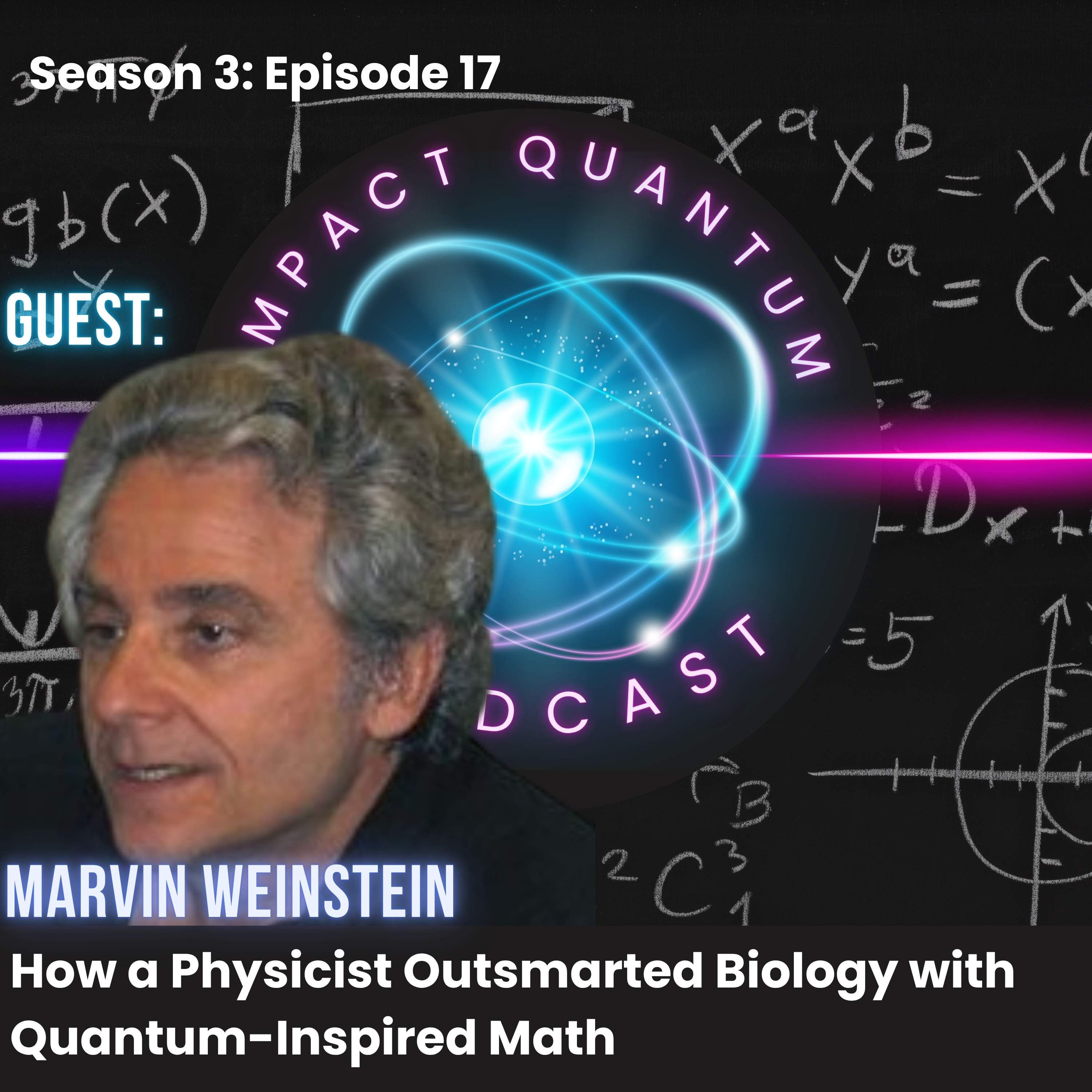
In today’s episode, hosts Candace Gillhoolley and Frank are joined by Dr. Marvin Weinstein, emeritus particle physicist at Stanford and co-creator of Dynamic Quantum Clustering (DQC). Marvin pulls back the curtain on how a quantum mechanics-inspired algorithm, running on ordinary computers, is revolutionizing how we detect patterns in complex biological data—specifically brain cancer.
You’ll hear the fascinating story of how Marvin, driven by personal loss, dove into decades-old, heavily-studied cancer datasets with DQC and uncovered new, highly accurate tumor classifications and biological insights that even seasoned researchers had missed. With a unique approach that’s completely data-agnostic and unsupervised, Marvin demonstrates how physics thinking can spark breakthroughs in biology, identify clusters with over 99% accuracy, and potentially pave the way for more precise cancer treatments.
This episode is a quantum-inspired masterclass—no PhD required, just a curious spirit and maybe a strong cup of tea. Whether you’re a technologist, scientist, or just love a good intellectual thrill ride, strap in as we explore how the boundaries between quantum theory, data science, and medicine are blurring in stunning ways. Stay tuned, stay entangled, and let’s get under the hood of quantum-powered discovery!
Timestamps
00:00 “Quantum Inspired Data Science Masterclass”
04:17 Exploring Old Glioma RNA Data
07:49 “Gene Analysis Optimization Strategy”
11:11 Adaptive Dimensional Analysis Success
17:29 Collaborative Breakthrough in Problem Solving
18:54 Reducing Function Sensitivity
22:03 Quantum Tunneling Enhances Data Analysis
28:35 Gene Expression Clustering Analysis
29:35 Gene Expression Standard Deviation Analysis
32:52 Undiscovered Insights in Brain Cancer
35:59 Prescriptive Algorithm Understanding Limitations
41:23 “Interpreting Biological Processes as Evolution”
42:26 Tumor Analysis and Drug Selection
47:09 Discovery Surprises Collaborators
49:06 Interdisciplinary Innovation in Precision Medicine
52:30 Orbit Calculations and Perturbation Theory
55:33 Exploring Lattice Theory and Applications
59:14 “Cheers: A Toast to Joy”
Transcript
Welcome to Impact Quantum, the show that peeks under the hood of
Speaker:quantum computing to reveal what's emerging and why it
Speaker:matters. Today's episode is an absolute masterclass
Speaker:in quantum inspired data science, with a guest who
Speaker:quite frankly makes the rest of us feel like we're still stuck figuring
Speaker:out long division. Joining Frank and Candice is Dr.
Speaker:Marvin Weinstein, emeritus at Stanford University,
Speaker:bona fide particle physicist and co creator of
Speaker:dynamic quantum clustering, a method that
Speaker:sounds like science fiction, but delivers real world,
Speaker:potentially life saving insight. Marvin takes us on
Speaker:a thrilling journey through brain cancer research, data
Speaker:agnosticism, and how a physicist wandered into
Speaker:biology and found patterns that even seasoned
Speaker:researchers had missed. This isn't quantum computing per
Speaker:se, it's quantum mechanics inspired analysis applied with
Speaker:surgical precision minus the surgical gloves.
Speaker:Whether you're a curious technologist or just here for the
Speaker:intellectual thrill ride, this one is for you. And
Speaker:no, you don't need a PhD to follow along. Just
Speaker:curiosity and perhaps a cup of strong tea. This episode
Speaker:is rated 5 Schrodingers. So buckle up and let's get
Speaker:into it.
Speaker:Hello and welcome back to Impact Quantum, the podcast where we explore the
Speaker:emergent fields of quantum computing and
Speaker:the upcoming ecosystem that is going to spread around it.
Speaker:So you don't need to be a quantum physicist, but you do need to be
Speaker:curious and curious about quantum computing. And with me today,
Speaker:as always, is the most quantum curious person I know, Candace Kahuli.
Speaker:How's it going, Candace? It's great. Thank you so much for asking. I'm really
Speaker:excited about today. Yeah. So I think today you actually have
Speaker:an honest to goodness physicist here on
Speaker:as a guest. Absolutely. Amongst many things that
Speaker:he's, that he's doing, I can say that he is a particle physicist at Stanford
Speaker:University as well as,
Speaker:as well as the CSO co founder at
Speaker:Quantum Insights Incorporated. He's got a lot, a
Speaker:lot of experience and a lot of great knowledge to share
Speaker:to our audience. I think everyone's going to find him as fascinating as I do.
Speaker:Cool, I hope.
Speaker:But I am a genuine quantum mechanic. That's right. There you
Speaker:go. So please welcome everybody, Marvin
Speaker:Weinstein to the show. How's it going? It's
Speaker:going well. As I was telling Candice, you got me in a very
Speaker:excited state today, so I hope I'm coherent.
Speaker:Awesome. Yeah. In the virtual green room, you had said you kind of
Speaker:uncovered something very interesting. So we can start there if you
Speaker:like. Well, yeah, I mean,
Speaker:basically the thing we were talking about
Speaker:during the previous interview was a tool that was Developed that was
Speaker:what the company was founded for, to apply the
Speaker:various problems. And it's called dynamic quantum clustering.
Speaker:And it differs from other clustering
Speaker:algorithms, other data mining tools, in that it
Speaker:is completely unbiased. You can take a first look at data with
Speaker:making no assumptions about if there is anything to be found in the data,
Speaker:cleaning the data or
Speaker:labeling it in any manner, shape or form. You just look at the raw
Speaker:data. So
Speaker:for personal history reasons, I mean, Candace was telling me about somebody
Speaker:she knew who partner had
Speaker:died or father had died of a brain tumor. But
Speaker:my first wife also died of glioblastoma.
Speaker:So when Quantum Insights decided
Speaker:to close its doors, I was sitting with all of this data from the Cancer
Speaker:Genome Atlas, including all of its glioma
Speaker:data. That means all low grade gliomas and
Speaker:glioblastoma data. So I had RNA sequencing data
Speaker:for all of those tumors. And basically
Speaker:I decided first thing I want to do with it is take a look
Speaker:at it and see if there's anything to see in that
Speaker:data that I mean people have looked, this data set's old,
Speaker:so it's been around for a long time, has been heavily studied.
Speaker:People were totally sure that everything that there
Speaker:was to be extracted from that data set had been extracted from
Speaker:that data set. And so basically
Speaker:I said, well, nobody's looked with our tool.
Speaker:And so what did I do? Well, the first thing was, as
Speaker:I promised you, I simply loaded up the data. I did
Speaker:restrict the gene expression from the 60,000 genes
Speaker:that it comes with down to what everybody believes is
Speaker:the 20,000 so called protein coding genes.
Speaker:Not all of them code for proteins, but they're the list
Speaker:that various tools
Speaker:restrict to. So I wanted to stay within what other people were doing.
Speaker:So I looked at those 20,000 genes. Well, that's a lot of data. I mean
Speaker:that's a lot of noise. It's actually not a lot of data. It's only 600.
Speaker:I mean that's always a misconception. People say biologists have huge data
Speaker:sets. They really don't. I mean, for example, all of the
Speaker:cancer data is 692
Speaker:tumors, brain cancers.
Speaker:That's not a big data set. There's only 692 pieces of
Speaker:information. I don't care that there's 20,000 genes
Speaker:because all you're seeing is the effect of 692
Speaker:combinations of the expression levels for those genes. The whole
Speaker:data set can be reproduced from those 692 pieces
Speaker:of information. So
Speaker:not like a physics data set which has Millions of
Speaker:samples and stuff to look at. This is a biology data
Speaker:set and typically restricted to a specific disease.
Speaker:It's not huge. What it is, is
Speaker:complicated and really hard to see what's going
Speaker:on because there's so much noise.
Speaker:So first thing I did, as I said, was restricted
Speaker:the raw data. It's a matrix after all, rows
Speaker:and columns, okay? Every row is the expression level
Speaker:for 20,000 genes. I'm rounding the numbers off. You don't
Speaker:want the 20,312 all the time.
Speaker:So it's that. And there are
Speaker:692 rows in all. You feed that into DQC, it's
Speaker:made to ingest that quickly and you do, you just
Speaker:simply run the first analysis and surprise. The first thing you see
Speaker:is there's a whopping big signal.
Speaker:In fact that data, raw, unprocessed,
Speaker:unlabeled, untreated in any way, no
Speaker:training set, separates into two clusters. One
Speaker:very large cluster which is mostly the lower grade
Speaker:gliomas, and another cluster which is
Speaker:almost all of the
Speaker:glioblastomas. Well, that's pretty
Speaker:cool. There's already a signal. It's not the best classification
Speaker:in the world. Maybe it's very good, it's competitive.
Speaker:But DQC has a standard trick which is
Speaker:you can pick out a smaller number of
Speaker:genes to look at, in this case a smaller number of features in the
Speaker:fancy language which
Speaker:give the same information. And so first run at that
Speaker:produced 544genes and exactly
Speaker:the same picture. So I didn't have to look at 20,000, I
Speaker:had to look at 544 which were doing most of the heavy
Speaker:lifting, produce the same two clusters,
Speaker:same, not wonderful, but pretty good classification
Speaker:scheme. Then there's another DQC based trick
Speaker:which is using the information in the two clusters, now
Speaker:I can order the genes that I'm looking at, the
Speaker:544, in order of their
Speaker:importance to the signal.
Speaker:Then I look the first 10 genes, the first 20 genes, the first
Speaker:30 genes, and I did those analyses over and over. Each time I did
Speaker:it starting from 10, I got a pretty good
Speaker:classifications. 20 made it better, 30 made it better
Speaker:until I got up to 90 genes and then at
Speaker:100, 110, 120, everything
Speaker:stopped getting better and started to get worse. Interesting. So the
Speaker:cutoff interesting was I wanted to look at the 90 gene signal
Speaker:because the cleanest information was going to be in the 90 gene
Speaker:signal. Did that and sure enough I find
Speaker:four clusters. So what are the four clusters? Three of
Speaker:those clusters are all low grade gliomas.
Speaker:100% low grade gliomas. They
Speaker:capture all of the low grade gliomas
Speaker:except for four tumors. The
Speaker:fourth cluster is all of the glioblastomas and
Speaker:those four that were not captured. Now remember,
Speaker:there were 692 tumors, I was missing four.
Speaker:So when you look at them plotted in the space,
Speaker:let's call it PCA space. You like that word? And it is the
Speaker:PCA space for the tumor expressions. Those four
Speaker:lie right next to the gliomas, whereas all the other data lie far away from
Speaker:the gliomas. Just for folks that may not know
Speaker:what PCA is, is it Principal Component
Speaker:Analysis? Principal component, yeah. PCA
Speaker:is a way of rotating the data so that
Speaker:the dimension of the data in which
Speaker:the data is most spread out is the first dimension. The dimension
Speaker:in which the data is next most spread out is the second.
Speaker:It tends, if you're lucky in low dimensions
Speaker:to show you what you need to see in order to
Speaker:try to do clustering. Because most clustering algorithms
Speaker:deteriorate rapidly as the dimension of the data goes
Speaker:up. So they like to do a hard dimensional reduction, they
Speaker:call it to two or three PCA directions
Speaker:and then try to cluster based on what they see there.
Speaker:There are algorithms which work in higher dimension, but,
Speaker:but still there are things they struggle with.
Speaker:DTC doesn't really care. It doesn't start with a hard dimensional
Speaker:reduction. It simply works
Speaker:with, with what is showing the most information. If it's 6,
Speaker:if it's 10, if it's 16, if it's 50, that's fine, I
Speaker:don't care. I'll, I'll work in that. The only impact
Speaker:and price I pay is the time it takes to run the algorithm.
Speaker:But, and so the usual trick is you work in the lowest number
Speaker:of dimensions that appear to be noise free,
Speaker:which you can tell by looking at the spectrum that you see in pca
Speaker:and then work your way up to twice that number of
Speaker:dimensions and look again and if you see the same information,
Speaker:well, it's quicker to run everything in the lower dimension, but
Speaker:you don't stop if you see a change. So
Speaker:at any rate, Granite, I got these four clusters.
Speaker:Now you notice the only misclassification out of
Speaker:692 tumors is four tumors.
Speaker:So a considerably less than 1%
Speaker:failure. Of doing close to like
Speaker:1/7 of 1%, would you say? Yeah, yeah, yeah.
Speaker:So I mean that's, that's, I'm trying. To quote the worst possible
Speaker:statistic that I can imagine, but less than 1%. We can all
Speaker:agree on. So that would put it at over 99%. If I tell you
Speaker:from this analysis you have a low grade glioma, I'm
Speaker:100% accurate. Right. If I tell you you have a
Speaker:glioblastoma, I might be as much as
Speaker:2 1/2% inaccurate on just glioma question
Speaker:that's better than world class. Let's say what's current state
Speaker:of the art is closer to like 80, 20. 19 around trying to
Speaker:say how do we compete? And I haven't succeeded yet. My
Speaker:collaborators, one bioinformaticist at
Speaker:Wisconsin and a cancer doc at Stanford,
Speaker:are going to have to help me with that. In searching the literature, what
Speaker:I find are statements like most schemes for
Speaker:doing this, unsupervised from
Speaker:the raw data and then moving on from an internal
Speaker:analysis. Still working, starting with the raw data,
Speaker:what they call the area under the curve. So the likelihood you're right
Speaker:is 70 to 80%.
Speaker:Interesting. So we're not talking anything like the same. There
Speaker:are some special biomarkers. If they're found
Speaker:on a glioblastoma, then people are pretty sure
Speaker:it's a glioblastoma at maybe the 1% level.
Speaker:Okay, but separating
Speaker:glioblastoma from low grade gliomas, blind,
Speaker:they're nowhere near that good.
Speaker:So at any rate,
Speaker:that's what I found. I now have the world's best classifier.
Speaker:In 90 genes, I plot the gene expression levels
Speaker:for each one of those clusters. And for most of the genesis
Speaker:I see the genes either fall into the category, the
Speaker:expectation for the expression of that gene
Speaker:for the either goes systematically up through
Speaker:the four clusters, going from the lowest grade glioma to the
Speaker:glioblastoma, or systematically goes down. That's
Speaker:what you want to see. Those genes are involved in what's happening,
Speaker:but there's still 544 genes.
Speaker:And I can't see the forest for the trees.
Speaker:Interesting. So does this inform treatment options?
Speaker:Well, that's the problem. Treatment options, or at
Speaker:least my understanding. So remember, I have to be
Speaker:very upfront. I'm not a biologist. Right. Everything
Speaker:you will hear me talk about, I learned by looking at this data. I have
Speaker:nothing formal training in biology whatsoever,
Speaker:so you're dealing with a novice. It reminds me of the
Speaker:the original Star Trek show where Bones would always like, I'm a doctor, not an
Speaker:engineer. Like you're like, I'm a physicist, not an engineer. I mean a doctor, you
Speaker:know. So what, what initially inspired you to take
Speaker:all of your quantum mechanics Knowledge and, and, and
Speaker:apply it biological data. Yeah, so remember I'm the
Speaker:co inventor of this algorithm. The other inventor is David
Speaker:Horn, Tel Aviv University, a frequent visitor to
Speaker:Slack. He collaborated on many physics
Speaker:papers. And Slack is not the
Speaker:messaging app. It's Stanford Linear Accelerator. Is that right?
Speaker:No case Stanford. It used to be called the Stanford Linear Accelerator
Speaker:Center. So I'll tell you out of school the story which
Speaker:reflects wonderfully on the doe. At some point the
Speaker:DOE wanted to put its name on everything
Speaker:and trademark it.
Speaker:Well, Slack said, because Stanford said you can't trademark
Speaker:the Stanford Linear Accelerator Center. It's us, right?
Speaker:We run the place. So DOE made
Speaker:SLAC change its name to SLAC S L A C
Speaker:and call it the SLAC National Accelerator Laboratory. So I guess
Speaker:as an abbreviation we're now Snal, not Slack.
Speaker:Slack sounds better. I grew up with it as slack for
Speaker:42 years. To hell with the DOE. I don't intend to
Speaker:listen to what they want. But it is now officially the SLAC
Speaker:National Accelerator Laboratory. Right. So at any rate,
Speaker:David Horn came into my office and life went as normal. He said, oh, I
Speaker:have something interesting to show you. Because he kind of had left high energy
Speaker:physics about eight years earlier and was looking
Speaker:into data mining. And he said there this cool idea
Speaker:that grows out of
Speaker:something done by somebody called Emanuel Parsons, called the Parsons
Speaker:estimator. And I figured out I should think about it as a
Speaker:quantum potential. I already was very
Speaker:suspicious. It sounded like a very strange idea.
Speaker:And so we did our usual thing. We stood at the blackboard and
Speaker:yelled at one another for three or four hours. And
Speaker:then we came to a meeting of the minds and said, this really isn't the
Speaker:stupid idea. It's kind of cute. And
Speaker:you know, David said, well, he showed me some simple problems
Speaker:having to do with classifying crabs. It's the standard
Speaker:old problem that people did
Speaker:and seemed to be very interesting.
Speaker:He said, but the problem is in order to understand who's
Speaker:so the what, the idea behind it is very simple. You take
Speaker:all the data, you create a function. The properties of this
Speaker:function are wherever there's more data
Speaker:than it is in the surrounding, there should be a peak. And
Speaker:wherever there's less data, there should be a value. The problem is,
Speaker:of course, the way you create that data is very sensitive to a parameter that
Speaker:you introduce. Okay, I don't want to get too
Speaker:messy in this. It's all published so it can be
Speaker:read and the sensitivity is hard to
Speaker:deal with. So what we finally
Speaker:understood was if we treated this. So this
Speaker:is just a professional deformation.
Speaker:Because we're particle physicists and quantum mechanics,
Speaker:we think of everything as having something to do with particle physics.
Speaker:Quantum mechanics. This problem has nothing to do with particle
Speaker:physics or quantum mechanics, except we want to get rid of the sensitivity of
Speaker:that function. And we said, if you think of this as the solution to
Speaker:a problem in quantum mechanics, that problem has a
Speaker:term having to do with the particles moving around and another
Speaker:one having to do with the landscape it finds itself in.
Speaker:That's called a potential function. It turns out
Speaker:that potential function always has sharper
Speaker:features, more pronounced dips
Speaker:than the solution, has peaks,
Speaker:and turns out to be much less sensitive to the parameter that goes into
Speaker:building that function. So, literally, by
Speaker:saying, what problem is this picture,
Speaker:the solution to which turns out to be
Speaker:trivial to solve what potential function,
Speaker:you get a sharper picture. And the sensitivity, the parameter used
Speaker:to build what's called the kernel function, that potential function
Speaker:goes down by a factor of 10. So you have a pretty
Speaker:unique answer. It's easy to arrive at. You don't have to be careful about
Speaker:picking your parameters. The problem is if
Speaker:you think of this as things living. So we have these
Speaker:valleys now where the bulk of the heavy
Speaker:concentration of data is, or we have stream
Speaker:beds, but the data is up along the
Speaker:walls as well as being down in the
Speaker:valley. So the question is, which data belongs to which
Speaker:valley, which stream bed, et cetera.
Speaker:And so you want to move the points down the sides of the valley
Speaker:and have them collect in whatever structure is at the bottom.
Speaker:Well, people try that. In fact, my
Speaker:colleague had been trying it. And as the dimension goes up,
Speaker:for reasons we understand, that
Speaker:surface becomes rippled just due to noise.
Speaker:And so basically, if you try to just move things
Speaker:down using ordinary calculus, what's called gradient descent,
Speaker:you're just moving points in the direction of the slope. They get
Speaker:stuck in the ripples. Oh, I see. Because
Speaker:it can't find the global minimum. It can't find the important
Speaker:minimum. Right. If things move according to quantum
Speaker:mechanics, all bets are off. It's a much nicer
Speaker:story. And it's the uncertainty principle, which made the
Speaker:solution wider to begin with. So we're going to
Speaker:exploit the uncertainty principle. If I move points
Speaker:according to the laws of quantum mechanics. The first thing is, unlike
Speaker:gradient descent, the quantum wave function extends out to
Speaker:where the valley starts going up again.
Speaker:So points automatically start to slow down as they
Speaker:reach the minimum. And they don't overshoot and
Speaker:rattle around, they just stop because they see now
Speaker:equal influence from Both walls and therefore no
Speaker:force. Also they don't see ripples because
Speaker:the uncertainty principle allows for quantum tunneling
Speaker:and they simply go through those tiny ripples or ride above them.
Speaker:So as a way of making the data move
Speaker:and find the minima in the function in any number of
Speaker:dimensions and as a way of speeding up the
Speaker:analysis, because quantum evolution is done by matrix
Speaker:multiplication, so it's enormously
Speaker:parallelizable. Didn't say that very well.
Speaker:Parallelizable, you get a very quick algorithm
Speaker:that is using physics principles. But to solve a non physics
Speaker:problem, just getting the points efficiently down to the bottom.
Speaker:If there is a riverbed that tells
Speaker:you something about the data, says there's some one parameter
Speaker:thing, some regression on the data that you can do to
Speaker:something that's very extended. It's a huge discovery.
Speaker:It's much better than finding simple clusters.
Speaker:But that's what this does. So DQC has
Speaker:advantages. One, it doesn't require training sets.
Speaker:So it's great for biology data because having annotated
Speaker:training sets that are really good, hard to combine.
Speaker:So this is interesting and what does DQC stand for?
Speaker:Dynamic Quantum clustering. Meaning we're using quantum mechanics.
Speaker:The find the minimum. Now do you need a quantum computer to do this
Speaker:or this is just an algorithm? Interesting. I told you I'm here under
Speaker:false pretenses. You asked me here to talk about quantum
Speaker:computing. And I told you I don't do quantum computing. I'm talking about using
Speaker:quantum mechanics to run on an ordinary
Speaker:computer. Could it run on a quantum computer? Yes, if
Speaker:they were really as fast and as good as they say they're going to be,
Speaker:would even be better because it can handle bigger. I'm
Speaker:focusing on biology, by the way. Way this algorithm is data
Speaker:agnostic, right? It's not talking about
Speaker:biology per se, it doesn't care. It just says that
Speaker:there's something interesting. Data is not distributed with
Speaker:equal density every place. Things that are more like one
Speaker:another tend to be located in a more dense region.
Speaker:Okay, so and this has been applied to many things. It's been
Speaker:applied to
Speaker:finding radioactive sources in the city of Chicago hidden
Speaker:in a building. Okay, it, there's a paper that I wrote on
Speaker:that it's been applied to. I guess
Speaker:there's no paper on this, but it was a problem I did for somebody
Speaker:finding
Speaker:tanks in the desert that have been camouflaged, painted,
Speaker:same thing using the data from a
Speaker:multispectral hyperspectral camera.
Speaker:So it doesn't care what the data is. It's data agnostic
Speaker:it's feature agnostic. It is
Speaker:unsupervised completely. That doesn't mean that you don't use the results
Speaker:of a previous analysis to now supervise the next analysis
Speaker:based on what you learned. You do do that.
Speaker:But at any rate, that was it. So what's now
Speaker:going on is, as I said, we have the world's best
Speaker:classifier. But I don't know how to tell you what the
Speaker:best drug for your tumor, the one that's most likely
Speaker:to work on, the biology that's happening now, should
Speaker:be. And that's why I need to go find a biologist and they're
Speaker:not so great at doing it either. So witness how
Speaker:many people go through many, many failed drugs. Yeah,
Speaker:well, precision medicine is definitely, you know, one
Speaker:of, one of the, you know, one of the biggest outcomes of using
Speaker:this type of, this type of clustering that
Speaker:we can, we can create. I mean there's so many, there's, there's just, there's
Speaker:so much out there that needs this type of, you know,
Speaker:this type of. Still in its infancy. It's got a place to go to
Speaker:be precision medicine. Where do you. Oh, go ahead.
Speaker:Oh, please don't let me. What you have to say. I was going to say
Speaker:based on dynamic clustering, quantum clustering,
Speaker:you know, where do you see it evolving in the.
Speaker:So I'll finish telling you this story about why I'm excited because
Speaker:I think it's evolving to a really. I, I've
Speaker:seen something today I never thought I would
Speaker:see. So last night it showed up at 10 o' clock
Speaker:in the evening and I'm still digesting what I saw.
Speaker:What I show you, you should take with a grain of salt. But there's no
Speaker:question, there's zero chance that I'm wrong in terms
Speaker:of what you'll see. Okay, so the way
Speaker:docs like to look at the problem or cancer
Speaker:researchers is they talk about so called
Speaker:biological pathways. Biological
Speaker:pathways are sets of genes
Speaker:which carry out some process. In the end, all processes
Speaker:are making proteins, but we're not looking at the proteins being
Speaker:made, but we know these sets of genes are
Speaker:functioning together to produce an interesting
Speaker:output. So if I can
Speaker:take the information I have and find
Speaker:a way of saying, oh, so in fact what I'm
Speaker:seeing is actually predicted by the following
Speaker:set of genes. And I can assign
Speaker:meaningful coordinates to each tumor
Speaker:based on where they are and what that set of
Speaker:genes is doing together. I mean, biospace,
Speaker:a point in that space depending on how many
Speaker:things still I'm producing. One axis in biospace
Speaker:and it's representing a process which is
Speaker:happening in the patient where a bunch of genes are
Speaker:telling me something, not one. And
Speaker:that bunch of genes I can look at and ask what are their
Speaker:properties? What are their common properties?
Speaker:So I will share something with
Speaker:you. So at any rate, did that.
Speaker:Okay. Went to biospace using DQC
Speaker:methods again. Remember I told you I had four clusters. So
Speaker:there are six pairs of clusters which
Speaker:differ in how the genes are being expressed in those clusters.
Speaker:So I can find the most, the list of the most important ones between
Speaker:1 and 2, 1 and 3, 1 and 4, 2 and 3,
Speaker:2 and 4, 3 and 4. So
Speaker:six possible axes
Speaker:in biospace, the sets of genes that are most important.
Speaker:And then using those axes which go from minus something
Speaker:to plus something, I can assign a coordinate to every one of the
Speaker:tumors. So I have points in a six dimensional space.
Speaker:Okay. The way that's done,
Speaker:it's done in a way such that zero on
Speaker:that axis means that for that set of genes,
Speaker:that point is consistent with what the value for
Speaker:all of the genes in that thing. The average value of those genes
Speaker:is. Plus means you are moving
Speaker:x standard deviations away from
Speaker:being at the average expression. So I don't need to know what the
Speaker:normal expression of a gene is. That's always one of the
Speaker:problems. You rarely have data for normal
Speaker:cells of the same type as the tumor.
Speaker:And so you don't know where to set your zeros. Here I'm doing it by
Speaker:the average and I'm saying how far from a standard deviation am
Speaker:I out one way and how far out am I the other way?
Speaker:And so you plot the same tumors.
Speaker:Now I have to remember what I do. I go to share
Speaker:share the screen. So you plot the same set of
Speaker:tumors. Now you see my background. Yes. And I am going to
Speaker:switch over to the computer in my basement and show you a fun thing.
Speaker:So the axes you see here are
Speaker:DQC's plotting of
Speaker:the cancers in a six dimensional biospace.
Speaker:But I want you to see, blues are glioblastomas,
Speaker:reds are the lowest grade gliomas,
Speaker:magentas are the next lowest grade gliomas.
Speaker:And the goals
Speaker:are closest to the glioblastomas.
Speaker:Interesting. Now I told you this is an animation. We're going to start the points.
Speaker:This is how the QC works. Okay. So we're moving the points
Speaker:downhill.
Speaker:You like that? Yeah. So it's all. What's
Speaker:happening, they're all converging into one like a
Speaker:regression, right? Right. There's a one dimensional
Speaker:shape. The healthiest tumors, they're not
Speaker:healthy, but they're the healthiest. They're not the least awful.
Speaker:Yeah, the least awful. So if I look at for this.
Speaker:We already saw that when we analyzed the. So the colors
Speaker:here are the clusters that I discovered
Speaker:in RNA sequencing space in what we call
Speaker:gene space.
Speaker:They've just been arranged in a line from best to
Speaker:worst. So blue is the worst. The
Speaker:glioblastomas over here. Okay. Okay. So
Speaker:for those listening, don't worry, we're gonna link in the show notes to a video
Speaker:representation of this. Interesting. At
Speaker:any rate, this is what you see.
Speaker:So the. This is the plot in bio space. Now that's very
Speaker:interesting because these have the dimensions of the bio coordinates
Speaker:and those coordinates have a meaning.
Speaker:Okay. In fact, I'll tell you what the meaning is. And this is based
Speaker:upon a set of data of patients.
Speaker:Yes, this is 692 patients.
Speaker:That data was submitted to the cancer genome project. Okay. Oh, so this
Speaker:is open source data that you're pulling. This is absolutely open source.
Speaker:What my company did when we existed, because we had various
Speaker:projects going and things like this, we downloaded all of
Speaker:that data for the RNA sequencing data and as much
Speaker:as we could find about each of those tumors, which was
Speaker:not a hell of a lot. But there's something, It's a good
Speaker:database. As I said, it's been studied for years and years and years.
Speaker:So this is results obtained by starting from no information
Speaker:and just relooking at the brain cancer data
Speaker:and saying, people have been studying this forever. Did they ever
Speaker:find anything like this? And the answer is no.
Speaker:This has never been discovered. This has never been discussed. So
Speaker:using traditional analytical sources,
Speaker:you could not. Whatever. You could not get at this information
Speaker:without doing the. The dynamic
Speaker:because you make a lot. Of assumptions about what you're supposed to look at. You
Speaker:make a lot of assumptions about how you filter the data.
Speaker:You end up throwing the baby out with the bathwater.
Speaker:Go ahead. No, you also said you didn't do any cleanup of the data. Like
Speaker:that's just the wrong. No. Well, I mean, they've cleaned it up obviously. Obviously at
Speaker:some level. But we're not doing the post. Whatever they
Speaker:did cleanup that people normally do where they filter out
Speaker:genes, where they have this gene should be expressed at
Speaker:least at this level. All genes that aren't expressed at that
Speaker:level we're throwing out of the data set. Okay.
Speaker:If I see a difference between two
Speaker:clusters and the genes are expressed differently in the two clusters,
Speaker:but what they call the fold value isn't big enough.
Speaker:I'm throwing it out of the data. Well, you can imagine
Speaker:if there's hidden information in the data and you're busy throwing things
Speaker:away, the chance you throw the baby out with the water bath water
Speaker:is very high. Exactly. And
Speaker:that's exactly what this shows. The benefit of going in
Speaker:unbiased, unfiltered,
Speaker:completely agnostic. Look to see if there's a signal first.
Speaker:And then when you see the signal, which I did. So stage one is,
Speaker:wow, there's a signal. Stage two, what is making the
Speaker:signal? EQC is built for solving those
Speaker:problems. Right. So basically, and
Speaker:that's where it differs from AI, okay, AI needs training
Speaker:sets for the most part. There are
Speaker:versions of AI now that claim not to, which
Speaker:are real. They make up data in order to train
Speaker:the data. There aren't enough training sets.
Speaker:So what you do instead is you make up artificial data and then try
Speaker:to teach it to reconstruct the real data.
Speaker:Okay, by by picking the parameters in the artificial data
Speaker:and then you try to classify existing data.
Speaker:But it's a different story here.
Speaker:Everything is understood. The algorithm is totally
Speaker:prescriptive. I know exactly what's going on.
Speaker:There's no mystery. Once I find something
Speaker:and we ended up, I just showed you with this concept of
Speaker:biospace, which is what
Speaker:people in literature, it turns out that's where the idea came from
Speaker:to look at it this way, what people were
Speaker:talking about as latent coordinates in the data.
Speaker:So there are people doing AI that say, oh, I'm going to keep feeding
Speaker:AI from this and AI is going to reduce my problem to
Speaker:some low dimensional manifold and I'll call that a latent
Speaker:coordinate picture. But then I'm faced with the problem. I don't really know
Speaker:what the coordinates mean. I am busy trying to interpret
Speaker:them and I certainly don't know how to exploit them.
Speaker:Different here. Right. So we started with no training data.
Speaker:Am I looking at here? Shouldn't be showing
Speaker:you this, but my, my collaborators say I can show it to you.
Speaker:So here are the axes. So what do
Speaker:you know from these axes? Well, the
Speaker:genes in this axis have, as I
Speaker:say, tumor associated fibroblast activation,
Speaker:their immune checkpoint genes
Speaker:signaling chemokine driven inflation, the pathways that are
Speaker:being recruited for this or that. Basically
Speaker:here it says if you want to
Speaker:change overexpression or under expression, you want to look at
Speaker:the drugs which do the following thing.
Speaker:There's one such description for every one of the six axes
Speaker:they have A meaning. And so if I simply look at the
Speaker:coordinates and biospace and see which. Along which of these
Speaker:axes the biggest signal lies,
Speaker:that's the first set of drugs you try on the tumor.
Speaker:So by looking at in biospace and how the tumor
Speaker:evolves in biospace,
Speaker:that's what this is, right? The evolution of the tumor
Speaker:in biospace. Every one of these points, after all, is a
Speaker:snapshot in time of the tumor at that point.
Speaker:What this suggests is it's a continuous
Speaker:evolution to glioblastoma through these
Speaker:biological processes. And as they change.
Speaker:So you're seeing the. So basically, what
Speaker:have I learned? God is showing me, or biology is
Speaker:showing me how the tumors evolved in
Speaker:time.
Speaker:Interesting. I don't know. That doesn't. So do they all start out
Speaker:as like you showed that image again, but
Speaker:the one where they're all on the same plane, the one that we're all
Speaker:on the same plane. This is the
Speaker:snapshot and survival term for the patient because that's what
Speaker:is changing along this curve. We already saw that. Oh, I see. So
Speaker:this had different survival times. So these are all
Speaker:tumors. I don't know where healthy is.
Speaker:Okay. So not everybody starts out, for example,
Speaker:you know, in the red. And then basically
Speaker:they probably do. Okay.
Speaker:Glioblastomas have to be. If you look at them in terms of their gene
Speaker:expression patterns, they're a mess. Okay.
Speaker:They've undergone many mutations to get where they are. And the more mutations,
Speaker:that's the different colors, basically, and they change. Okay. So
Speaker:everyone starts out maybe with the red, but not everybody
Speaker:goes all the way to the blue. Purple. Right. And they probably. Everybody probably
Speaker:starts out to the left of the red. Right. Because these
Speaker:tumors probably form at the single cell or small number of
Speaker:cell levels. Okay. And take 10 years to grow.
Speaker:Okay. The first show up and be seen. Okay. So
Speaker:it's not. We don't have examples of the earliest
Speaker:version. That's the beauty of what. What's blowing me away. Yeah.
Speaker:Don't need to know any of this. I don't
Speaker:have to know. I only need the gene expression pattern
Speaker:and I only needed the information about survival time to
Speaker:interpret the axis. Everything else came after
Speaker:I found the axes when I had to interrogate
Speaker:pathway databases to find out what they do.
Speaker:And truth be told, I asked an AI to give me the
Speaker:information about that because it's a pain in the ass to
Speaker:go through those things yourself. So we could use. And I just
Speaker:wanted to know what I might see. This is not to be taken
Speaker:seriously. Okay. Because My, my
Speaker:biologist and my doctor friend are going to have to do the job
Speaker:of vetting what these interpretations. I only trust
Speaker:AIs a little
Speaker:bit. It's sort of fun to do that. Okay.
Speaker:But what I wanted to give you was a feeling
Speaker:for the difference between biospace information
Speaker:and simple single gene information. Okay.
Speaker:And it's awesome what the difference is. And
Speaker:it's awesome that there's a progression in
Speaker:biological processes that lead you to
Speaker:glioblastoma. I can't tell
Speaker:you this actually represents evolution,
Speaker:but if it looks like evolution and it smells like
Speaker:evolution and it wax like evolution, it's
Speaker:evolution, okay? I mean that's just my feeling.
Speaker:Now I've already given you all the I don't know any biology,
Speaker:do know a lot of physics, do know how DQC works.
Speaker:Okay. I know that better than anybody. But this
Speaker:business that you can take the information that you learned in
Speaker:the genetic right, in the single gene
Speaker:basis and convert it to biological
Speaker:process basis and learn entirely new things
Speaker:more suited to advising doctors who are treating
Speaker:cancer patients. Because I can take a new
Speaker:tumor stuff and put it on that plot, see where it
Speaker:is, see what its access definition is
Speaker:and see what the likely best drug is to start with. And
Speaker:then if that doesn't work, drop down to the next most likely. The next
Speaker:most likely. So
Speaker:basically that sort of we can stop sharing actually
Speaker:now, which he says I can stop sharing.
Speaker:Okay, great. So you know why I'm
Speaker:in this befuddled state at the moment? Because I am still
Speaker:absorbing what this is telling me. I certainly never expected
Speaker:when I thought of trying that because people talked about these latent
Speaker:variables and hidden dimension, hidden coordinates
Speaker:and describe ways that might work. I didn't see any
Speaker:examples actually worked out. This is the
Speaker:story from beginning to end
Speaker:genetic coordinates to discovery
Speaker:to the world's best classifier to changing that into
Speaker:bio coordinates discovered from the genetic side.
Speaker:The treatment options, a tool for helping doctors treat,
Speaker:for suggesting to cancer researchers new experiments to
Speaker:do to verify what they're seeing on this.
Speaker:Lots of suggested. I alone with no knowledge can think
Speaker:of 10 things people should explore based on this. And
Speaker:drug companies want to know what the next set of things
Speaker:to target should be for a given disease.
Speaker:Wow. I think that's pretty cool. That is
Speaker:impressive. So it really is. You know,
Speaker:DQC is telling me the data is whispering
Speaker:to you. I'm the tool
Speaker:that'll teach you how to listen.
Speaker:That's the way I feel about it. Since it's my baby, it's grown
Speaker:up, I really think it's grown up and
Speaker:I'm very impressed with where it got. So you're getting me in my
Speaker:very biased statement for it. Oh, we can tell it's super, super humble. But
Speaker:no, it's really. It's really exciting. But also to see where it can
Speaker:be taken from there, you know, like, this is just the beginning.
Speaker:The. There's so many scratching the surface. First place, those
Speaker:axes could be improved because there's more than one
Speaker:set of genes that give similar information
Speaker:how to exploit it, how to do the bench experiments.
Speaker:That's not me. I don't know that stuff. And I'm
Speaker:83. I'm not ready to start learning how to be a bench
Speaker:biologist. Okay. But
Speaker:it's. It. It's just so cool. I mean, you know, it's
Speaker:like you've seen the underbelly of what's happening in the biology.
Speaker:At any rate, I don't know if you agree with me, but I think it's
Speaker:really cool. No, that is really cool.
Speaker:There's a lot to take in. I'm sorry about
Speaker:that. No, no, I mean, you know, we have a scale system for these
Speaker:shows, right? Like five. Five. What is the five Schrodinger.
Speaker:Schrodingers, yeah. So we have, like from zero to five Schrodingers. This is definitely gonna
Speaker:be a good five Schrodinger show. Like, and I was able to follow on because
Speaker:I was a d. Data scientist before this. So, like, when you
Speaker:said pca, like, I knew what you were referring to at least. I.
Speaker:But like, so, like, it was like, this show is really geared towards the
Speaker:quantum curious. Some of which will be data scientists, some of these will be
Speaker:marketers, some of those will be, you know, kind of traditional software engineers,
Speaker:et cetera, et cetera. Marketers. Right. Because it's our thesis that
Speaker:when the quantum computing ecosystem comes around, and
Speaker:indeed, I think what you've proven today is you don't really need
Speaker:quantum computing to take advantage of the
Speaker:innovations in quantum science. Right. Like. Right.
Speaker:I think that was an assumption I think Candace and I had. I don't want
Speaker:to speak for Candace, but I know I certainly did. But I know that there
Speaker:is a field called quantum inspired algorithms, which is probably.
Speaker:That's sort of what this falls. Yeah,
Speaker:but it's just exciting
Speaker:that innovation like this can come about in such a way that
Speaker:it's going to improve people's lives. What you've discovered is
Speaker:I'm not a biologist or a doctor, but I would imagine that a doctor or
Speaker:pharmaceutical Researcher would look at that and say, oh, you know what this means? This
Speaker:means xyz. I hope so. I mean, I mean
Speaker:I'm pretty much at the limit of what I can do even
Speaker:with collaborators on our own. The, the point
Speaker:we're writing the paper now. This is, I've already blown
Speaker:my collaborators out of the water because this was discovered last night and they
Speaker:don't know about it yet. I have their permission to talk
Speaker:about it though, so that's cool. It's,
Speaker:you know, so I, I, I'm glad you liked it and the five
Speaker:shortinger level because I'm only here because you guys refuse
Speaker:statement. I don't know anything about quantum. Well, I, I do know something about quantum
Speaker:computing but I am not a quantum computer person and
Speaker:so I didn't belong on your show but you kept refusing to let me off.
Speaker:But I mean, I think it's important that people think about like this is not,
Speaker:I think one of the things that obviously you're, you're, you're a great
Speaker:presenter and great teacher of these very
Speaker:complicated topics but you've also something to figure it out. Plus I also think it's
Speaker:important for people to realize that quite quantum physics and research in that
Speaker:space is already improving people's lives or at
Speaker:least already showing fruits of that. And
Speaker:I think that your research kind of shows that. It's like, you know, you don't
Speaker:have gen, you don't have the billionaires facing off over, you know,
Speaker:Jensen saying it's going to take 20 years, Bill Gates saying it's going to take
Speaker:less. Right. I mean this is pretty basement
Speaker:and the data is free. So I think the other lesson here
Speaker:is we have a wealth of data that's under explored
Speaker:because looking at it in an unbiased fashion hasn't been done.
Speaker:Right. So I have lots more diseases I want to look at
Speaker:and I have all this TCGA data for
Speaker:pancreatic cancer and various other
Speaker:cancer and so
Speaker:it's sort of fun, right? I like how you kind
Speaker:of mix, you know, I know you say you weren't appropriate, but I think you
Speaker:were totally appropriate for the show and you've got the physics
Speaker:background when you're talking about quantum clustering,
Speaker:why it's affecting the biological,
Speaker:giving us biological data that we're able to move forward with
Speaker:potentially for precision medicine. I love the
Speaker:bridges that are being created all over
Speaker:the place here that you're not just kind of stuck in one thing thinking you
Speaker:can only do one thing because you have a certain amount of knowledge but how
Speaker:you've bridged that to bring in all of this
Speaker:biological data information, I think it's
Speaker:fantastic. I'm very happy that you came and you joined us today.
Speaker:I learned. I'm glad I didn't bore you and I hope I didn't get too
Speaker:far into the weeds, which my wife accuses me of doing all the time.
Speaker:Mine too.
Speaker:Where can people find out more about you and what you're up to?
Speaker:Me and what I'm up to? Well, I'm on LinkedIn. People contact
Speaker:me through LinkedIn all the time.
Speaker:I have a long history and you know, if you go look at
Speaker:the archives, the physics archives. Physrev. Physrev A.
Speaker:Physrev B. I, I mean my, my past history is a little
Speaker:eclectic, even in physics, which I attribute to having a
Speaker:short attention Spanish. But I started in
Speaker:particle physics. In phenomenology means looking at data,
Speaker:trying to understand what it's telling me. I moved into
Speaker:pure abstract particle physics
Speaker:and then I went into what's called lattice field theory and lattice gauge
Speaker:theory, which is trying to learn stuff from
Speaker:how to say this. Didn't expect to talk about this. So,
Speaker:so let's talk about how we do physics, which is another
Speaker:totally off topic thing. And you may be running out of time. I don't know.
Speaker:You tell me when I have to shut up.
Speaker:But the, the, the story is
Speaker:physicists are smart, but there are very few problems we know how to solve
Speaker:exactly. Only a handful.
Speaker:Everything else is done by a process we call perturbation theory.
Speaker:Mathematicians also call it perturbation theory. You say, well, this
Speaker:problem that I know how to solve exactly kind of looks
Speaker:a little bit like this other problem, but with some
Speaker:modifications. So let me add the modifications to the problem
Speaker:and try to calculate corrections to the answer
Speaker:based on the modifications. So I have the original problem
Speaker:set and forces involved and the changes in those
Speaker:forces a little bit. And then I calculate
Speaker:perturbatively what's happening. People do it in
Speaker:celestial physics all the time. I have this
Speaker:planet moving around the sun in an elliptical orbit. Oh well, but
Speaker:there's the moon. So how does that affect the orbit?
Speaker:Well, I can't solve that problem. That's already a three body problem.
Speaker:And there's no exact solution to the three body problem by the time
Speaker:it's also got Mars and Jupiter and
Speaker:Saturn and Pluto and Mercury in the problem.
Speaker:I can't plot orbits. But people do it all the time.
Speaker:NASA plots orbits. How do they do it? They calculate
Speaker:the original orbits and they Start calculating the effects of Mars
Speaker:and this and that on that orbit, because we know what those
Speaker:forces are if Mars is on its orbit. And through
Speaker:successive corrections, successive iterations, you're
Speaker:able to make the small perturbations in the orbit that get the answer
Speaker:right for you and eventually lets you send something to the moon
Speaker:and not miss. Okay,
Speaker:so perturbation theory is, is what we use. But what is perturbation
Speaker:theory based on? I have a solution, I know how to get
Speaker:exactly. And I know how to make small corrections
Speaker:to that solution. And then I can describe all kinds of
Speaker:crap. So, for example,
Speaker:condensed matter physics talks about matter.
Speaker:So I ask you, has anybody ever proved that the table you're
Speaker:sitting at exists?
Speaker:Is there such a thing as a table made out of wood? In fact,
Speaker:is there such a thing as wood? The answer is no.
Speaker:Use wood to build houses. I use engineering
Speaker:principles to calculate the stress and load on a beam.
Speaker:How the hell do I do that if I don't know wood exists?
Speaker:I describe wood, I assume it exists, I
Speaker:characterize it in terms of a bunch of properties,
Speaker:and then I can, based on that, make small correction
Speaker:calculations again to see how the wood behaves
Speaker:when I stand on it. But I have to start from the
Speaker:assumption it exists and that there are properties
Speaker:I can measure for it and make prediction based on that.
Speaker:But the first principles thing that would exists, no way.
Speaker:Nobody solved that problem. Okay? So I was
Speaker:very interested in that because that's sort of a first principles problem,
Speaker:right? It's very philosophical, isn't it? It's where the, a
Speaker:hard science like physics kind of meets up against.
Speaker:Oh, we meet up against soft stuff all the time and
Speaker:we fail to solve the problem. But that's okay.
Speaker:It, it's. At any rate,
Speaker:I was always interested, always after many years in
Speaker:phenomenology, I and papers
Speaker:published in phenomenology and things like that,
Speaker:getting into field theory and, and
Speaker:trying to understand from first principles how to solve hard problems
Speaker:that, like quantum chromodynamics.
Speaker:That intrigued me because we're kind of using up this
Speaker:perturbation theory paradigm, okay? It's very
Speaker:useful, it's very good. But we're already running into lots of
Speaker:problems where it doesn't work. We don't know a problem that's
Speaker:approximately like the problem we want to solve.
Speaker:So how do you solve it? So I got involved in that. I got involved
Speaker:in what's called lattice field theory. And then I said, but how am I going
Speaker:to know I'm right? Because
Speaker:I could be Wrong in pushing my answer in the one
Speaker:known direction. There got to be other problems,
Speaker:but there's only one quantum chromodynamics. It's the one we
Speaker:live with, it's the one we're made of.
Speaker:So I don't know if I'm cheating or not, but there's
Speaker:lots of condensed matter problems and they all have different
Speaker:answers and many of them are strong coupling problems and you
Speaker:can't treat them perturbated. So take the same methods
Speaker:and change your field and go look at condensed matter and see if you can
Speaker:develop techniques to do that. Then did that for
Speaker:a long time and then developed some methods and decided,
Speaker:oh, David Horn came into my office and I said,
Speaker:oh, this looks interesting. So I can't stay
Speaker:in one area now, to me it makes sense why I'm changing to other
Speaker:people. It looks like I have no attention span. So that's
Speaker:okay because I do this for me. And
Speaker:so as long as I see the thread, I'm happy. But that's how I'm here.
Speaker:I'm now in biology, quote. But we're
Speaker:glad. We're glad that you're here. Glad that we got to learn
Speaker:a bunch of stuff today. I think it's going to be really
Speaker:exciting to unpack it and to
Speaker:have you back because you are just a. Few
Speaker:guys, but I'm going to bore you. So. No, I don't feel bored. I
Speaker:mean, I'm more fascinated. I'm confused. It's about some things, but,
Speaker:like, I'm also fascinated, too, and we want to be respectful of your
Speaker:time and. But we'd love to have you back on the show.
Speaker:I'm sitting in my office. I have
Speaker:Nothing on until 5:00 clock this evening. Awesome. We'll
Speaker:definitely have you come back then because again,
Speaker:it's just really great information. It's important, it's exciting. I think it's very
Speaker:exciting. So, unfortunately, we have a little limitation,
Speaker:so. Yeah, but definitely. And so folks can
Speaker:reach out to you on LinkedIn and engage with you directly, if you're cool with
Speaker:that and let your AI. I don't promise to
Speaker:answer everybody, and if they're a crackpot,
Speaker:I don't promise to be polite. There you go. That's fair.
Speaker:I'm liking that. I like that. Let our
Speaker:AI finish the show. And that wraps this quantum
Speaker:odyssey on impact. Quantum. A massive thank you to Dr.
Speaker:Marvin Weinstein for taking us deep into the fractal jungle of
Speaker:biology, data, science and quantum mechanics with
Speaker:only his brain, DQC and a suspiciously
Speaker:underutilized basement server farm. From classifying
Speaker:glioblastomas with 99% accuracy to uncovering
Speaker:biocordinates that could revolutionize precision
Speaker:medicine. Marvin reminded us that sometimes the biggest
Speaker:scientific breakthroughs don't require a billion dollar
Speaker:lab, just a stubborn physicist, open source data,
Speaker:and the audacity to ask what if? If you enjoyed
Speaker:this episode, and really, how could you not? Be sure to
Speaker:subscribe, share and let your fellow Quantum Curious friends
Speaker:know. And as always, check the show notes for links to
Speaker:Marvin's work, ways to connect, and possibly a
Speaker:diagram that will make your head spin just a little less.
Speaker:Until next time, stay curious, stay entangled,
Speaker:and remember, just because you can't observe the Quantum doesn't mean it's
Speaker:not observing you. Cheers.







Leave a Reply