
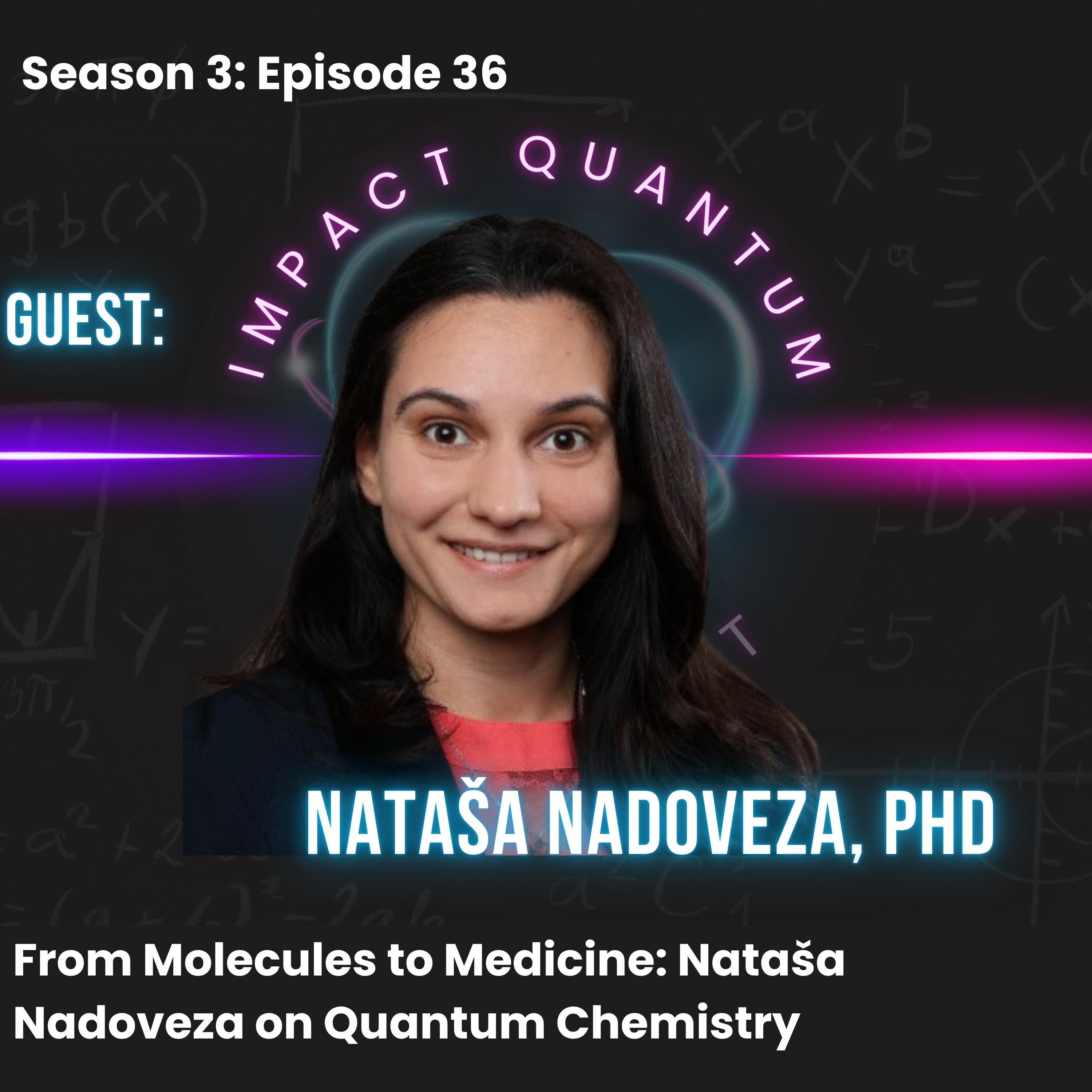
Welcome to a new episode of Impact Quantum! In today’s show, host Frank La Vigne and co-host Candice Gillhoolley dive deep into the fascinating world of quantum chemistry with special guest Natasa Nadoveza, who recently completed her PhD in this cutting-edge field. Together, they unpack what nuclear quantum dynamics is, explore its significance in understanding molecular processes, and discuss how quantum-level simulation could revolutionize industries ranging from medicine and drug discovery to energy and materials science.
Throughout the conversation, you’ll hear about the very real challenges of translating theoretical breakthroughs into practical tools, especially when it comes to scaling simulations beyond simple molecules. Natasa Nadoveza shares her journey from chemistry student to quantum researcher, and reveals some of the surprising quirks and behaviors of molecules when you look at them through a quantum lens.
Whether you’re quantum-curious or a science enthusiast, this episode will ignite your imagination with stories about catalytic processes, energy transfer, and even the quantum mysteries behind everyday things like color, smell, and photosynthesis. If you’ve ever wondered what it takes to run a multi-step simulation on a supercomputer, or how science—especially quantum science—continues to challenge our understanding of the world, you’ll find plenty to geek out over in this illuminating discussion!
Time Stamps
00:00 “Impact Quantum: Quantum Chemistry Insights”
05:22 “Methane Study Challenges in Theory”
07:45 Quantum Effects and Drug Discovery
11:44 “Catalysts: Reducing Energy Barriers”
14:46 Molecular Bond Simulation Insights
18:31 Quantized Energy in Molecules
24:01 Quantum Effects and Everyday Relevance
25:16 Quantum Chemistry and Reactivity Essentials
29:24 Heat and Electrical Conductivity Explained
31:37 “Challenges of Running Simulations”
36:30 “Challenges in Intuitively Learning Quantum”
39:44 “Data Compression Challenges in Simulation”
42:19 “Exploring Industry vs. Academia”
Transcript
Hello, and welcome back to Impact Quantum. And your ears do not
Speaker:deceive you. I am not Bailey. Bailey is on holiday because, yes,
Speaker:even AI agents need to take a break. Down this episode,
Speaker:we get into some very interesting discussions around
Speaker:quantum chemistry and its implications for medicine, science,
Speaker:and, well, just about everything. So I also get to
Speaker:geek out because at one point in the past, I was a chemical engineering major,
Speaker:so brought back a lot of memories. So here's the
Speaker:show, and no dubstep this time. Hello, and welcome back to
Speaker:Impact Quantum, the podcast. We explore the emerging field of quantum
Speaker:computing, where you don't need to be a PhD in physics,
Speaker:but it probably helps. You just need to be a little curious. Right. And the
Speaker:most quantum curious person I know, and maybe even the most curious person I know
Speaker:is with me. Candice. How's it going, Candace? It's great. Thank you so
Speaker:much. The sky is blue. The sun is shining. It's just going to be a
Speaker:beautiful day today. I'm very excited. Nice, nice. We're recording this as I'm on the
Speaker:west coast for Microsoft Ignite. And it
Speaker:is. I can. I can smell the. The fresh Pacific air,
Speaker:and it's about 20 degrees warmer than it is at home. So all
Speaker:the locals are saying how cold it is, but I'm loving it. You see, it's.
Speaker:It all depends on where you come from. Right? It's all relative. Exactly.
Speaker:So today we are lucky enough to be speaking with
Speaker:Natasha Nadavisa. I definitely mispronounce
Speaker:the last name. I apologize. And she is involved
Speaker:in nuclear quantum dynamics. Hi,
Speaker:Natasha. How are you today? Hi. I'm really good. Thank
Speaker:you for inviting me. Cool. So
Speaker:the obvious question is, what exactly is computational
Speaker:and quantum chemistry and what does nuclear physics have to do
Speaker:with it? Because most people. I think I know the answer, but most people, when
Speaker:they think of nuclear physics, they think, you know, nuclear reactors, nuclear weapons, that sort
Speaker:of thing. Yeah, well, I mean, that's also what
Speaker:is nuclear physics. But in this case, with nuclear quantum dynamics,
Speaker:we usually refer to. Well, first, quantum dynamics. It's
Speaker:basically the study of systems which evolve in time.
Speaker:Ergo, dynamics following the quantum
Speaker:laws. So basically, we are solving the equations of motions which are
Speaker:derived from quantum dynamics, from quantum mechanics. And
Speaker:the nuclear is just to say that we are following, in this case, the motion
Speaker:of nuclei. So in my particular project, we are
Speaker:working on studying chemical reactivity. So we are
Speaker:studying how the bond in the molecule will break, but we
Speaker:are following the motion during this process of the nuclei.
Speaker:Interesting. And I. Can those be Used to do copied
Speaker:computations.
Speaker:Well, I mean in, in this case we are using still the classical
Speaker:computers to do quantum dynamics. Whether or
Speaker:not it can be done on the quantum computers, if that is
Speaker:your question, that is one of, probably one of the most
Speaker:promising applications. But I don't really know much about
Speaker:that particular field. So it is
Speaker:as far as I know, it is still under the development.
Speaker:That's cool. When we were preparing for the call, you had mentioned to me
Speaker:that you had recently completed your PhD work. Congratulations on
Speaker:that. That's a very big deal. I'm very
Speaker:curious at what moment early in your,
Speaker:I want to say in your education, once you hit university, at what moment
Speaker:did you realize that this was the field that you wanted to commit yourself
Speaker:to? Well, I guess
Speaker:that was at the end of my master studies because in principle I have
Speaker:a background in chemistry, so I was always interested in
Speaker:how we can understand the world around us at the molecular level.
Speaker:I kind of very naively thought back then that we can understand everything
Speaker:if we understand the behavior of molecules. Now
Speaker:it's not really everything, but it is still quite a lot.
Speaker:And as I had a background in experimental chemistry, in
Speaker:principle of organic chemistry, biochemistry, synthesis and
Speaker:analysis. When I first started learning about
Speaker:the quantum mechanics, which was quite late in my studies when
Speaker:I got into this field, I realized that in principle, if we
Speaker:can do this kind of calculations, we can follow the behavior of
Speaker:molecules and it's very nature and it's very core. And
Speaker:that was kind of like the more underlying level of if we understand
Speaker:how this very basic behavior influences the molecules and we can
Speaker:understand how the molecules difference is much more bigger processes
Speaker:and then we kind of can do this stepwise understanding of
Speaker:different phenomena. And that's when I got interested
Speaker:into this in this particular field of quantum dynamics.
Speaker:And I. Well,
Speaker:you work at the intersection of this deep theoretical
Speaker:chemistry and I want to
Speaker:think about real world applications. What do you think is the
Speaker:biggest challenge in translating quantum level
Speaker:simulations into deployable
Speaker:industrial tools? Well,
Speaker:the thing is that I would say the biggest challenge that we are
Speaker:facing is the size of the system which we can study at this level of
Speaker:theory. In my particular case, I was working in a very small
Speaker:molecule, methane, which is basically the smallest possible
Speaker:carbohydrate that you can have. And we were studying the breakage of a CH bond
Speaker:in that molecule. And even when you have a very, very small system,
Speaker:it can, it can get very computationally difficult because there is a lot of
Speaker:parameters to take into account if you want to have this very high level of
Speaker:theory. And on the one hand there is
Speaker:importance because if we can understand on such level
Speaker:how the energy is flowing through the system, how the energy is actually being
Speaker:used, then it can have a very important industrial application because this,
Speaker:this particular reaction is still the main route to produce
Speaker:hydrogen. And then if we could understand better how to control this
Speaker:process with much smaller input of energy and the much smaller
Speaker:cost of the process, we could actually have much
Speaker:bigger gain. But the problem is, in order to understand this on such
Speaker:a high level of theory, we can work on a very small system.
Speaker:Because if we would want to increase the size of the system, if you would
Speaker:want to, let's say if you have a metal as a catalyst,
Speaker:it also affects the process, but if it wants to take into account also movement
Speaker:of these atoms, the system would grow exponentially and it wouldn't really be
Speaker:doable anymore. So there is always this balance in between
Speaker:how accurate answer we want and how big of a
Speaker:question we can ask to get that accuracy.
Speaker:And that has been what they say is classically
Speaker:intractable problems in computer science. And this is the idea
Speaker:that quantum computers are able to
Speaker:address those problems more effectively. Not all problems, but just some
Speaker:problems. Unfortunately the, some of them, some of those
Speaker:problems are really important. Whether it's, you know, chemistry, kind of
Speaker:everything we experience in life has something to do with chemistry. Right?
Speaker:Ourselves has to do with chemistry. What do
Speaker:you, you know, what is
Speaker:the potential here for drug discovery and like
Speaker:side effect mitigation and things like that? Like, is that one of
Speaker:the top
Speaker:advantages of this technology, you could simulate that?
Speaker:Well, in principle, I would say if
Speaker:you talk about the accuracy, then also we need to take into account, as I
Speaker:mentioned, the size of the system. Because if the system is quite big, then
Speaker:these quantum effects might not play such a significant role. So when it comes
Speaker:to drug discovery, if you're talking about the molecular processes, when we have, for
Speaker:example, let's say we have this
Speaker:specific part of the enzyme, which I'm pretty sure your
Speaker:future guest will explain much better. But if we have something which can
Speaker:be, let's say presented with the, on a much smaller scale,
Speaker:then these effects might be much more relevant, obviously. But
Speaker:if you say, if you talk the,
Speaker:as you mentioned, the side effects of the drugs, now if we talk about,
Speaker:I would say again, it's not really my field, but I would imagine the side
Speaker:effect might have to react on a much bigger scale
Speaker:because side effects would be, we don't really know where it will be. It could
Speaker:be Affecting some of different organs. So then we would need to take
Speaker:human organism as a bigger, let's say the,
Speaker:the hole. And I probably wouldn't have so emphasized
Speaker:molecular effects. But still this kind of simulations I
Speaker:think could be still improved by the quantum computing because
Speaker:it doesn't necessarily need to be on the molecular, on the molecular level.
Speaker:It can also be for different kinds of simulations, can be
Speaker:sped up and different kind of simulations have different problems in terms of
Speaker:computational efficiency. Interesting.
Speaker:So if you could, you know, pick a problem,
Speaker:what is there like an unsolved problem that keeps you up
Speaker:at night where you say I really hope one day to explore
Speaker:or help answer. Is
Speaker:there any type of problem like that that you could, you could mention?
Speaker:Well, one of the things that I find very interesting is that usually when we
Speaker:talk about quantum dynamics, we either study the movement of
Speaker:electrons or as a chemist in a chemistry or the movement of
Speaker:nuclei. But what I think it would be very interesting if we
Speaker:could study, let's say the chemical activity by following all of those
Speaker:elements, if they would all move at the same time. Now this is something which
Speaker:is computationally very difficult and I don't know if there
Speaker:is any potential of it actually being possible anytime soon,
Speaker:but I feel like if that would be possible, it would be really amazing because
Speaker:then we could gain much better insight into for example, chemical activity or
Speaker:molecular behavior on a much more
Speaker:accurate, in much more accurate way.
Speaker:Interesting. But it's not just medicine, right? I mean
Speaker:we could create better fuels, better batteries. Right. There's
Speaker:all sorts of potential here. Does any one of
Speaker:those in particular interest you?
Speaker:Well, I would say I'm the most interested in
Speaker:biological or medical applications, but as you mentioned,
Speaker:in principle most of the things are in the end chemical. For example, if we
Speaker:want to talk about reducing the, the co emission
Speaker:then I, as far as I know there are, there's a lot of research where
Speaker:how this can be captured or converted into something
Speaker:or how the fuels are going to be burned or a lot of those processes
Speaker:in the end. Or lots of catalytic catalysis.
Speaker:Catalysis and a lot of different reactions in
Speaker:a lot of processes are actually depending on the chemistry.
Speaker:So you mentioned catalytic and catalysis, which oddly enough,
Speaker:that's a harder word. Catalytic is easier to say.
Speaker:I actually, fun fact, started my college career to be a chemical
Speaker:engineer, but I switched to computer science and
Speaker:I think, I think I remember. But could you explain what catalytic
Speaker:processes are for those who are not chemistry aware? Not
Speaker:that I'm chemistry aware, I just, I hear the terms, I'm like, oh, I remember
Speaker:that talk. Yeah, yeah, I remember that. So what exactly is catalytic?
Speaker:Well, in principle in chemistry, when you have a chemical reaction, it will involve,
Speaker:let's say, the breakage of a certain bond. Now in order to break a bond,
Speaker:you have an energy of activation. You need to give some energy to the system
Speaker:in order for this bond to be broken. Now the catalytic
Speaker:process is usually some third party, let's say, which is participating
Speaker:in this chemical reaction and it just serves to reduce this
Speaker:energy barrier. So it's in this sense helping the chemical
Speaker:reaction, in a sense that you don't need to put that much of energy to
Speaker:break, let's say, a bond. But this activation will be much
Speaker:lower. And a lot of processes
Speaker:that are important could be quite expensive by, without a catalyst or even
Speaker:not possible. Which is why there is always a need to
Speaker:investigate which kind of material will be most efficient in this.
Speaker:Yeah, that makes sense. Most people I think, know that word catalytic from their
Speaker:cars and catalytic converters. Yeah, I'm not really sure
Speaker:what that is. Oh, it's something that they put on. I don't know
Speaker:exactly what it does, but it meant to clean the emissions. And it's basically
Speaker:when the exhaust pipe goes through, it goes
Speaker:through the muffler to reduce the sound. But it also goes in called a catalytic
Speaker:converter to scrub some of the particles from it or break
Speaker:down some of the bonds. So it's not as the emission is not as toxic.
Speaker:I'm sure someone will tell us in the comments, Candice, exactly what a catalytic converter
Speaker:does. But yeah, I had mine stolen off my car
Speaker:when I. And they tend to get stolen a lot because I think historically
Speaker:they, they use platinum in them.
Speaker:So they were inherently expensive. They used to be like a couple of thousands of
Speaker:dollars to fix or replace. But I think they've changed
Speaker:the formula. So it's. If you get it on newer cars, they're
Speaker:not, they're not made of as expensive material and as a result the
Speaker:thefts are not as important. So typically, yeah, but I think about
Speaker:5, 10 years old cars will start having the platinum in them.
Speaker:So we've talked a lot about chemical reactions,
Speaker:we've talked about enzymes. I'm wondering if you could explain
Speaker:just at the very base, basic level, what
Speaker:happens during a chemical reaction to someone who's never
Speaker:taken any chemistry and doesn't really understand it. How can
Speaker:you describe it? Okay, well, the first thing that
Speaker:one needs to understand is that there is a molecule, right. And the molecule
Speaker:contains different atoms. And these atoms are
Speaker:bonded in a certain way. Now the chemical reaction in principle means that
Speaker:some of these bonds will be broken and some new bonds might be created.
Speaker:So the structure of the molecule itself will change. That's
Speaker:the. Let's say that in the most basic way
Speaker:that's fair. So let me ask you, so in
Speaker:what are you looking for when, what does quantum
Speaker:mean in the context of chemistry? Are you, are you like expecting
Speaker:like molecules to be dancing around or interacting? Like, what are
Speaker:you looking for when you're running these kind of simulations?
Speaker:But depends on the kind of simulation. If you're looking at this, for
Speaker:example, what I was working on with the chemical reactivity,
Speaker:what we have there is that we wanted to study what is the probability
Speaker:of a bond being broken. Now there is a lot of experiments that are done
Speaker:and now the experiments are getting very advanced in
Speaker:one can prepare actually a quite precise quantum state of a molecule.
Speaker:Now the quantum state we, as you said, the molecule,
Speaker:in this case, if we talk as a single molecule, which probably will be
Speaker:single, but the, the, all of the bonds are vibrating. The
Speaker:molecule is also rotating a bit, as you said, it's like dancing around. And
Speaker:then if they are all dancing at the same, with the same energy in the
Speaker:same way, we say it's the same quantum state. And
Speaker:then. Okay, sorry, go ahead. No,
Speaker:no, go ahead. I had a light bulb moment. So like I.
Speaker:Okay, it's good, it's good, it's good, right? Things are making sense, you know?
Speaker:Yeah. So. So the experiment would be depending on what
Speaker:kind of quantum state we prepare, how is the chemical reaction going to go?
Speaker:What is the. The goal is always if we want bonds to break, then
Speaker:the goal is to prepare such a state so that the probability of bond breaking
Speaker:is the highest possible. Right. So in this sense, when
Speaker:we do this simulation, that is exactly kind of what
Speaker:we do. We try to follow the evolution of a
Speaker:molecule of a specific state. And in the theory, we can
Speaker:prepare this specific state much easier than experiment. Because in experiment you have a
Speaker:lot of molecules and then there is a quite complicated apparatus to prepare
Speaker:it in a quite uniform state. And it's not going to be quite.
Speaker:It's not going to be exactly uniform. But if there could be as close as
Speaker:possible, then we can. Experiment is more. More precise.
Speaker:But in theory we can much easier than which was one
Speaker:single state and just see how the molecule will
Speaker:evolve going from there. So now
Speaker:I kind of forgot about your question. But the point of the simulation in this
Speaker:sense would be to See, what are the different
Speaker:effects that are affecting the probability of this bond being
Speaker:broken? And the reason why we need quantum
Speaker:effects here, it's not only necessarily that there might be some quantum effect.
Speaker:Now, the most famous one is tunneling. And of course, when you're breaking a CH
Speaker:bond, where you have a hydrogen and carbon, the hydrogen is
Speaker:quite small, it's quite light, and it can have the tunneling, meaning that as
Speaker:I mentioned earlier, there is this activation energy. And this
Speaker:molecule, this atom doesn't really need to go through this whole barrier. It
Speaker:can go. It can tunnel through it. So the reaction can happen at the lower
Speaker:energy than it would, which is one of the
Speaker:quantum effects, but which. Could save a lot of money in energy
Speaker:consumption if you needed. If you figured out how those. Those tunneling effects
Speaker:work. Okay, that makes sense to me now. Sorry.
Speaker:Two. Two light bulb moments. Two light bulb moments
Speaker:after. After a very long, exhausting week. That's good. My brain does still work.
Speaker:Okay. So. But what I wanted to say, it's not only about the quantum effect.
Speaker:It's also that if you want to understand, even without the quantum effects, even without
Speaker:the tunneling, he wants to understand how exactly this process is going.
Speaker:It's much better if we could study it, if you could apply the
Speaker:mathematical equations, the models, that actually corresponds to the nature of
Speaker:our system, which is why we do quantum dynamics in this case,
Speaker:because the way the atoms are behaving in the molecules,
Speaker:they're following this. They're not following the classical laws of physics.
Speaker:Okay. And to that point, what's something surprising that you've
Speaker:learned about how the molecules behave that most people
Speaker:would never guess?
Speaker:Most surprising way. Well, I would say one of the
Speaker:surprising way is that the way the molecules use the
Speaker:energy. Because I think that's.
Speaker:I think that's what surprises the people is that the levels are quantized,
Speaker:which means that the molecule cannot be in. If
Speaker:you talk, for example, about the vibration of a bond, right? So
Speaker:if you have, let's say I have two balls and they are
Speaker:vibrating, they could be vibrating in any different way. But if you go to
Speaker:the quantum level, then not every. There is. Not every state
Speaker:is, let's say, possible because the states are quantized. So it can be in
Speaker:one quantum state or it can be in another. But what is in between
Speaker:is just there isn't the state in between. It's kind of like, I
Speaker:remember learning this when I was a young lad,
Speaker:or at least a younger lad, that it's kind of like
Speaker:steps and stairs, right? You You. You
Speaker:really can't be in between the steps, Right. You
Speaker:know, you have. You can't stand in between the steps. Right. You can.
Speaker:You know that. That analogy works better. Right. So, you know, kind of all those
Speaker:states in. In between the. The. The individual,
Speaker:I think electrons, I don't know if it applies to other
Speaker:particles, too, can only be in certain orbits in certain. Certain places.
Speaker:So that is one of the, for me, I thought was one of the great
Speaker:mysteries, like. Well, you know, in our physical world. Right. Like, you know, when I'm
Speaker:going up the stairs, I exist at some point and every
Speaker:level there. But at the quantum level, it almost like, for lack of
Speaker:better term, pixelates, you know? Yeah,
Speaker:that's what people say, that the levels and the general state, they're like
Speaker:quantized. So they are there. There are specific. I mean, there are
Speaker:states, but they aren't continuous.
Speaker:That blew my mind when I heard that. Still
Speaker:does.
Speaker:This stuff is so fascinating to me. What do you think people misunderstand.
Speaker:Misunderstand most about chemical reactions, how
Speaker:they actually work in nature?
Speaker:Well, I'm not quite sure if people actually think about
Speaker:chemical reactions.
Speaker:I. I haven't encountered many misconceptions.
Speaker:So I don't know, maybe you can tell me what you think about chemical reaction
Speaker:and I can tell you if it's a misconception or not.
Speaker:Well, we keep on going back to photosynthesis and quantum
Speaker:tunneling, and that is just not something
Speaker:I ever thought about photosynthesis as something
Speaker:that was quantum. But then how, you know, the light is
Speaker:reacting and the changing of the molecules and creating these. These
Speaker:chemical reactions, I found that to be incredibly fascinating. It's
Speaker:not something I saw in the first
Speaker:place, is that. So that was something that had
Speaker:surprised me. And the other thing, too, that I really respect about plants,
Speaker:which sounds like a weird statement, is the fact that they are
Speaker:little. Every leaf is a little solar panel. But they've also figured out
Speaker:the energy storage mechanism, right? So they store
Speaker:it basically as sugars or some kind of sugar. Right. And
Speaker:that can be, you know, metabolized later or burned later, depending on what
Speaker:words you want to use. I think that's amazing because the biggest problem,
Speaker:I think, with solar panel or renewables today is the energy storage.
Speaker:And, you know, right now, I think most people think of those
Speaker:as separate things. Solar panels, right? You can. You can slap a solar panel on
Speaker:anything, but you don't get the most use out of it
Speaker:unless you find a way to store that energy. And pushing that energy
Speaker:into the grid has A lot of other logistical problems for the power
Speaker:company. So it's not, I think if I
Speaker:had to answer the question, what is the most
Speaker:common misconception? It's people don't understand that
Speaker:these things are complicated. Right. These things have connections. Right. So
Speaker:most people, you know, we'll say, well, we'll just put solar panels in every month,
Speaker:everything. Well, that's great. But when the sun is out, you're generating a lot of
Speaker:power and that disrupts kind of how the grid can kind of
Speaker:adjust the power levels and things like that. So it's not as simple as just
Speaker:slap on a solar panel. Right. You have to find a way to store that
Speaker:energy for later. Plus it. The sun never shines at night. Right. So
Speaker:unless you're in a north pole or south pole. But
Speaker:you know, for the most part, I think, I think people don't understand. I think
Speaker:it kind of is like kind of what you said. Right. People don't think about
Speaker:this. Right. And chemistry is literally involved in
Speaker:everything we do. Yeah.
Speaker:But in principle, a lot of this research in like let's
Speaker:say this artificial photosynthesis or solar panels is actually inspired by
Speaker:nature. Because you said nature usually figures the most elegant way to, to
Speaker:do, well, basically everything that we could possibly think of.
Speaker:So the only matter is trying to understand how it actually works in nature. What
Speaker:are the. How the nature regulated and solve these and then
Speaker:to try to somehow recreate our own solution and to try to adapt it
Speaker:to what we need to do it for.
Speaker:That's interesting. Where do you think quantum effects matter most in
Speaker:our real lives? That in our bodies, in materials,
Speaker:in energy or something else? What do you think?
Speaker:Yeah, that's the question I get a lot when I tell people what I'm working
Speaker:on, because my thesis was about the quantum effects in this. And then people
Speaker:are like, but what are quantum effects? And like, are they any relevant? Because
Speaker:usually people think about the quantum. They think about the very,
Speaker:let's say electrons and atoms. And that doesn't seem to be very
Speaker:relevant to the world we are living in because it's just so much smaller
Speaker:and we cannot really see, we cannot interact with it. But I would
Speaker:say in principle that could play probably a very
Speaker:significant role in a lot of processes.
Speaker:If we go to elementary level, like
Speaker:for example, the way we see things or the way our
Speaker:senses work or, well, in principle,
Speaker:chemical reactions, is that, say, probably the, the most obvious one.
Speaker:But a lot of those things, even though they are on
Speaker:the very, let's say small level, they could still have effect on
Speaker:much bigger scale. Okay,
Speaker:so can you explain to me why in quantum. Can quantum
Speaker:chemistry explain and help me understand why certain
Speaker:reactions happen quickly while others barely happen at all?
Speaker:Oh, well, probably. I mean, it's
Speaker:kind of. Well, actually for the. With the quantum chemistry, people
Speaker:usually refer to, let's say, calculating electronic structure, which is basically
Speaker:calculating the energy of a given structure of a molecule.
Speaker:So I don't know if that first, if there is an approach
Speaker:that would be applied directly to reactivity. But this is extremely important
Speaker:because if you want to understand how usually in
Speaker:chemical reaction, as you mentioned, whether it will happen or not, it can depend
Speaker:on many different things. But the main things are depending on the energy, how does
Speaker:the energy flow, how does the energy change if you're going from one
Speaker:state to another? And then if you want to understand how these things are
Speaker:happening, then you would have to know exactly at this state, what exactly
Speaker:is the energy? Because sometimes differences could be not that, not
Speaker:that big. And especially if you have different competing reactions.
Speaker:For example, if you have a lot of different
Speaker:processes that would go at the same time, then the question is, well, which
Speaker:one will go faster and which one will go. Which one will be
Speaker:energetically more. More favorable. So for all of those
Speaker:questions, one would need to have a quite precise calculations.
Speaker:And that's where the quantum chemistry can play a role.
Speaker:Interesting. What is
Speaker:an enzyme? Because I
Speaker:remember the answer, and there were things that always bothered me
Speaker:about how they work. But what is an enzyme, basically?
Speaker:I mean, as much as I probably remember, as much as you do from. The
Speaker:biology class, I'm sure you remember.
Speaker:As far as I remember, enzyme is in principle, in biology, doing what
Speaker:the catalyst is doing in, well,
Speaker:chemical reactions, which are not biological. So it is helping chemical reactions.
Speaker:It is the kind of participating. Participate in the reactions
Speaker:too, right? That was the thing that blew my mind. Like, they, they. That's what
Speaker:I remember that blew my mind was like, well, they're involved, they make things
Speaker:easier. They lower the energy state. Again, I guess going back to what you said,
Speaker:right? Nature always finds out a pretty elegant way, right? My favorite line
Speaker:from Jurassic park, the, the original was, life finds a way,
Speaker:right? No, like. And that blew my mind
Speaker:because it seems like it almost seemed. And I know it
Speaker:doesn't because it can't. Like, it almost seems like it violates the,
Speaker:like, thermodynamics because it's like it lowers the energy
Speaker:state. It doesn't participate. I don't know. That's the part that always blew my
Speaker:Mind. Right. Like, I don't want to go down too far in this rabbit hole,
Speaker:but, you know, I don't talk to chemistry PhDs very often. So
Speaker:like, I always, you know, and there was a previous show we had where I
Speaker:was like, you know, lasers were finally explained in a reasonable
Speaker:way. And I was so excited about that. Like. But anyway.
Speaker:So how does quantum chemistry
Speaker:change your understanding of everyday things in life, like
Speaker:color, smell, light?
Speaker:Well, I mean, quantum chemistry is very broad field,
Speaker:so it, it can be
Speaker:applied to, to different, let's say, aspects of our
Speaker:life. But I don't know if
Speaker:we could, if. If it's enough to use only quantum chemistry and to use
Speaker:only that kind of study to change the things that you
Speaker:mentioned about the smell or the how the
Speaker:baby. See, I think there's much more processes involved there, and I would
Speaker:say it does certain contribution, but I don't think that
Speaker:it actually solves. It provides the full answer to
Speaker:something, you know, so big as a.
Speaker:Such a. About the questions which depend on so many different
Speaker:processes.
Speaker:Fascinating. All this is just fascinating, right? I mean, like,
Speaker:you know, people. People think
Speaker:science is boring. A lot of people. Not all people. No one on this call,
Speaker:obviously. Right. But like, it's just so
Speaker:fascinating. Like, you know, there's just so much
Speaker:to it that can explain so many things. You know, the thing that when I
Speaker:was a kid I learned that just blew my mind was things
Speaker:that are good heat insulators tend to be good electrical
Speaker:insulators. And things that are conduct heat pretty well tend to be very
Speaker:good electrical conductors too. Right. Like, so the idea that glass can
Speaker:kind of, you know, be like a. Doesn't transfer
Speaker:temperature very easily, but metal does, right? So, you know,
Speaker:I don't know. For me, like, that was the thing that was like, well, why
Speaker:is that? Like, and you start pulling at the threads. And you start pulling at
Speaker:the threads and you get. Ultimately you get down to the molecular level of like,
Speaker:why that is. Right? And I guess, you know, now you can go down to
Speaker:the submolecular level of like. Well, why is that? Right.
Speaker:It's just. It's just one of those things where,
Speaker:yeah, I'm like, it's a cool field. Like, it's not.
Speaker:It's not for the timid, that's for sure. Because there's a lot of. There's a
Speaker:lot of everything. There's a lot of math, there's a lot of rules to memorize,
Speaker:but there's a lot to it. But like, you know, I feel like once you
Speaker:kind of get a sense of like,
Speaker:you know, chemistry. You can understand a lot more things. Like
Speaker:it's kind of like it really is at that bridge of. It's like a junction
Speaker:box, so to speak. Right. Of physics, biology and
Speaker:yeah, I guess quantum physics too, right. Like it all touches on that.
Speaker:Yeah. But as I said, it's like what is the most
Speaker:fascinating for me in this field is that it's never like
Speaker:one study or one approach that provides some very
Speaker:significant answer. It's usually a very complex interplay of different
Speaker:research groups working on something on different people from different background. It's
Speaker:like a lot of small inputs about something, A lot of looking at the same
Speaker:problem from a lot of different perspective, asking different questions which are
Speaker:sometimes complementary. And then in the end we kind of
Speaker:build a picture and try and manage to explain some phenomena
Speaker:which are in the world around us.
Speaker:Very cool. Have you ever run a simulation that
Speaker:completely challenged your assumptions?
Speaker:Usually the simulations that I was running had so many technical
Speaker:issues that it's not like you run a
Speaker:simulation, you ask a question, you run a simulation, you get the answer and then
Speaker:you're mind blown how cool this answer is. It's mainly like the simulation
Speaker:fails and then you have to figure out why did it fail and
Speaker:then you kind of try to figure out at what
Speaker:moment. Because especially in the simulations that are multi step, so you
Speaker:have to do one calculation, then the other, then the other. Then there
Speaker:is also freezer group, as I said, involved. And then when you put it in
Speaker:the end you get the result and then you can you try to analyze this
Speaker:result and then it's usually trying to understand whether if it's
Speaker:meaningful physically or was it some numerical artifact
Speaker:or. So I would say it's. Most of the work is
Speaker:actually trying to debug things or trying to understand what
Speaker:was some issue that didn't work well, that affected
Speaker:everything. Let's say it's a quite challenging field,
Speaker:especially in some situations where it's not that easy to
Speaker:compare with experiment. Because when we talk about this particular
Speaker:field that I worked on, there is a lot of experiments. But the
Speaker:thing is that the conditions of the experiment and the theoretical model are quite
Speaker:different. And then there's all different theoretical models, but they all have
Speaker:different assumptions and they are like, you know, they're just
Speaker:not the same. They're always. There's always
Speaker:something which we cannot. If you compare them and we get the same result, we
Speaker:can be quite. It's quite suspicious because you don't expect them
Speaker:to be the same. So in that sense, it could be quite challenging
Speaker:to. Sometimes, at least in my
Speaker:project, it could be quite challenging to understand if
Speaker:the model worked well or was there some numerical
Speaker:artifact or some instability. And then there is a lot of testing
Speaker:and a lot of changes and a lot of kind of, you know,
Speaker:computational work just to try to see if the results are meaningful or
Speaker:not. In the end. Is
Speaker:there actually a. I'm sorry. Go ahead, Frank. No, no. I think it's all fascinating.
Speaker:It's all good. Sorry, I was just curious. Is there a quantum concept out
Speaker:there that still feels kind of mysterious or. Or hard to wrap your
Speaker:head around? Yeah, most of them,
Speaker:for me. No, I mean, we laugh, but, like, that's important, right?
Speaker:You're obviously very accomplished. You're very smart. Right. You just got your PhD.
Speaker:Congratulations, by the way. If
Speaker:you find it hard, people who are regular
Speaker:civilians shouldn't feel bad about it being
Speaker:difficult. That's kind of. I see that as a positive. Right. I see
Speaker:that as a positive sign. I think if you think about
Speaker:it as a whole, it's complicated to everyone. I don't know if there is
Speaker:someone who can say, okay, I understand everything. Maybe there are people who
Speaker:are more experienced in these domains, but I would say it's
Speaker:so broad, and usually people tend to focus on something
Speaker:smaller. As I said, I worked on this specific project and I
Speaker:gained some expertise and knowledge in this specific project. But I would say the most
Speaker:important thing is, just, as you mentioned, to be curious, because you will probably never
Speaker:understand everything. And especially if you decide to do research, you will
Speaker:work on the things that you don't know how to do because they just. No
Speaker:one knows how to do them. And then in the end, of
Speaker:course, you will learn along the way and you adapt.
Speaker:But one shouldn't be scared of not knowing things. It's
Speaker:completely normal. Also, it would be boring if you would know everything already.
Speaker:And I was just thinking, you're not going to do research in the stuff that
Speaker:people already know. Right. Or that you already know. Right. Like, it's a.
Speaker:It's one of those things where by definition, it is by definition, a
Speaker:you're not going to know. And even Richard Feinman, who is
Speaker:legendary, said, if you think you understand quantum mechanics, you don't
Speaker:understand the quantum mechanics. Right. It is. It is something that,
Speaker:until someone can explain all the weirdness, makes no logical
Speaker:sense to our, you know, our
Speaker:part to our world. Right. Like, you know. And that's an interesting question. Right. So,
Speaker:you know, you think about like the world humans occupy, right. Our day
Speaker:to day, you know, and there's things bigger than
Speaker:us, right. There's a fancy word for all these things. I forget what it was,
Speaker:was. But basically there's like planet size things,
Speaker:solar, galaxy sized things. Right.
Speaker:It's all underlying the same laws of physics, we think. Right,
Speaker:but like those will behave differently than, you know, me tossing a baseball, you
Speaker:know, down the road or whatever.
Speaker:And at the subatomic scale, like those rules are a little different too.
Speaker:Right. Like it's a different game. And you know, our brains evolve to
Speaker:understand this level of reality. Right. So it's kind of like may not
Speaker:things. May things don't have to make sense for them to be true is basically
Speaker:what I was trying to say. Yeah. And I could say that's probably one
Speaker:of also the main problems in this domain is that we are kind of used
Speaker:to learning things intuitively, especially when it comes to physics.
Speaker:Everyone understands the forces because everyone was pushed at some point in their life.
Speaker:So we kind of can grasp these concepts without much of
Speaker:mathematics because we are just experiencing it in everyday life. But when it comes
Speaker:to quantum, those laws are quite different. And then if people try to
Speaker:understand it intuitively, they could either misunderstand it or they could
Speaker:just get super confused. Especially if you try to visualize something, it's like just,
Speaker:it's just too difficult to visualize things. So. And
Speaker:that's probably creating a lot of friction if people start to like,
Speaker:let's just say and just get acquaintance
Speaker:or learn this field because it's just, it
Speaker:doesn't work as other sciences do when they can do things
Speaker:intuitively. So is
Speaker:there something in nature, a smell, a color,
Speaker:a biological process, a flame, that makes
Speaker:you think this is quantum chemistry in action?
Speaker:I think there is a. But then again, it's
Speaker:in again, if we go on the very end of the process when we
Speaker:perceive things, when the light hits the, the eye, I think
Speaker:in the very end there is a sort of isomerization of one molecule.
Speaker:And that, as far as I know, is one of the examples of
Speaker:quantum processes which are kind of key process or at
Speaker:least one of the key processes in the way that we can actually see the
Speaker:world around us. Okay,
Speaker:very cool. I'm
Speaker:sorry, go ahead. Oh, go ahead. I'll say if you could describe quantum chemistry
Speaker:using a metaphor from art or music or
Speaker:any metaphor, what would it be?
Speaker:Quantum chemistry. That's an interesting
Speaker:question.
Speaker:Well, I mean, I would say quantum chemistry
Speaker:as such would be, I don't know how to explain the. The
Speaker:whole field. But let's say if we focus
Speaker:on. Perhaps if you focus
Speaker:on quantum dynamics. But I still. I don't know. I mean, I would have to
Speaker:think about it a bit. A bit longer. That's fair. Okay.
Speaker:We don't want to put you on the spot. Yeah, yeah. It's. I mean, there's
Speaker:so much. I mean, it's. I can see why you would like this field or
Speaker:anyone would like this. Feel like there's just so much. There's just so much
Speaker:to think about and so much to. To research. Right.
Speaker:Mm. There's so many problems to solve.
Speaker:Right. I mean, and this just seems so
Speaker:exciting, you know, Quantum chemistry, quantum biology, like,
Speaker:you know, Frank, I'm obsessed. Oh, yeah, absolutely. I. I
Speaker:just. There's just so many questions that I have that I want to understand.
Speaker:So, you know, what's like a. What's like a
Speaker:typical day for you, like when you're studying quantum
Speaker:chemistry and what it. What does a day look like for you?
Speaker:Well, I would say the main problem in the domain was
Speaker:how to express the data efficiently because this kind
Speaker:of simulations are usually. One needs a huge amount of
Speaker:data. And we were working a lot with the tensor networks, with
Speaker:the tensor methods, really, and trying to do kind of tensor
Speaker:decompositions and try to kind of compress the data. But
Speaker:then the problem is that when you compress the data, we also kind of lose
Speaker:the accuracy. We might. So most of the typical
Speaker:day, it kind of depends on which stage of the project it was
Speaker:and what kind of the problem we are working on. But I would say the
Speaker:typical day would be trying to understand why something failed and
Speaker:how to make it work. Interesting.
Speaker:Interesting. No, it's all very fascinating. And tensors. Right.
Speaker:So let's talk about that. Tensors are very popular in the AI field, which is
Speaker:what I do currently for my day job. They are also
Speaker:something that a lot of hardware companies are
Speaker:optimizing for. Do you. Do
Speaker:you. What do you, you know, when you're doing research or doing anything
Speaker:computational, do you use GPUs, do you use kind of cloud or
Speaker:is you. You focus more on kind of like the. The actual
Speaker:chemistry and the beakers and the pouring of stuff?
Speaker:Well, I was using mainly the supercomputers, so
Speaker:it's. Yeah. In front, there are a couple of
Speaker:supercomputers which are kind of of a different level.
Speaker:Some of them belong to university, some of them are national. So most of the.
Speaker:These kind of simulations are happening there. I didn't work with the GPUs myself,
Speaker:although there are also available. But in
Speaker:principle for this kind of simulation, of course one cannot run it
Speaker:on a local computer. So one needs to have some more
Speaker:computational infrastructure which can support such kind of calculations.
Speaker:Right. Not just a really good gamer PC card. You
Speaker:need one of those supercomputers. That's interesting.
Speaker:What's next for you? I see we're coming close to top of the hour, so
Speaker:I want to be respectful of your time. What's next for you? Like what, what
Speaker:are you doing now? You just got your PhD. You know, they used to be.
Speaker:Candace, you remember these like the, you just won the Super Bowl. What
Speaker:are you going to do next? I'm going to Disney World. Going to Disneyland. But
Speaker:yeah, that was like these commercials, they stopped that about 15
Speaker:years ago. So I don't know if anyone else remembers it, but. So like, what's
Speaker:next for you? You just were. We're in the stadium and I go to you
Speaker:and I say, you just got your PhD. What do you do now?
Speaker:Well, I put a lot of thought in what I want to do next. And
Speaker:in principle I'm explor options in industry
Speaker:because I kind of trying to decide what kind of research would I like
Speaker:to do because I would like to still continue doing a research. And then there's
Speaker:this big question between research in industry and research in private, in, in
Speaker:academia. What are the differences? What are the similarities?
Speaker:And I would say I kind of found that
Speaker:I would prefer to focus now on
Speaker:more applied other. I wouldn't say more applied is a correct term,
Speaker:but let's say more of application of a research to building something that
Speaker:can actually be tangible and that can, you know, end up being
Speaker:some sort of a product and have some impact which is more visible now
Speaker:and not a bit less visionary than it is in academia.
Speaker:So at the moment, yeah, I'm exploring different options and
Speaker:following the trends which are currently. But what is going
Speaker:on in the, in the research and private sector.
Speaker:Very cool.
Speaker:This has been absolutely fascinating. I'm really happy that we had you on as a
Speaker:guest and I'm even. Happier that we recorded it this time.
Speaker:No, we can't, we can't keep going back. That was a terrible mistake.
Speaker:Thank you so much for inviting me. It was really nice to talk to you.
Speaker:Where can folks find out more about you and what you're up to? Do you
Speaker:have a website? Do you have LinkedIn or research? Okay, I
Speaker:have a LinkedIn. Yeah, I thought about creating a website, but I kind of
Speaker:never got around to do that, but I would say the LinkedIn would be the.
Speaker:The best place someone wants to connect or to just discuss
Speaker:a bit more about whatever science that would be the
Speaker:best place, I would say.






Leave a Reply