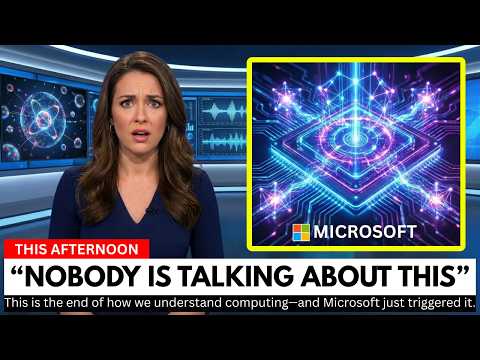
In February 2025, the world of physics and quantum computing experienced a tremor that went quietly unnoticed by the general populace but resonated deeply within the scientific community. Microsoft announced something in the academic journal Nature that demanded attention not for a fleeting moment, but for its historical significance. It was the kind of development that doesn’t just tweak existing paradigms but ushers in a new one altogether. The engineers of the quantum universe went silent, contemplatively so, as they grappled with the weight of Microsoft’s revelation: the Majorana 1 chip.
Based on content from Luminox
Quantum computing, often touted as the next frontier of computational power, has been a land of promise shadowed by the ever-present specter of decoherence. The dream is tantalizing: computers that leverage quantum bits, or qubits, can tackle problems in minutes that would take classical computers millennia, transforming fields like cryptography, material science, and artificial intelligence in the process. Yet, quantum systems are notoriously fragile, collapsing into classical noise upon interacting with their environment, a problem that has stifled their progress from theoretical marvel to practical reality.
The traditional path towards stable quantum computation has involved intricate strategies of quantum error correction, an immense endeavor requiring hundreds to thousands of physical qubits just to sustain a single logical qubit robust enough for practical tasks. The cost and complexity of such systems are staggering, not simply in engineering terms but in what they demand of our imagination and perseverance.
Then came Microsoft’s pivotal shift—a departure from this arduous path that asked a deceptively simple question: instead of correcting qubit errors after they occur, could one construct a qubit that essentially circumvents errors by its nature? Enter the concept of topological qubits—a construct not merely an innovation, but a rethinking, anchored in an elegant symmetry of the universe as yet untouched by noise and chaos.
The heart of this journey begins with the enigmatic physicist Ettore Majorana, whose theories in 1937 introduced the idea of particles that are their own antiparticles. The Majorana fermion has since eluded direct observation as a fundamental particle yet found a semblance of existence in quasi-particles—exciting possibilities that emerge in engineered quantum systems under stringent conditions.
A topological qubit moves beyond the conventional. It stores information not in a singular location but in an ethereal network of relationships spread across space, entwined in the fabric of quantum topology. Such a qubit resists the local disturbances that would otherwise dismantle a less fortified system. This resilience is born from a kind of quantum geometry where, much like the surface deformation of a donut doesn’t alter its fundamental nature, the topological encoding keeps information intact against local noise disruptions.
The realization of such qubits required more than theoretical prowess; it demanded a kind of experimental precision that borders on art. Microsoft’s triumph here is not solely a testament to their technology but also of their persistence through decades of challenges—both the setbacks visible to the world and those faced quietly behind closed laboratory doors.
Chetan Nayak, a key figure in this undertaking, described the new class of materials involved as enabling a unique kind of qubit distinct from any that precede it. Complemented by Dr. Priya Meta’s caution and enthusiasm, the sentiment among researchers is one of cautious optimism, recognizing a milestone not just in engineering but in redefining foundational physics once thought too abstract for real-world application.
This shift comes with a story of strategic realignment—Microsoft had gradually wound down programs focusing on more traditional quantum architectures, quietly betting on a breakthrough that would indeed redefine the trajectory of their quantum research. Such decisions are profound, often revealing more than any press release could capture about the conviction behind them.
For those in the quantum community and beyond eyeing the developments at Microsoft with interest, the question remains not just how but when this breakthrough will weave itself into the fabric of everyday computation. If the bet pays off, the next era may arrive sooner than anticipated, challenging us to reconsider not just what we can compute but how we understand the world itself.
As we stand on this precipice, we must ask: How will this quiet revolution change the technology landscapes underpinning our industries, security, and lives? In answering, we might begin not with yet another blueprint or algorithm but with a deeper inquiry into the dance between clarity and complexity—and our place within it.
—