In the dim corners of a petri dish under a soft glow, researchers at the University of California, Berkeley, unraveled a mystery embedded in life’s most ancient processes. Their findings opened a window into a world where life itself whispers of the universe’s secrets, hinting at an intertwined destiny between biology and quantum mechanics far older than human understanding.
The story begins with a rule in quantum physics that scientists once believed belonged strictly to subatomic theater: particles existing in two places at once, tunneling through otherwise impassible barriers, and becoming entangled over cosmic distances. For much of the 20th century, these principles were positioned as distant, irrelevant phantasms to the complexities of messy, molecular biological processes bound by the warm chaos of cellular life.
Based on content from OMNI
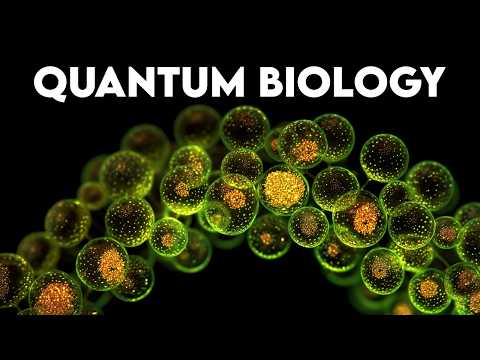
Yet in 2007, as we peeked inside a bacterial light-harvesting protein, shadows of these principles emerged from within green sulfur bacteria, organisms whose exquisite, three-billion-year dance with light happens via unexpected quantum choreography. What scientists observed was a form of quantum coherence, in which energy within the protein didn’t wander randomly but explored all potential paths simultaneously—a phenomenon known as superposition. This allowed the energy to find its way with near-perfect efficiency: a marvel we had only dreamt of achieving.
The question this stumbled discovery prompted is as vast as the oceans that cradle the planet: did life unwittingly discover the principles of quantum mechanics to thrive, or have these arcane rules always been at life’s core, weaving through the tapestry of existence?
Within the burgeoning domain of quantum biology, such debates have inspired vibrant discourse. Initially met with skepticism, the notion that life harnesses quantum effects is substantiated via diverse evidence—from avian migration guided by Earth’s faint magnetic whispers to the olfactory mysteries of our own noses.
As photosynthesis transformed from textbook simplicity to an intricate quantum opus, one must grasp its finer details to appreciate the nuance: sunlight, as a single photon, is absorbed, initiating a meticulous cascade that elevates an electron, poised to traverse the protein labyrinth towards the reaction center. Here, nature’s quiet orchestration defies randomness, opting instead for a majestically coordinated quantum gamble, given the chaos of molecular landscapes. Quite a feat, considering how these electrical trails navigate with an agility our solar technology envies.
The FMO complex in green sulfur bacteria, refined over epochs within dim aquatic homes, exemplifies life’s quantum savvy. Questions of coincidence versus intentionality linger still, as scientists probe whether such coherence is an engineered adaptation or an incidental marvel of life’s architectural genius. Subsequent studies, such as those by Gregory Engel in 2017, imply that chlorophyll’s precise geometries may enhance this enigmatic coherence, suggesting evolution’s nuanced dance not only harnesses chemistry but is also sculpted by quantum finesse.
Yet the narrative extends beyond photosynthesis. Consider the European robin’s migratory symphony, a biological compass that resonates with quantum whispers. Here arises another phenomenon—the cryptochrome proteins within avian eyes, hypothesized under theoretical frameworks since 1978, that potentially leverage Earth’s feeble magnetic embrace through radical pairs. These paired molecules engage in a subtle, quantum-choreographed dance sensitive to cosmic-scale fields, guiding migration over continents with breathtaking precision.
From micro to macro, life’s narrative is replete with quantum dialogue that bridges realms, suggesting we must rethink our separations between living and non-living worlds. If life’s machinery has in fact been a proactive expression of quantum principles all along, then the boundary between physics and biology may be more permeable than previously imagined. As we return from this quantum journey, perhaps we might re-envision life not as a distinct phenomenon but as a breathtaking manifestation of the universe evolving reflexively, steeped in the laws that govern its every particle.
These discoveries invite us to wonder, ponder, and forever question: if life is the universe perceiving itself, what mysteries await us in the tapestry of existence that extends far beyond our current comprehension? Perhaps the answers lie softly beneath our feet, within the whisper of the leaves, and in the flutter of a bird’s wings—interwoven tales of time, quietly awaiting our discovery.
—