Imagine if constructing a quantum computer was analogous to building an elaborate clockwork, where each cog, no matter how small, must align perfectly for the entire mechanism to function. In the realm of quantum computing, particularly within the universe of universal quantum computers, the challenge is mind-bogglingly complex, requiring not just thousands but millions of precisely tuned components—qubits, in this instance—to operate in harmony. And yet, despite the daunting numbers, breakthroughs in how we can manage these qubits more efficiently bring us step by step closer to turning theoretical marvels into practical tools.
The conundrum we face with quantum computing is grounded in both its promise and its challenge: a universal quantum computer must house millions of entangled qubits and implement robust error correction schemes to be effectively operational. But producing and managing these millions of qubits all at once is like trying to keep a million plates spinning simultaneously—an overwhelming task. The game-changing approach? Use photons as qubits but distribute their generation across different moments in time.
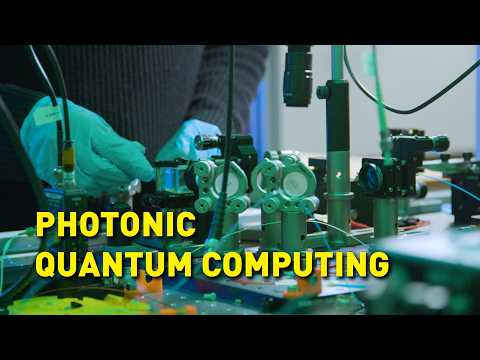
This video is from Quantum Source.
The architecture of such a quantum computer starts at what’s called the Resource State Generators (RSGs). These are the engines of the quantum machine, continuously producing batches of entangled photons. It’s a bit like a factory assembly line where each part is vital but manageable in size. These clusters of photons are then handed over to what can be likened to a master craftsman—the stitching devices. Here, these clusters are intricately weaved into a growing fabric of entangled qubits, expanding with each addition to form a massive, interconnected cluster.
But the innovation doesn’t stop there. In this quantum tapestry, we also entail a fascinating feature known as delay loops. Think of these as time capsules within the quantum realm. They are essentially long fiber loops acting as a form of quantum memory. Photons can be routed into these loops, where they bide their time before being reintroduced to the stitching device to be entangled with newer photon clusters. This staggering of entangled clusters through time is a clever workaround to the otherwise insurmountable task of handling millions of qubits simultaneously.
This process iterates across numerous RSGs and stitching devices, knitting a vast and complex quantum network, slice by slice. Each slice is then fed into an array of detectors which, under the guidance of a classical computer, perform precise sequence measurements to execute the desired quantum algorithm. It is an orchestration of quantum phenomena, with each step carefully planned and executed to enhance the overall capacity and capabilities of the system.
To visualize it, consider this: the technique is akin to weaving an immense tapestry where each thread represents a cluster of photonic qubits, and the overall design emerges gradually, formidably representing a complete, functional quantum computation canvas. With this innovative approach, we can perform a million qubit error-corrected calculation with mere hundreds of qubits generated at each time step, piecing together the full quantum computing potential in manageable, incremental blocks.
What makes this development exciting isn’t just the sheer computational power it promises but the elegance of its scalability. Just as an artist can add threads to a tapestry without having to start from scratch for each new stroke, scientists can scale up quantum computing operations without being overwhelmed by complexity.
By rethinking how these qubit clusters are generated and intricately linked across time and space, we edge closer to the reality of practical, universal quantum computing—a tool that, undoubtedly, will revolutionize fields from cryptography to AI, and beyond.WordPress tags: