Spend enough time around quantum computing conversations, and you start hearing the same things over and over again: qubits, coherence times, error correction, and algorithm breakthroughs.
But there’s another kind of scaling happening in this industry that doesn’t get talked about nearly as much.
It’s the scaling of the companies themselves.
This week, Vancouver-based Photonic Inc. announced a leadership shift that quietly signals something important about where the quantum industry is headed. Founding investor Don Mattrick is stepping into the CEO role, while Paul Terry transitions into Chief Product Officer.
On the surface, it looks like a typical executive reshuffle.
But if you zoom out a little, it’s something else entirely.
It’s a signal that Photonic is moving from the breakthrough phase into the build-the-industry phase.
And that transition matters.
When Quantum Companies Grow Up
The quantum industry has spent the last decade proving that the science works.
Now the next challenge is proving that the business works.
Photonic has been building momentum for a while. Late last year, the company secured a $130 million USD first close in its latest funding round. Around the same time, it demonstrated something that caught the attention of many watching the infrastructure side of quantum: quantum communications running over existing fiber networks in partnership with TELUS.
That’s not just a lab experiment.
That’s a glimpse of how quantum technology might actually integrate into the world we already have.
And when a company shifts from research breakthroughs to deployment and partnerships, something interesting happens.
Leadership structures evolve.
You begin to see executives whose job is not just to invent technology, but to scale ecosystems.
That’s where this shift becomes meaningful.
A Builder Moves Into the CEO Seat
Don Mattrick is not a typical startup CEO.
He’s a veteran of global technology companies and a Member of the Order of British Columbia, someone who has spent decades navigating large-scale markets, partnerships, and complex technology ecosystems.
Moving from investor and board member into the CEO role sends a clear signal: Photonic is preparing for a different kind of growth.
Not just scientific progress.
Commercial progress.
Quantum companies are increasingly realizing that the next frontier isn’t simply making better qubits.
It’s building companies capable of delivering those systems to the world.
Let the Scientist Focus on the Product
At the same time, Paul Terry’s move to Chief Product Officer may be the most strategically important piece of the announcement.
Terry has been central to the development of Photonic’s Entanglement First™ architecture, a design philosophy that flips the traditional quantum computing model on its head.
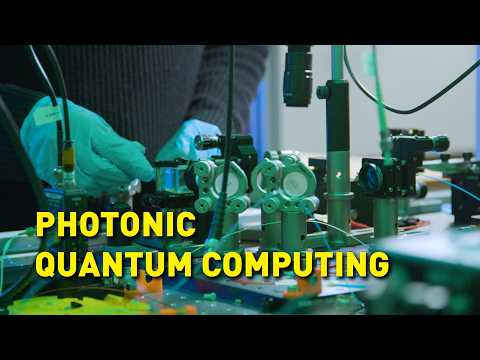
Instead of building a single massive machine isolated inside a cryogenic system, Photonic is focusing on networked quantum systems.
Their approach uses optically linked silicon spin qubits, which communicate using photons.
Light.
That matters because photons travel naturally through fiber-optic cables — the same infrastructure that already powers the global internet.
The implication is powerful.
If quantum systems can communicate through existing fiber networks, then scaling quantum computing might look less like building one giant supercomputer…
…and more like building a distributed quantum network.
In other words, quantum computing could scale more like the cloud than like a single machine.
Why Connectivity Might Win
One pattern I keep noticing in the quantum industry is this shift toward connectivity as the real scaling challenge.
Building one extraordinary quantum processor is an achievement.
But building an ecosystem where multiple quantum systems can communicate, coordinate, and scale together?
That’s a different problem entirely.
Photonic’s “Entanglement First” approach is essentially tackling that problem head-on.
Instead of asking, How do we build the biggest quantum computer possible?
They’re asking:
How do we connect many quantum systems together so they can grow into something larger than any single machine?
That question might turn out to be one of the most important ones in the entire industry.
Why This Matters for the Curious Observer
If you’re new to the quantum world, leadership changes like this might feel like inside-baseball corporate news.
But in reality, moments like this are how technologies move from academic breakthroughs to real-world impact.
Quantum computing promises extraordinary things:
• discovering new medicines faster
• designing advanced materials for energy and climate solutions
• securing global communications
• solving optimization problems that classical computers struggle with
But none of those things happen if quantum technology stays locked inside research labs.
We need companies capable of manufacturing, supporting, and integrating these systems into global infrastructure.
When a company raises nine-figure funding rounds, forms partnerships with telecom giants, and reorganizes leadership around product and scale, something important is happening.
The industry is maturing.
Vancouver’s Quantum Moment
Photonic is headquartered in Vancouver, but its ambitions clearly extend far beyond Canada. With operations expanding across the United States and the United Kingdom and a growing team of more than 150 researchers and engineers, the company appears to be preparing for its next chapter.
For Don Mattrick, that likely means scaling partnerships and market reach.
For Paul Terry, the focus will be transforming Photonic’s deep technical breakthroughs into products that industries can actually deploy.
And for the rest of us watching the quantum ecosystem evolve, it’s another reminder of something I keep coming back to.
Quantum computing isn’t just about physics.
It’s about systems.
Systems of hardware.
Systems of networks.
Systems of companies.
And systems of people capable of turning scientific possibility into technological reality.
The science may start in the lab.
But the future of quantum will be built by the organizations that learn how to scale it.
And right now, it looks like Photonic is preparing to do exactly that.