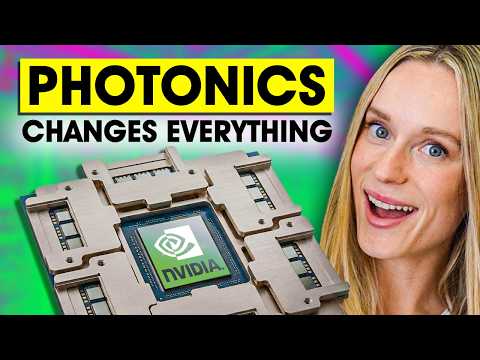
In a rather hushed yet monumental move, NVIDIA has earmarked a staggering $4 billion for two photonics companies—Lumentum and Coherent—that have traditionally flown under the radar. This financial commitment is not just a bold stroke in NVIDIA’s ledger; it signals a seismic shift poised to redefine the AI hardware stack as we know it.
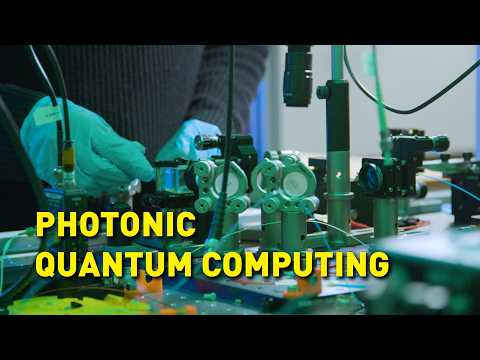
Here’s the kicker: many of us have been convinced that the bottleneck in advancing AI is with chips. Yet, upon delving deeper, the bottleneck is actually the humble wire. This problem of copper cables, which we’ve relied upon for so long to carry data between GPUs in the world’s sophisticated training clusters, is hitting its physical limits—heat, resistance, and energy costs are all mounting. As it turns out, the physics of electricity can’t keep up just when AI’s demands are surging. What engineers are now pivoting towards is something quite radical: photonics, the science of moving data as light.
Based on content from Tiff In Tech
Photonics opens a new frontier by eliminating resistive heat, signal degradation, and drastically cutting energy consumption. It’s these attributes that potentially offer over 90% energy savings for certain computations compared to their electronic counterparts. This is not just hearsay—MIT’s research backs it up.
When I pored over NVIDIA’s press release and CEO Jensen Huang’s comments, it was clear why this move is transformative. Huang spoke of constructing “gigawatt-scale AI factories,” leveraging light as the medium for data transfer. These aren’t merely flashy words; they indicate a foundational rethink of AI infrastructure.
The underlying pitch here is that while a conventional GPU uses electrons speeding through copper interconnects, an Optical Processing Unit—or OPU—employs photons traversing silicon waveguides. This not only reduces heat but side-steps many of the physical limitations that have constrained electrical signals. Moreover, through wavelength division multiplexing, engineers can pump multiple independent data streams through a single optical channel without interference, much like fiber optics carrying the internet across continents.
NVIDIA’s decision to invest $2 billion into each of Lumentum and Coherent indicates more than just a passing interest; it’s a pivotal infrastructure undertaking. Market responses were immediate, with Lumentum and Coherent stocks soaring on the news. These investments underscore a phase change—not a mere incremental improvement—in addressing AI’s growing energy and communication demands.
As AI models balloon in size and complexity, they demand commensurate increases in computational and energy efficiencies. Under the old electronic regime, the associated electrical and thermal challenges grow exponentially. But by shifting to photonics, NVIDIA is effectively dismantling these barriers, allowing clusters to become larger and more efficient.
This shift isn’t just about new hardware; it’s about enabling capabilities at a national infrastructure scale. It transforms the approach from simply accommodating new AI models to actively unleashing their potential. NVIDIA’s moves have already prompted commitments from its photonic partners to expand U.S. manufacturing capacity, revealing the broader strategic importance of this technology.
For those in the trenches, this evolution in AI hardware promises to open unprecedented career opportunities. Understanding photonics now may well become the differentiator that defines the next wave of technology leaders. As with previous transitional epochs—from multi-core processors to cloud computing—those who grasp the intricacies early can write the playbook for everyone else.
In conclusion, the AI systems of the near future may very well owe their breakthroughs not just to smarter software, but to the incredible potential unleashed by clearing the bottleneck of copper interconnects. As we edge closer to 2028, the models we encounter may indeed be powered by light, carving new paths through the limitations of today. Let’s keep an eye on how this plays out.
Stay curious,
Frank
“`